ICC to Introduce Bat Gauge Checks to Police Bat Sizes in International Cricket
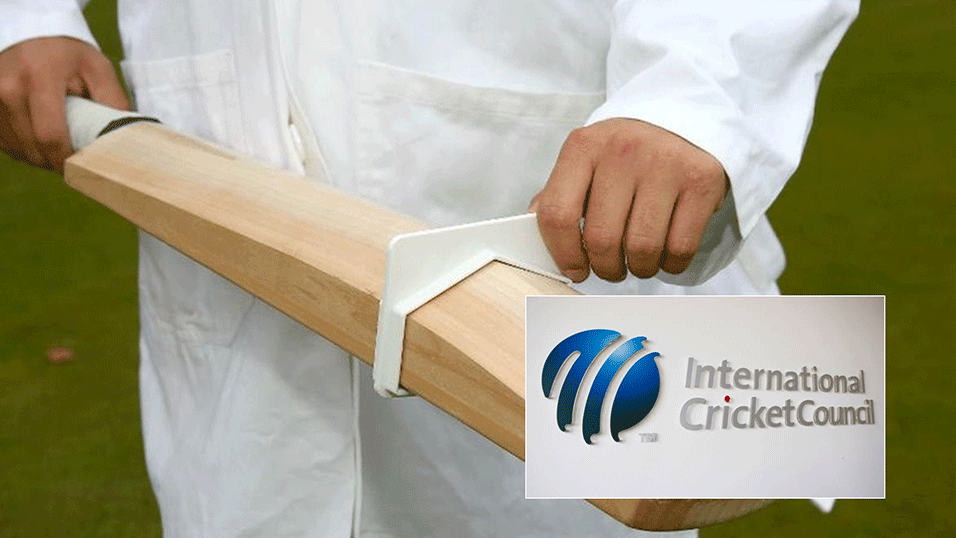
The International Cricket Council (ICC) is set to introduce a new rule to check bat sizes in international cricket. Under the decision, match officials will be able to test players' bats through a gauge of the prescribed dimensions at any time before a match. The move is aimed at ensuring that bat sizes remain within the approved limits.
Six-hitting has risen alongside aggressive batting in modern cricket, helped by batting-friendly pitches and shorter boundaries. But questions have also been raised over whether bigger and thicker bats give batters an extra advantage in playing big shots. The ICC's new initiative is intended to reduce any such extra advantage.
Hindustan Times reported that using a gauge to check bat sizes was among the recommendations of the ICC Cricket Committee led by Sourav Ganguly. The Chief Executives' Committee approved the proposal at a recent ICC meeting in Bali. The rule will take effect in international cricket once umpires receive the necessary instructions.
Bat dimensions are currently set out in Law 5 of the MCC's Laws of Cricket. Under it, a bat's edge can be at most 1.56 inches thick, its depth 2.64 inches and its width 4.25 inches.
The gauge method was first introduced in the IPL last year. This year the IPL averaged 19.27 sixes per match, compared with 8.88 in the inaugural 2008 season. Alongside improved power hitting, there is concern that extra bat advantages may also be behind the rise in sixes.
Before the gauge was introduced in the IPL, match officials feared that bats thicker than the prescribed size were being used, since not every bat was checked and room for irregularities remained. Under the new rule, players such as Sunil Narine, Ravindra Jadeja and Riyan Parag had to change their bats after they failed the size test. From now on, no bat outside the prescribed dimensions will be allowed.
The ICC is also moving to improve the quality of cricket balls. Its Cricket Committee has recommended trialling a new type of ball, starting with age-group cricket at the 2029 and 2030 Under-19 World Cups. It has also decided to introduce competitive tendering for buying new balls and to strengthen the ball approval process.