
Barbados town Speightstown signs three-year deal with Bristol as part of reparative process
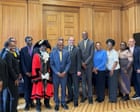
Speightstown in Barbados has signed a twinning agreement with the UK city of Bristol. The centuries-long relationship between the town, known as Little Bristol, and Bristol is rooted in the transatlantic slave trade.
Barbados says the new partnership between Speightstown and Bristol is part of its wider push for reparatory justice, built in small steps rather than around a multi-trillion-pound claim.
Colin Jordan, the island's labour minister, signed a three-year memorandum of understanding (MOU) with the Bristol city council leader, Tony Dyer, at City Hall on Friday.
Speightstown is the second-largest town in Barbados. In the 17th and 18th centuries its port shipped sugar, produced by enslaved African people, to Bristol. A bar bearing the name is still a popular venue within the island, Jordan said.
In an interview after the ceremony, Jordan said the agreement sat firmly within the island nation's wider push for reparations, led by the prime minister, Mia Mottley. "I see the MOU as part of the reparative process," he said. "It is doing it in a complementary way because it is focused on the relationships between two towns, two cities, two peoples."
He was careful with his language. "People get emotive about reparations," said the politician, who is also MP for St Peter, the parish where Speightstown sits. "The word reparations comes from the word repair."
Defensiveness, he continued, had threatened progress around the conversation. "The walls go up, and then it's difficult for the message to get through."
The agreement has no money attached to it and Bristol city council confirmed there was no dedicated funding for major projects involved.
However, it does set out a framework for cooperation on heritage, education, tourism, culture and the creative economy. The exact terms are to be determined through a series of discussions.
Jordan said the money question was settled. "There is not going to be some grand $4tn something somewhere," he said. "It's going to be building block by building block." He offered a Barbadian proverb to make the point that steady progress was better than extravagant windfalls.
The MOU recognises the relationship began in the transatlantic trafficking of enslaved Africans. "Acknowledging that, we believe, is probably half of the repair," he said.
He described a relationship that ran one way for roughly two centuries. "Bristol and the UK benefited from the extraction of wealth from Barbados and Speightstown," he said. The aim now was one that was "mutually beneficial, inclusive".
Jordan expected exchanges between schools and universities, and between cricket and football bodies – and also pointed to trade.
Repair, he argued, was not only financial. "Value is not just currency," he said. He gave the example of a Speightstown schoolchild whose parents are unable to afford a school bag, helped through a link with a Bristol school. He also suggested the relationship could offer "psychological repair" to Bristolians uneasy about their ancestors' part in slavery.
The MOU runs to November 2029. Bristol is pursuing the same model elsewhere, with a parallel MOU with Odesa, in Ukraine, covering the same period.
Edmund Hinkson, Barbados's high commissioner to the UK, who witnessed the signing, placed the deal within a longer history. Barbados's 1650 slave code, he noted, defined Black people as chattel, and was later copied across the Caribbean and the Americas.
Hinkson said Barbados was not looking for the trillions of pounds that economists, including the Brattle Group, have estimated is owed for two centuries of unpaid labour. "We know that the UK is not going to pay that," he said, although he noted that British taxpayers, including Caribbean ones, serviced the debt used to compensate 46,000 enslavers in 1834, until 2015.
The high commissioner commended Bristol's "maturity" in recognising the historical link between Barbados and the city's role in the transatlantic trafficking of Africans into the Caribbean, including Barbados.
He said he believed that the Black Lives Matter protests in 2020, which included the toppling of the statue of enslaver Edward Colston, had propelled that recognition and education of Bristolians.
Speightstown also has a twinning-style MOU with Reading, formally signed in 2003, and Charleston, South Carolina, part of the Gullah Geechee corridor, in the US.
The signing with Bristol comes days before Barbados marks 60 years of independence on 30 November, and five years as a republic.
