
Separate European army would slow response to a Putin attack, NATO chief Rutte warns in Berlin
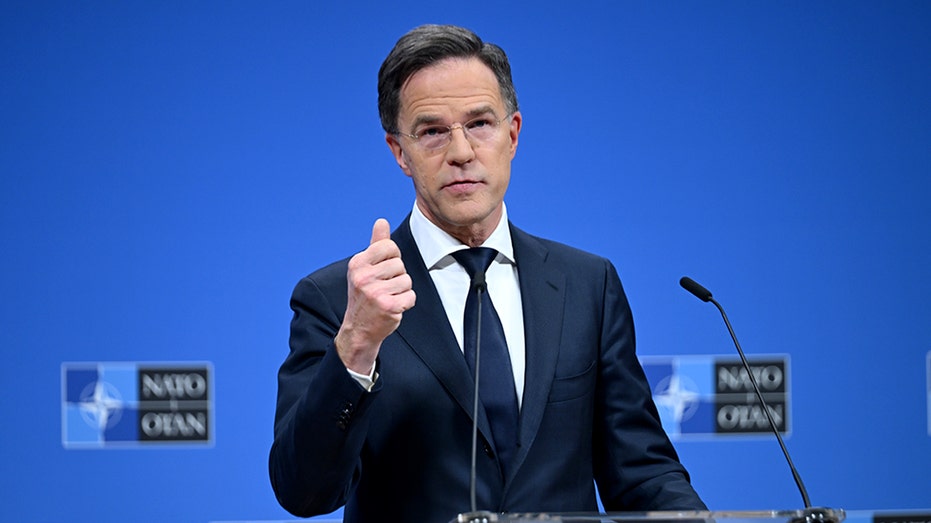
Speaking at the 72nd annual session of the NATO Parliamentary Assembly in Berlin on Monday, NATO Secretary-General Mark Rutte warned that creating a separate European army could undermine the alliance's ability to respond quickly to a Russian attack, as Moscow continues to ramp up its military capabilities during the ongoing war in Ukraine.
Rutte cautioned that competing military command structures could hold up decisions in a crisis, warning that Russia's "war machine" is running at full throttle and could also pose a threat to Europe long after the war in Ukraine ends.
"What I would counsel against is having all the nations with their own militaries working together in NATO and then on top of that having a big European structure, because then if Putin attacks, we will first need two or three weeks to agree who will do what, and then he will probably end up in Rotterdam before we have decided. So that has been my argument," Rutte said, according to Ukrainska Pravda.
Rutte pointed to the United States as a model for an integrated military, arguing that European countries would also need to move beyond separate national forces to establish a unified army. "My point has always been that if you have a European military, you cannot also have national militaries. The United States has one military," he said.
"There is not a specific army or navy for the state of New York or for the state of California. It is an integrated United States military. If Europe is able to pull that off, fine," Rutte said.
Rutte said it was Russia's expanding military production and cooperation with China, Iran and North Korea that pose a long-term threat to NATO, regardless of how the war in Ukraine ends. "We face great dangers coming from Russia and the fact that Russia works so closely together with Iran, China, and North Korea, we know that Russia's war machine at the moment is running at full speed," he said at the assembly in Berlin.
"Its war economy keeps growing, and it won't stand still when the war against Ukraine hopefully will end one day. That whole machine is there and will continue," he said.
Rutte also rejected the idea that only countries bordering Russia or Ukraine face a direct military threat, warning that Moscow's long-range missiles put capitals across Europe within striking distance. "Let me say once again to everyone here who is not on the eastern flank: I have news for you. You are on the eastern flank too. These latest Russian missiles need only five minutes longer to reach Lisbon, Rome or The Hague, my hometown, than to reach Tallinn, Warsaw or Helsinki," Rutte said. "So we are all on the eastern flank here."
The NATO chief's remarks came amid plans to deploy an early-warning aircraft to Poland after Polish prosecutors said three Russian Kh-101 cruise missiles landed on Polish territory Friday during strikes against Ukraine. Polish Deputy Defense Minister Pawel Zalewski said NATO would deploy an Airborne Warning and Control System, or AWACS, aircraft to strengthen surveillance along the alliance's eastern flank, according to Reuters. "This is a very good system that gives us even deeper operational awareness which allows us to respond better to this kind of threat," Zalewski told reporters following a NATO meeting in Brussels.
Beyond Russia's ongoing military threats, Rutte said Europe's interconnected infrastructure, including energy networks and communications systems, is vulnerable. "We are all targeted, that we are all affected when it comes to our pipelines, our cables, our energy grids, and our economies. They are all interconnected, and that means that we are all in this for the long term," he said.
Rutte said defending NATO countries demands civilian preparedness, pointing to northern European nations that have begun teaching residents about their responsibilities in the event of war. He named Norway, Sweden, Denmark and Finland, saying they have made clear to their citizens what they need to do in case war breaks out, how not to get in the way of the military but to be helpful, and how police, ambulance and fire services work together supporting the military.
Ukrainian President Volodymyr Zelenskyy also warned Monday night that intelligence indicated Moscow was preparing a new wave of strikes against Ukraine. US special envoy Jared Kushner said Sunday that President Donald Trump was willing to consider Article 5-style security guarantees for Ukraine as part of a broader postwar security arrangement for Europe. Rutte's warnings come amid uncertainty over Ukraine's long-term security arrangements and whether Western allies will offer guarantees resembling NATO's Article 5 collective defence commitment as part of a future peace agreement.
