Big midterm wins for US gun control activists, more than 200 Everytown-backed candidates elected
The US midterm elections were not only a big win for the Democrats, but also a huge victory for the gun violence prevention movement, and a sign of the declining power of the once-feared gun lobby.
More than 200 people who were endorsed by Everytown for Gun Safety, the umbrella organisation for a network of violence prevention groups, won state and federal races, according to data the non-profit shared with the Guardian. Nearly 550 former volunteers for Moms Demand Action, a group that is part of the Everytown network, ran for office as incumbents and first-time candidates.
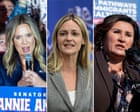
They include Annie Andrews, the South Carolina senator-elect, JoAnna Mendoza, the Arizona representative-elect, and Paige Cognetti, a Pennsylvania representative-elect.
This success is part of a nearly decade-long shift, from violence prevention and gun control being issues seldom mentioned on campaign trails, to ones that candidates, most of them Democrats, are centring in their campaigns. It is a change that tracks with public opinion: more than half of adults in the US now favour stricter gun laws.
Angela Ferrell-Zabala, the executive director of Moms Demand Action, said, 'People are lining up with us because they want this problem to be fixed. They've seen us do our work and now it's expanding and people are getting into office.'
These new elected officials follow the path of Maxwell Frost, the representative from Florida, who started his career as organising director for March for Our Lives, the gun-safety group founded by the survivors of the 2018 mass shooting at Marjory Stoneman Douglas high school in Parkland, Florida; Lucy McBath, a Georgia representative who was a volunteer for Moms Demand Action after her son, Jordan Davis, was shot and killed in 2012; and Abigail Spanberger, Virginia governor, also a former volunteer for Moms Demand Action.
Alongside the changing politics of violence prevention, the spending power of gun control groups has now eclipsed that of gun rights groups. In previous decades, the National Rifle Association (NRA) poured more money into races, mostly to support Republicans. But now that has flipped, according to analysis by the Trace.
In 2026, Everytown spent $53m on state and federal races, according to Ferrell-Zabala, while pro-second amendment and gun industry organisations spent just under $3m.
One of the candidates Everytown supported was Sandra Jauregui, who was just elected to become Nevada's lieutenant governor. For Jauregui, the issue of gun violence has been important for nearly a decade. In October 2017, she survived the nation's deadliest mass shooting at the Route 91 music festival in Las Vegas, where 58 people were killed and nearly 870 injured. Even though she was a member of the Nevada state assembly at the time, she didn't publicly discuss the experience until nearly two years later.
'I didn't want to have to share my story. And then Parkland happened,' Jauregui said, referring to the shooting at Marjory Stoneman Douglas high school where 17 students and school administrators were fatally shot. 'And these high school students were resilient and strong. They had to deal with the same post-traumatic stress I did, but they weren't staying silent. So I drew strength from these students.'
Once she shared her story in 2019, she started working with groups such as Everytown to pass new laws, including a ban on bump stocks, the gun accessory that was used in the Route 91 shooting, and a red flag law. 'We can't fight gun violence if we don't get elected,' Jauregui added. 'And I did that by having tough conversations with people who don't agree with me.'
Having people such as Jauregui in office at this moment is especially important, Ferrell-Zabala said. Though homicides have been declining in recent years, guns remain a deeply polarising topic. Since Donald Trump took office again in 2024, the bureau of alcohol, firearms and tobacco has started rolling back restrictions on transporting guns and accessories. The agency also lost 2.5% in funding. And the administration has eliminated funding for community violence prevention and cut off grants for research.
Making up for lost ground will require newly elected officials to tailor their work to the specific needs of their constituents, especially those who own guns. 'Every community needs something different,' Ferrell-Zabala said. 'Organisers and people advocating for gun safety already understand how to work across different experiences. They'll know how to build those relationships. This isn't a zero-sum game.'