Unhealthy food sold in the open outside schools, authorities consider training vendors
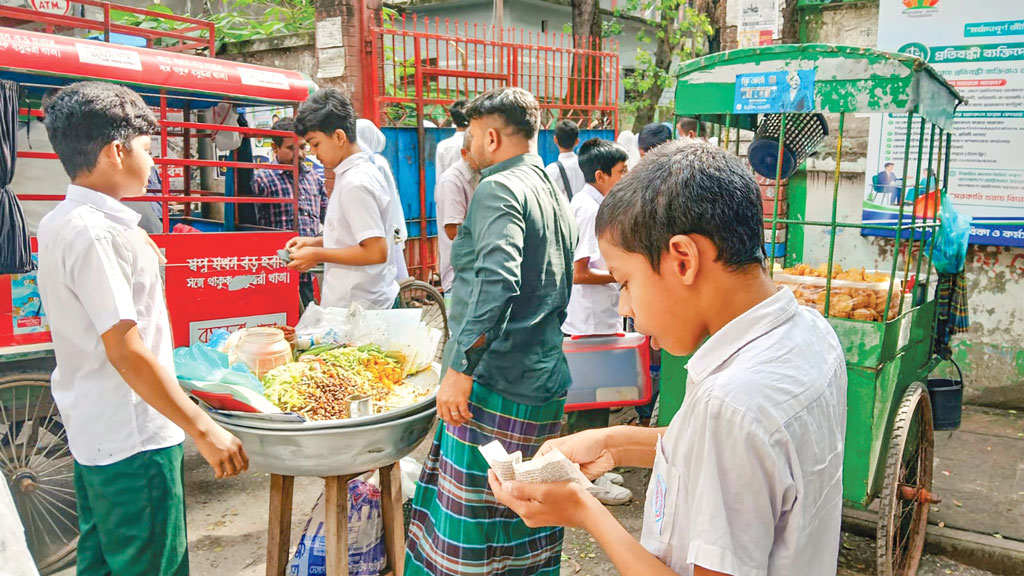
Young students are facing health risks from food such as jhalmuri, chotpoti, pickles, fuchka and bhelpuri sold in the open outside educational institutions in the capital. Many students bring tiffin from home, yet the hawkers' food outside school still draws them.
Last Sunday at 12:30pm, students were seen crowding around stalls selling bhelpuri, fuchka, jhalmuri and chickpeas on the road in front of Hussein Muhammad Ershad Government Primary School in Khilgaon, Dhaka. The food was kept uncovered; some students ate standing on the road, others bought it and took it inside.
Student Md Salman said that although he brings tiffin from home, he eats outside food every day. In his words, home food is not as tasty; he eats bhelpuri, muri and fuchka on different days.
The same picture was seen in front of Khilgaon Government High School. A vendor named Kamrul sells pickles, hog plum and guava beside the road, and dust blows onto the food as vehicles pass. Next to him, Akn Mia sells chotpoti and fuchka from a glass-covered van, but the bhelpuri is kept on a separate open table and the container of liquid sour sauce has no lid, with flies seen around it.
Middle-aged chotpoti vendor Akn Mia said his father sold food at that spot from 1972 and he himself has run the business for a long time. He claimed the business could not have survived so many years if the food were bad. He also said some vendors use harmful ingredients instead of tamarind to make the sour sauce in order to save costs, which causes stomach problems in children, but that he uses nothing of the sort in his own food.
Khilgaon Government High School head teacher Mehrunnesa said students are told not to eat outside food but do not want to listen. Because the hawkers sit outside the school's own land, the school cannot evict them directly. She said that on one occasion, after the city corporation was informed, police removed the vendors, but they returned the very next day.
Food and sherbet are also sold in the open in front of Titumir College in Mohakhali. Sherbet seller Md Monir prepares several glasses of sherbet with ice in advance for quick serving; none of them has a cover.
Tasnim Akter, a parent returning from Holy Cross Girls' High School with her daughter, said children who eat such food sometimes complain of stomach pain at night or the next morning. In her view, the authorities should monitor the food sold around educational institutions, and vendors should also be made aware.
Public health expert Mushtaq Hossain said a clean environment must be ensured when selling street food; food should as far as possible be kept in glass-covered places, vendors must make a habit of washing their hands with soap, and buyers too should clean their hands or use a clean spoon before eating. Care must also be taken, he said, so that stale or rotten food is not sold.
Mushtaq Hossain also said natural tamarind should be used instead of artificial souring ingredients, and textile dye or any other unauthorised colour must not be mixed into food. In his view, such colours in food can cause stomach pain and skin problems and, in the long term, risks such as liver and kidney damage and cancer. Doctors say such food may also contain adulterants or repeatedly used oil, harmful colours and toxic chemical ingredients.
At a press conference at the Secretariat on October 27, Dr Zahed Ur Rahman, the prime minister's adviser on information and broadcasting, said the government is taking an initiative to bring temporary roadside food shops under registration in order to improve quality. He said germs and adulterated ingredients in the food from these shops can harm people's health.
Md Anwarul Islam Sarkar, member (law and policy) of the Bangladesh Food Safety Authority, said many street food vendors do business with very little capital, so the authority does not see fines through mobile courts as the solution. Instead, an initiative is being taken to train and motivate the vendors. He said the programme will initially cover vendors in front of educational institutions in areas including Khilgaon and Bailey Road in the capital, though the starting date has not yet been fixed.