Blind in one eye, Uttara's Abdul Jalil still stops passers-by with his flute
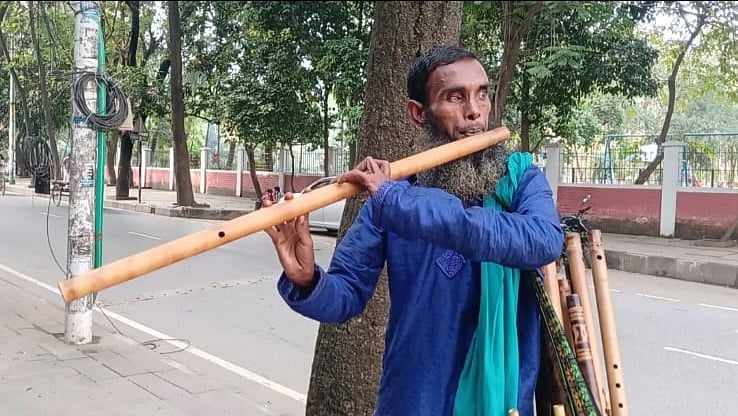
On Monday afternoon, beside the Sector 4 Kalyan Samity park in the capital's Uttara, a man stood by the roadside playing the flute. Hearing the tune, several young people and a woman gathered around him. Some asked for Bangla songs, others wanted Hindi film tunes. The man with the flute played each request in turn — sometimes a patriotic song, sometimes a popular number from an old Bangla film.
The flutist's name is Abdul Jalil. He lives in a rented house near Uttara Sector 9. He has been blind in one eye since birth. Though he cannot see with one eye, his flute draws the eyes — and ears — of passers-by.
Abdul Jalil says he has earned his living by playing and selling flutes for 35 to 40 years. The flute's tune is his means of income, and his love for that tune is what has kept him in this profession for so many years.
Jalil can play songs in both Bangla and Hindi on the flute. If someone names an old song, he tries to play its tune for them. Standing on the road that day, he played Kanak Chapa's patriotic song 'Ek Nodi Rokto Periye', Shahnaz Rahmatullah's 'Sona Sona Sona, Loke Bole Sona, Sona Noy Toto Khati', and Baul emperor Lalon Fakir's 'Milon Hobe Koto Dine'.
He then played 'Pardesi Pardesi Jana Nahi' from the Aamir Khan film 'Raja Hindustani' and the tune of 'Bahut Pyar Karte Hain Tumko, Sanam' from the film 'Saajan'.
Abdul Jalil says he earns 300 to 400 taka a day selling flutes, and somehow runs his household on that. When flutes do not sell, he sometimes drives a rickshaw. But his attachment is to the flute; that attachment is why he chose playing it as his profession.
Though his family lives in hardship, Jalil has never faced opposition from his wife or children over playing the flute. Instead, they encourage him. He has also taught his elder daughter to play. Jalil says, 'When I play the flute, people gather around. They listen, spellbound. That is what I love. Caught in that love, all these years have passed.'
Abdul Jalil has no formal education, but he has taught many people to play the flute. He says he has taught more than a hundred people — some learned the technique of picking up a tune from him, others learned the basics of playing.
The flute is not his only instrument: Jalil can also play the ektara, dotara, violin and harmonium. He is familiar with the sounds of many instruments, but the flute holds a special pull for him. Jalil says, 'The flute called the arbanshi — it took me 12 years of practice before I could draw a tune from it.'
His days pass playing and selling flutes. Every day from morning to evening he moves through Uttara's different sectors, sometimes standing by a road, sometimes near a park. Hearing the tune, some come forward to buy a flute; others stand for a while and listen.
Abdul Jalil regrets, however, that today's youth are drifting away from practising musical instruments. He says flutes used to sell more, but the young generation no longer cares for such instruments. In his view, if young people stayed connected to instruments and cultural pursuits like these, their minds would stay well, their interest in good work would grow, and they would stay away from drugs.