After China, Russia now offers Pakistan space technology
A new chapter has opened in Pakistan's space journey. Last Wednesday (25 November), Mohammad Zeeshan Ali travelled to space aboard China's 'Shenzhou-24' spacecraft as the first Pakistani astronaut. On that very day, Russia made Pakistan a major offer of space technology and expertise.
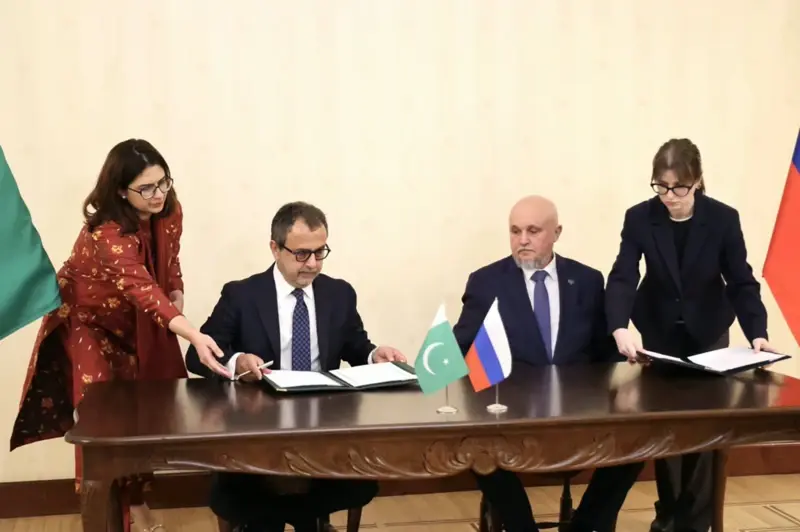
Russian Energy Minister Sergei Tsivilev made the announcement in Moscow at the 11th session of the Pakistan-Russia intergovernmental commission on trade, economic, scientific and technical cooperation. He said Moscow is ready to share its long experience and technical skills with Pakistan in satellite navigation and communication, remote sensing (earth observation), manned spaceflight and space technology.
According to a statement from Pakistan's Ministry of Economic Affairs, an economic protocol was also signed at the meeting to expand cooperation in energy, agriculture, information technology and trade, as well as science and space.
Russia's offer came just ahead of Pakistani Prime Minister Shehbaz Sharif's upcoming visit to Moscow, where 15 to 16 agreements are expected to be signed. Analysts see the offer as highly significant.
Pakistani defence analyst Syed Muhammad Ali said Pakistan had so far depended mainly on China for space technology. If cooperation with Russia grows, new horizons will open in satellite launches, design, navigation, data exchange and the training of Pakistani scientists and engineers. He also remarked that the influence of the United States and Russia in resources, experience and space technology is still far greater than that of China or the European Union.
Dr Adil Sultan, dean of the Aerospace and Strategic Studies faculty at Air University in Islamabad, believes that because Western countries did not include China in the International Space Station (ISS), Beijing built its own space sphere and brought Pakistan into it. If Russia now joins, Pakistan's satellite-building capacity will increase many times over.
Dr Sultan said remote sensing technology will help Pakistan tackle climate change and support agriculture, especially in assessing flood damage and planning crop production. But he also reminded that Russia's own strategy of expanding its sphere of political influence is at work behind the move.
Dr Ishtiaq Ahmed, executive director of COMSATS, said Russia has been somewhat uneasy since the late 1990s over the growing strategic relationship between India and the United States. In his view, Russia's policy towards South Asia has changed; while its strategic relationship with India remains, Pakistan has now also become important to Moscow. He also noted that Moscow and Islamabad share largely common interests on Afghanistan and regional security.
Dr Qamar Cheema, executive director of the Islamabad-based Sanobar Institute, believes Russia's step also sends an indirect diplomatic message to India. India, he noted, is still undecided whether to buy Russia's fifth-generation 'Su-57' fighter or the American 'F-35'. However, Dr Cheema also believes Western sanctions on Russia impose some limits on how far Moscow-Islamabad ties can go.
Meanwhile, senior Indian Army officers have given statements to the media on the matter. They claim that during the 'Operation Sindoor' episode, Pakistan was receiving 'real-time' information on Indian military cantonments from Chinese satellites, giving it an idea of where and how an attack might come.
Indian media outlet 'The Print' reported that between January 2025 and June this year, Pakistan successfully launched a total of six earth-observation satellites. They have been deployed in low Earth orbit in such a way that they can continuously photograph Indian territory. Islamabad built them jointly with Beijing, and all six reached space with Chinese assistance.
Retired Indian Navy flag officer Rear Admiral Sudhir Pillai has written about Pakistan's satellite cluster in a blog. In his words, Islamabad's back-to-back satellite launches in just 16 months are no ordinary event, and he suspects they are being used for military purposes.
In the history of spaceflight, the Soviet Union's Yuri Gagarin became the first human in space in 1961. Observers believe that after entering space holding China's hand, Russia's offer of cooperation will create a new balance in Pakistan's foreign policy and technological progress.