Lyricist Shahid Mahmud Jangi Writes a Hundred Years of Bangla Song History After Six Years of Research
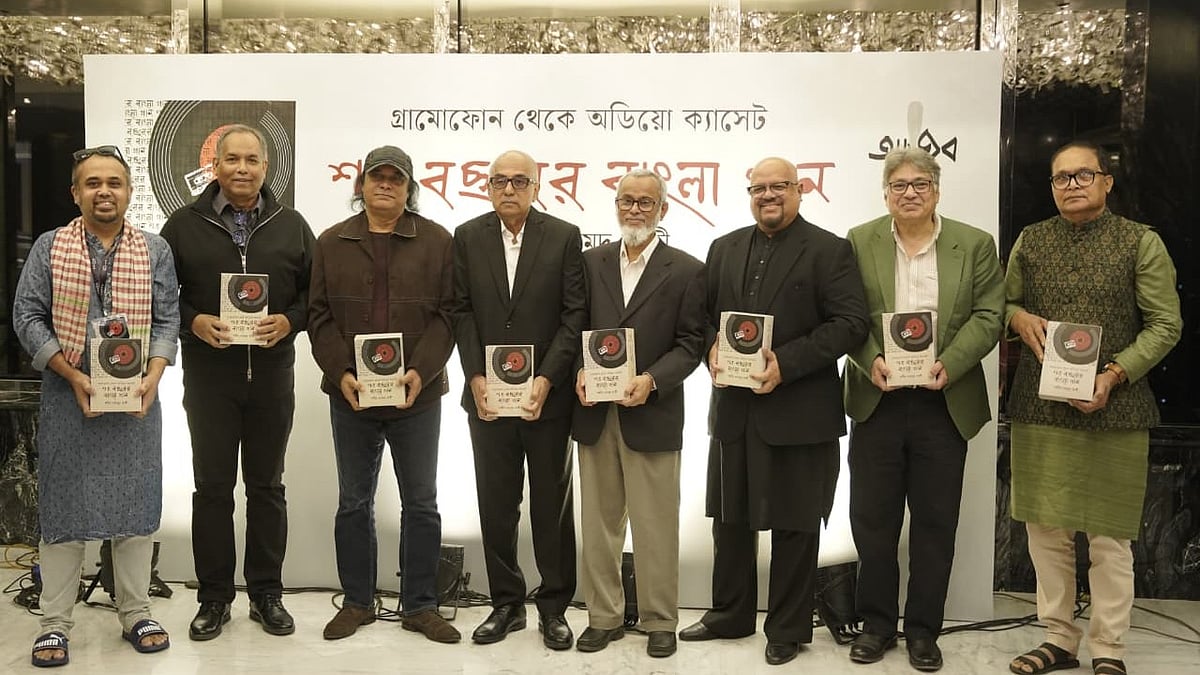
Lyricist Shahid Mahmud Jangi has written a book on a hundred years of Bangla song history. The book, written after nearly six years of research, is titled 'Gramophone Theke Audio Cassette: Shotoborsher Bangla Gaan'. Published by Azab Prokash, it was unveiled on Friday (27 November) at the Renaissance Hotel in Dhaka. The publication gathering was organised by Azab Karkhana.
At the gathering, Jangi said the book covers the period from 1891 to 1991. To trace Bangla song's journey from the gramophone era to the time of the audio cassette, he has written about the work of 225 artists and composers. The book also discusses lyricists' identities and their contributions to Bangla song. The author hopes the book will be useful for future research on the history of Bangla song.
The gramophone in the book's title recalls the start of commercial recording of Bangla song. According to Banglapedia, in 1902 in Kolkata, Gramophone Company recording engineer Frederick William Gaisberg recorded songs by Gauhar Jan. Records from companies such as HMV, Columbia and Pathe became popular in Kolkata. In Dhaka too, filmmaker Salahuddin had set up a gramophone record company named 'Dhaka Record'.
Shahid Mahmud Jangi was born on 6 February 1956 in Chattogram. A large part of his life was spent in Chattogram. From 1985 he settled in Dhaka in connection with business and music.
Songs written by him are spread across albums by Souls, Renaissance and LRB. He wrote Souls' 'Chayer Kape Porichoy' and 'Bhalobasi Oi Sobujer Mela', Renaissance's 'Hridoy Kadamatir Kono Murti Noy' and 'Aaj Je Shishu', and LRB's 'Ekdin Ghum Bhanga Shohore'. He also wrote 'Somoy Jeno Kate Na', sung by Samina Chowdhury.
Jangi himself wrote the story of how 'Ekdin Ghum Bhanga Shohore' was created. On the way back from Chattogram to Dhaka, sitting in a microbus, he wrote the song's two verses — Ayub Bachchu and Partha Barua were with him, and a recording for BTV was scheduled the next day. Reaching Dhaka, at a room in Hotel Blue Nile, Bachchu picked up the guitar and Partha sat at the keyboard; the song was created through a whole night's work. It later found a place on LRB's first album.
In the 1980s, alongside love songs for Souls, Jangi also wrote about society and the times. He has said he wrote 'Mukto Manik Pabar Ashay' for Souls' second album, with music by Tapan Chowdhury. The first Bangla song sung by Ayub Bachchu, 'Harano Bikeler Golpo', was also written by him.
In February this year, on the occasion of Jangi's 70th birthday, a memoir volume titled 'Apon Aloy Shahid Mahmud Jangi: Gaane Gaane Sottor' was published. Edited by Joy Shahriar, fellow travellers including Naquib Khan, Samina Chowdhury, Kumar Bishwajit, Fuad Nasser Babu, Pilu Khan and Partha Barua wrote in that book.
Present at Friday's publication gathering were Hamin Ahmed, Fuad Nasser Babu, Nasim Ali Khan, Pilu Khan, Tapan Chowdhury, Golam Morshed, Labu Rahman and Shahzada Mahmud Chowdhury.
At the event, Hamin Ahmed said, 'In our country, research on songs and publishing books on them is almost non-existent. In that respect, this book will remain a milestone.' Fuad Nasser Babu said, 'Such research-based work is very important to preserve the rich past of our songs.'
Publisher and musician Joy Shahriar said the book will play a role in studying and preserving the history of Bangla song. In his view, work on this scale is the first of its kind in Bangladesh. Published ahead of the Amar Ekushey Book Fair, the book can be ordered from Azab Prokash's Facebook page and various online bookshops.