Defaulters are 'holding a gun to your head', Rehman Sobhan tells finance minister to his face
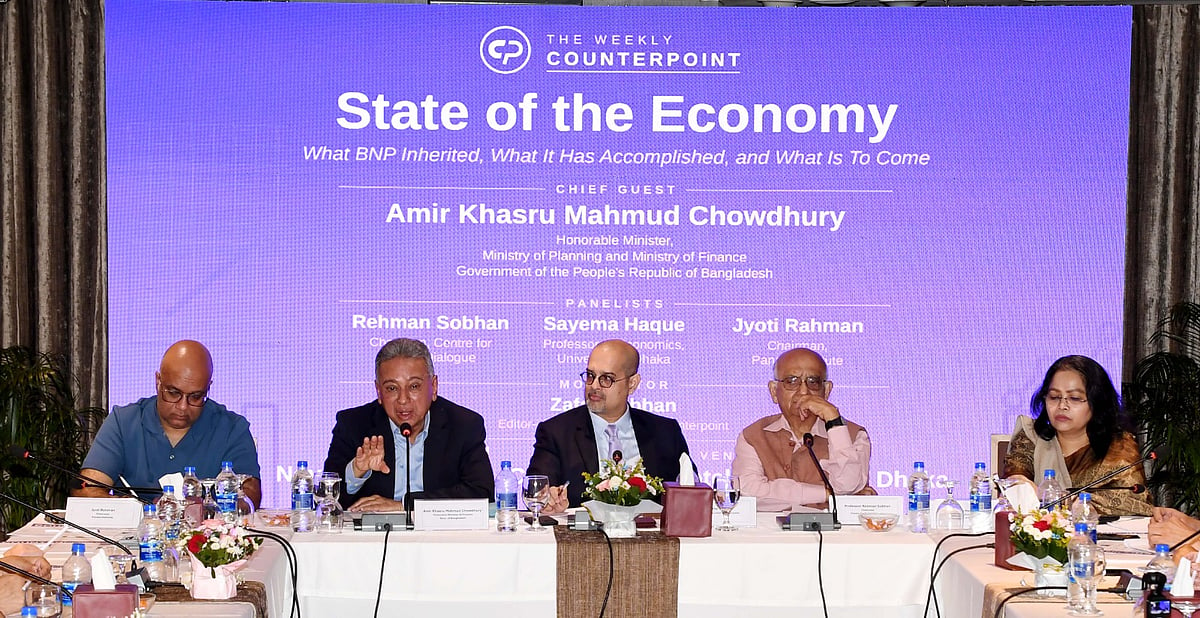
Eminent economist Rehman Sobhan has said the economy's three biggest problems are high inflation, the failure to take effective action against loan defaulters, and weakness in tax collection. These problems are longstanding and political interests have become entangled with them, so implementing economic reform will not be easy for the new government, he said.
He made the remarks as a designated discussant at a seminar titled 'The current state of the country's economy: what BNP inherited, what it has achieved and what lies ahead', organised by the weekly Counterpoint at a Dhaka hotel on Saturday. Finance Minister Amir Khosru Mahmud Chowdhury was the chief guest at the seminar.
The other two designated discussants were Dhaka University economics teacher Saima Haque and Panam Institute chairperson Jyoti Rahman. Economists, lawyers and business representatives also attended the seminar.
Addressing the finance minister, Rehman Sobhan said the inflation rate is the same as it was five or seven years ago. If fortunate, he said, it might be brought down from 8 percent to 6 percent — but even at 6 percent, while it might please macroeconomic economists, the prices ordinary people on the street have to pay would remain at an unbearable level.
On the loan default problem, Rehman Sobhan asked the finance minister whether they would really be able to tackle it effectively. The problem is not new, he said; it has been going on for 40 years.
He said big business groups are now putting pressure on the government, saying their factories cannot run properly unless their loans are rescheduled. In his words, 'They are now permanently holding a gun to your head over the special threat you are about to face.'
According to Rehman Sobhan, the problem has not merely been built into the business model; it has become part of the political process itself, and it has never been resolved satisfactorily.
Recalling the period after 1991, he said the late finance minister Saifur Rahman had to face a trial by fire every year. 'We used to say no loan defaulter should be allowed to contest elections, and we should stand firm on this law. But he and every finance minister after him took the path of loan rescheduling just two weeks before elections. People were allowed to contest elections with down payments of 2, 5 or 10 percent.'
On the tax-GDP ratio, he said the trend has been downward. The root of the problem is that a huge number of people who are supposed to pay tax either do not pay or pay too little. He called the move to split the National Board of Revenue (NBR) a misleading step inherited from an IMF recommendation from 30 years ago, and said changing the NBR's structure will not solve the underlying problem.
In Rehman Sobhan's view, the lack of accountability and punishment lies behind longstanding problems such as loan defaults and tax evasion. No government has been able to take effective punitive action against these offences. A strong government must take stern action against those who have used impunity to practise loan default and tax evasion year after year; otherwise real progress in these areas is impossible, he said.
At the seminar, Finance Minister Amir Khosru Mahmud Chowdhury said the economy is turning around through inflation control, alternative financing and institutional reform, and that inflation sits at the centre of economic policy decisions. To ease inflation pressure on low-income people, 50 lakh family-card-holding families are currently receiving Tk 2,500 each per month, he said.
The finance minister said that despite the burden of past loans and rising expenditure, every loan instalment is being paid on time and Bangladesh has not defaulted. To reduce overdependence on commercial banks and keep credit flowing to the private sector, alternative financing initiatives have been taken, including dollar bonds on the New York Stock Exchange, panda bonds, samurai bonds and a Bangladesh equity fund on the Hong Kong Stock Exchange, he said.