Bangladesh's Garment Exports to the EU Fall 11.67 Percent as Buyers Press for Even Lower Prices
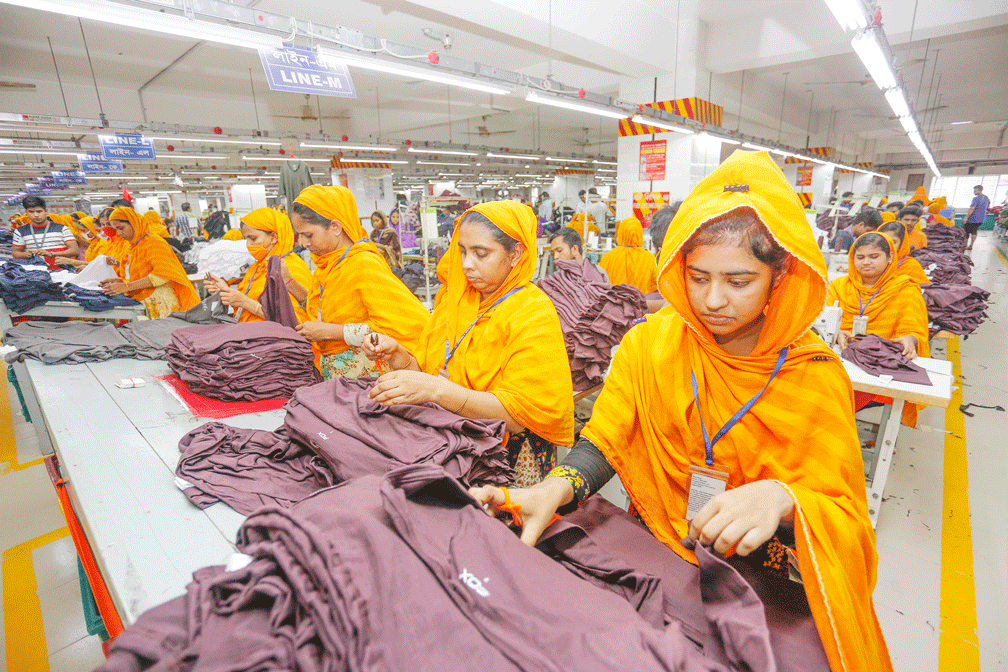
The European Union is the largest destination for Bangladesh's garment export earnings, taking 61 percent of total shipments. That long-standing pattern has now broken: in the first eight months of this year, Bangladesh earned only €11.93 billion from garment exports to the EU, compared with €13.50 billion in the same period last year.
Export earnings have thus fallen by €1.58 billion year on year, a decline of 11.67 percent. The picture emerges from the Bangladesh Apparel Voice (BAV), which analysed data from Eurostat, the European Union's statistical office.
It is not only total earnings that have fallen — the unit price of garments has dropped too. Between January and August 2025, the average price per kilogram of clothing was €14.87; in the same period this year it has fallen to €13.76, a decline of 7.43 percent per kilogram. Export volumes fell by 4.58 percent over the same period.
Mahiuddin Rubel, founder and chief executive of the Bangladesh Apparel Voice, says that although production costs at home are rising, European buyers are unwilling to pay higher prices for garments — instead they are pressing suppliers to ship at even lower prices, raising fears of further pressure on exporters' businesses.
Domestic cost pressure compounds the problem. Factories have long faced uncertainty over energy supplies while paying high prices for what they get, and recent government restrictions on sourcing fabric yarn are pushing costs up further. Exporters are thus squeezed from two sides: fears of weakening demand in Europe and rising production costs at home.
Even before the downturn could be reversed, Europe's instability has added fresh worry. Sudden protests, vandalism and looting in major buyer countries such as France and Italy, along with heated politics across Europe, are creating new risks for garment exports, exporters fear. If the situation does not improve quickly, they warn, EU economic activity could slow, reducing consumers' purchasing power and disrupting new demand for clothing.
Imports have fallen across the EU market as a whole. In the first eight months of this year, EU countries imported €60.29 billion worth of clothing, down 3.83 percent from €62.69 billion in the same period of 2025. The average import price per kilogram also fell, from €19.91 to €19.65, a decline of 1.29 percent.
Among competitors, China is comparatively better placed. Its garment exports rose 2.38 percent in the first eight months to €19.71 billion, with volumes up 3.45 percent, although its average price per kilogram fell 1.04 percent.
Vietnam presents a contrasting picture. Its garment export earnings rose 4.46 percent to €3.00 billion, even though export volumes fell 5.13 percent — because its average price per kilogram rose 10.11 percent. Selling smaller quantities at better prices increased Vietnam's earnings, while for Bangladesh the price effect is working in the opposite direction.
Most of Bangladesh's other competitors in the European market also saw exports fall: Turkey by 11.02 percent, India by 10.84 percent, Sri Lanka by 11.12 percent, Indonesia by 11.03 percent, Pakistan by 9.63 percent, Morocco by 6.10 percent and Cambodia by 4.51 percent.
The effects of volume and price, however, differ by country. Pakistan's export volume rose 3.82 percent but its average price per kilogram fell 12.96 percent. Cambodia's volume fell 11.63 percent, yet its average price per kilogram rose 8.05 percent.
All told, Bangladesh's garment sector now faces a three-way squeeze in the European market — falling earnings, falling prices and rising production costs at home. Exporters fear that if Europe's political instability drags on and buyers keep pressing for lower prices, the trend may continue for the rest of the year. The sector's biggest question now is how to survive the price war and win back lost ground.