Four Gourds for One Taka in Panchagarh: Farmers Fear Losing Their Capital Despite a Good Harvest
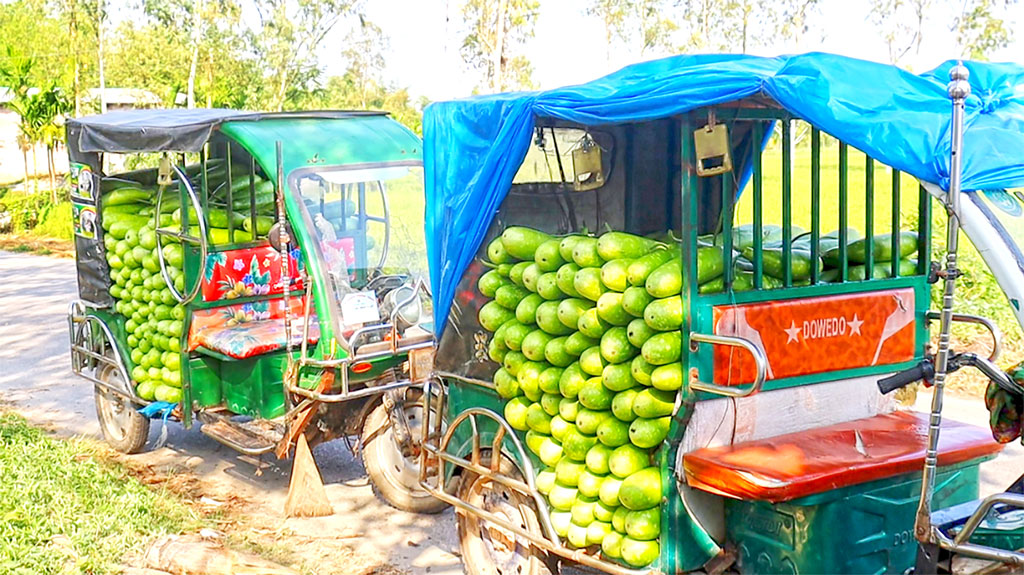
Bottle gourd farmers in Panchagarh have fallen into a severe crisis this season. The price of the vegetable has crashed so badly that taking gourds to market has become a losing errand, and in Atwari upazila four gourds have reportedly been sold for just one taka.
Abdul Kader, a gourd farmer from Toreya in Atwari upazila, said on Thursday that he paid 100 taka in autorickshaw fare to take his gourds to market and sold them for only 120 taka — leaving just 20 taka in his hand after transport costs. Had he known, he said, he would not have brought the gourds to market at all.
Kader is not alone; almost every gourd farmer in Panchagarh is in the same state. Getting no price in the market, many are no longer harvesting gourds from their fields, and some have even stopped tending the crop.
Sajjad Hossain, a gourd trader in Atwari upazila, said gourds are collected from various parts of Panchagarh and sent to Dhaka and other places across the country. But with prices so low this time, traders too are in trouble: after paying for collection, labour and transport, making a profit has become difficult.
According to traders, gourds from all over the country are flowing into Dhaka. With supply high, prices there have fallen, and that blow has landed on the farmers of Panchagarh.
Inquiries show that gourd yields have been good in various upazilas of Panchagarh this season, yet there is no smile on farmers' faces — because of the unbelievable price collapse that has four gourds selling for a single taka.
The arithmetic is stark: gourds produced at a cost of 20,000 to 30,000 taka per bigha are selling for only 3,000 to 5,000 taka. In previous years, farmers earned 40,000 to 50,000 taka from gourds grown on the same land.
Talking to farmers in different areas of Mirzapur union in Atwari on Thursday, it was learned that each bigha produces 3,000 to 5,000 gourds. Production costs — land preparation, seed, fertiliser, pesticide, irrigation and labour — run to 20,000 to 30,000 taka. With no price in the market, farmers cannot recover even a small part of that cost.
Dulal, a gourd farmer in Mirzapur union, said that despite a good harvest there is no price this time. Having to sell four gourds for one taka, he fears losing his capital.
Farmer Abas Ali asked how a farmer is supposed to run a household if, after growing a crop with so much labour, even the production cost cannot be recovered. He demanded initiatives to save the farmers.
Attempts were made to speak to upazila agriculture officer Mostak Ahmed, with several calls to his mobile phone, but he could not be reached. It therefore remains unknown whether the administration has any plan for the farmers in this crisis.
A good harvest that brings no price is a reminder of an old risk for farmers: higher production does not by itself mean higher income, and without a balance of market and supply, the crop itself becomes a burden. Panchagarh's gourd farmers are now facing exactly that reality.