Murder, Robbery and Extortion Rising on the Rivers: River Police Themselves Attacked on Raids as Cases Near 6,000 in Two Years
Fishermen are being shot dead by river pirates while out fishing. Boat workers who refuse to pay extortion money are beaten and hacked. Cargo, including fertiliser, is looted from freight vessels. Kidnapping, mugging, drug trafficking and illegal sand extraction are also taking place on the waterways — and members of the River Police are themselves coming under attack when they raid to stop these crimes.
Several senior River Police officials say fear rises on the rivers as evening falls. Passenger trawlers, fishing boats, cargo vessels and bulkheads are all being targeted. In their view, criminals choose the rivers because surveillance by law-enforcement agencies is thinner on the long waterways than on land, and river-centred crime is consequently rising.
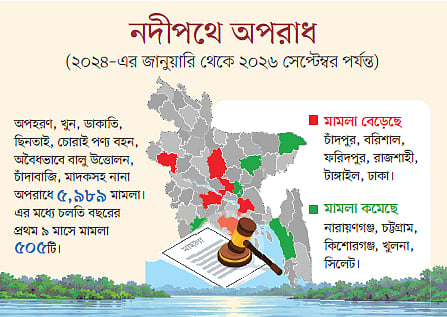
According to River Police headquarters, the force works in 11 regions to maintain law and order and control crime on the country's waterways. In those regions, 2,085 cases were filed in 2024 over murder, unnatural death, robbery, mugging, arms, carrying stolen goods, illegal sand extraction, kidnapping, extortion and drugs. In 2025 the figure rose to 3,399 — an increase of 1,314 cases in a single year.
From January to September this year, a further 505 cases were filed in five categories — murder, robbery, kidnapping, piracy and unnatural death. Together with the previous two years' cases in all categories, the combined total stands at 5,989.
On the night of 1 February last year, a fisherman named Md. Hossain, 30, was shot dead by river pirates while fishing on the Meghna near Purba Ilisha union in Bhola Sadar upazila. Three other fishermen — Abbas, 32, Kanchan, 34, and Sohel, 29, all from Baghar Hawla village in the same upazila — were wounded. The River Police say a gang of pirates tried to rob the fishermen's trawler that night and opened fire when the fishermen resisted, spreading panic among fishermen in the area.
Shah Alam Mallik, general secretary of the Bangladesh Fishermen's Federation, says robbers and pirates attack fishing boats and passenger vessels on waterways along the borders of five districts. The attacks usually come after dusk at Haimchar in Chandpur, Lakshmichar and Kanchikata in Shariatpur, the Padma-Meghna confluence and adjoining chars in Munshiganj, the Meghna near Raipur in Lakshmipur, and the Meghna chars near Hizla and Mehendiganj in Barisal. Fishermen are killed or injured and their money, goods and fish looted.
Mallik says robberies are currently rare because the Coast Guard, police and fisheries department are running round-the-clock operations to protect mother hilsa in the Padma-Meghna. But once the operations end and fishermen return to the water, there is a risk of night-time robbery in remote char areas. He demanded that Coast Guard and police patrols stay strong even then for the safety of fishing communities, saying more patrols on district-border waterways and remote chars would reduce these crimes.
Freight vessels are being robbed too. On 10 October last year, criminals looted about 6,500 sacks, or 317 metric tonnes, of fertiliser from a bulkhead on the Meghna near Narsingdi; the River Police later arrested 11 people over the incident. Earlier, on 23 December 2024, seven crew members of the fertiliser-carrying vessel MV Al-Bakhera were hacked and slaughtered on the Meghna at Haimchar in Chandpur — a brutal killing on board a vessel that deepened concern over river security.
Ahmadul Kabir Molla, vice-president of the Bangladesh Bulkhead Owners' Association, says extortion in the name of tolls is collected from every vessel while loading beside the river at Harirampur in Manikganj — 2,000 taka — at Ilisha in Bhola, 500 taka, and at Rustampur and Aminbazar in Savar, 2,500 taka. He alleges tolls in name and extortion in practice are being taken from vessels at points on rivers across the country, and he wants the administration to intervene to stop it.
On the morning of 7 October last year in Narayanganj, an organised gang carrying traditional weapons including tetas, spears and ramdas stopped a vessel on the Meghna and demanded extortion money. When the crew of the bulkhead MV Joynob Brishti Paribahan refused, workers Mohibullah and Zakaria were beaten and hacked. When members of the Chalibhanga River Police outpost went on a raid, the extortionists attacked them too with tetas and spears, injuring Assistant Sub-Inspector Maksud and constables Sohag and Saidur. Police eventually brought the situation under control by firing rubber bullets in self-defence, and two men, Rana and Sajjad, were arrested at the scene.
River Police chief and Additional Inspector General Md. Rezaul Karim says there are problems with filing cases and giving testimony to stop extortion. People complain of extortion on the rivers, he says, but no one files a case against the extortionists; when police file a case themselves, the crime cannot be proved in court for lack of witnesses.
The River Police also come under attack when stopping illegal sand extraction. On the night of 21 April this year, five members of the Lakshmikunda River Police outpost of Ishwardi in Pabna were shot during such a raid on the Padma near Haripur in Kushtia Sadar upazila. And on the afternoon of 19 August, criminals stabbed River Police constable Zakir Hossain and hit him on the head with a brick as he returned from patrol at Kaukhali in Pirojpur; five police members, including outpost inspector Md. Arman Hossain, were injured trying to protect him.
Regional statistics show the highest number of cases in both 2024 and 2025 was in the Chandpur region — 850 in 2024, rising to 2,017 the following year. Barisal was next in both years, rising from 448 to 611 cases. In the first nine months of this year, in the five categories of murder, robbery, kidnapping, piracy and unnatural death, the highest figure was in the Dhaka region, 86 cases, followed by Narayanganj with 82.
The sheer scale of the waterways adds to the security challenge. According to River Police headquarters, the country's navigable waterways stretch 7,500 kilometres in the monsoon, shrinking to 4,500 kilometres in the dry season, with regular vessel movement on about 3,500 kilometres. The River Police have 124 outposts in riverine areas; their members patrol to gather information on criminals, and operations based on that information are bringing success, the force's chief says.
But Professor Muhammad Omar Faruq of the Criminology and Police Science department at Mawlana Bhashani Science and Technology University in Tangail believes the recorded statistics do not capture all the crime. River-centred crime is increasing, he says, and in reality incidents are more numerous than the statistics show. In his view, the force must be strengthened by filling gaps in manpower, equipment and training so that surveillance and supervision can increase. Identifying crime-prone spots and running coordinated operations with other forces, he says, can gradually bring river crime down.