Papaya Rots on Trees, Gourds Sell at Four for a Taka: Bumper Harvest Ruins Farmers While Dhaka Prices Stay High
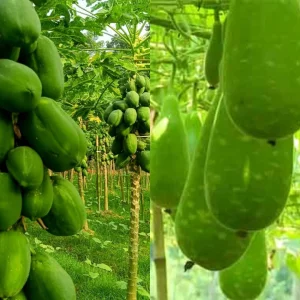
The gourd vines are heavy with fruit and ripe papaya hangs from the trees, but there are no smiles on farmers' faces. With supply far exceeding buyers in the market, the prices of these vegetables have fallen to rock bottom. In places, four bottle gourds are selling for just one taka, while a kilogram of papaya fetches two to three taka.
In this situation, even covering the costs of harvesting, labourers' wages and transport has become difficult. To cut their losses, some farmers are cutting down their gourd vines, while others are leaving papaya unpicked to rot on the tree.
Yet in the capital's retail markets, a single gourd costs 40 to 60 taka, and papaya sells at around 30 taka a kilogram. This huge gap between the production area and Dhaka's markets has exposed both the plight of farmers and the limitations of the agricultural marketing system.
In Panchagarh's Atwari Upazila, the gourd harvest has been good this year. But because production has risen, growers are not getting the expected price. In some areas four gourds sell for one taka, elsewhere each gourd fetches two to five taka — yet at the local retail market a buyer must pay 20 to 30 taka for one.
Farmer Dulal Islam of Telipara in the upazila's Mirzapur Union invested 60,000 to 70,000 taka in gourd cultivation on 40 decimals of land. So far, selling his gourds has earned him only 3,000 taka. He says the proceeds cannot even pay the labourers' wages, and selling two to three thousand gourds does not bring in the price of a kilogram of beef. Forced by circumstances, he has cut down his vines and is feeding some gourds to cattle. His question: if farmers do not get a fair price after so much labour and expense, how will they continue farming in future?
Ansarul Islam, a farmer from Jhaljhali Ularchap in the same upazila, has also stopped tending his gourd plot under the pressure of losses. He says that alongside higher fertiliser and pesticide prices, labourers' wages have risen too — a worker must be paid 600 to 700 taka a day — while a gourd sells for at most five taka. Continuing to care for the plot at this price would only deepen the loss, he fears.
Papaya growers, like gourd farmers, are in trouble. In Manikganj's Singair Upazila, the Department of Agricultural Extension had set a target of papaya cultivation on about 900 hectares this year. Favourable weather, high-yielding varieties and expanded acreage raised production — but with a huge volume of papaya reaching the market at the same time, prices have collapsed.
In different parts of Singair, papaya is selling from the field itself at two to three taka a kilogram. At this price it is impossible to recover the costs of seed, fertiliser, pesticide, irrigation, land rent and labour. Many farmers are therefore not harvesting the fruit at all; in places ripe papaya is rotting on the tree, and elsewhere farmers are preparing to clear papaya plots for other crops.
Delwar Hossain of Gopalnagar village spent 40,000 to 50,000 taka growing papaya on two bighas of land, but at selling time buyers refuse to pay more than two to three taka a kilogram. At this price, he says, even the labourers' wages and van fare are hard to meet. Tajul Sikdar, another farmer of the same upazila, has cut down the papaya trees on two bighas to stem his losses and is now considering alternative crops.
The papaya price collapse has also hit wholesalers and traders who invested money in advance. In Dhaka's wholesale market, green papaya has sold at four to ten taka a kilogram for a week. Yet at the same time last year, retail papaya prices had reached 80 to 100 taka a kilogram. Encouraged by last year's high prices, many farmers and traders increased production and advance investment this year, but with supply surging, those expectations have not been met.
Karwan Bazar papaya trader Mahfuzur Rahman, encouraged by last year's good prices, had advanced three crore taka to farmers in five districts this year. With prices falling, he has sold papaya at six to seven taka a kilogram for several days, and the price has since dropped further to four taka. Yet transporting papaya from Chuadanga and Jashore to Dhaka alone costs more than four taka a kilogram. He doubts whether even 500,000 taka of his three-crore advance will come back, and he is worried about repaying bank loans and interest.
Aji Ullah brought three tonnes of papaya from Singair in Manikganj to Karwan Bazar. By his calculation, production costs including land rent, seed and fertiliser come to 10 to 12 taka a kilogram, and with transport and labour the total reaches 13 to 15 taka — yet he had to sell at six to eight taka. Abu Bakar, who has sold vegetables at Karwan Bazar for two decades, says a fall in papaya prices to this level is rare in his experience.
With early winter vegetables starting to reach the market, wholesale prices of some items are also trending down. At Bogura's Mahasthan wholesale market, pointed gourd fell within a week from 40 taka to 25-30 taka a kilogram, bitter gourd from 55 to 45, cauliflower from 70-80 to 60, and radish from 35 to 22 taka. But while wholesale prices fell, retail prices did not fall at the same rate: at Bogura town's Fateh Ali Bazar, pointed gourd sold at 50 to 60 taka, bitter gourd at 80 and cauliflower at 160 taka a kilogram.
Obaidur Rahman Mondal, director of the field services wing of the Department of Agricultural Extension, said buyers' interest has shifted as winter vegetables begin to arrive. Gourds and papaya, being available all year round, are also seeing an effect on demand. Both the acreage and production of gourds and papaya have increased, he said, with high-yielding hybrid varieties spreading in many districts. As yields and market supply rose together while demand lagged, prices fell.
Agricultural economist Dr Jahangir Alam Khan believes the price collapse of gourds and papaya exposes the weakness of the country's agricultural marketing system. Higher production, he says, is no guarantee of higher farmer income; with perishable goods, when supply floods the market at once, farmers are forced to sell cheap. Without adequate storage, agro-processing and effective transport of produce between regions, such crises will recur. To ensure fair prices he has proposed forming an agricultural price commission, and he cited India's minimum support price system, crop insurance schemes and government procurement and stocking of farm produce as examples. Unless production planning, storage, processing and fair-price measures are taken together, he warned, even a good harvest can become a financial disaster for farmers.