China's Markets Lose $2.4 Trillion as AI Race With the US Takes Its Toll
Trillions of dollars have been wiped from China's stock markets in recent months amid growing anxiety about the future of artificial intelligence, as Beijing races against the United States for dominance in the sector.
The STAR 50 Index, which tracks technology and innovation companies on the Shanghai stock exchange, has plunged 40% since June. Other indexes of major companies have dropped by about 20% over the same period. According to Bloomberg, a total of $2.4tn has been wiped from the Chinese stock market since May.
According to Goldman Sachs, AI stocks account for over 40% of the stock market value in China and Hong Kong, meaning any dent in their value sends shockwaves across the whole domestic market.
The Chinese government has invested heavily in AI, including a 60bn yuan state-backed AI investment fund which started putting money into domestic developers this month. But Chinese consumers have proved reluctant to spend in many parts of the economy, including technology, meaning many tech companies struggle to turn a profit.
The lack of profits is one reason for the sell-off. Another is the threat of western countries, especially the US, extending bans on Chinese technology. The US has banned humanoid robots from China, citing national security risks, and is thought to be considering a ban on Chinese components in data centres.
Dan Wang, the China director for the Eurasia Group, said: 'This year, the profit margin is not as good as expected. And the US is raising rates. And China's domestic demand is so weak.' She said there was a 'general anxiety' among technology companies about whether the state-backed model would work in the face of weak consumer demand.
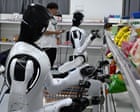
As China races with the US to pull ahead in AI, Beijing has doubled down on robotics, also known as embodied AI, as the key to rolling out the technology across society, and as an answer to demographic problems such as the ageing population and shrinking workforce. But demand for robotics is being driven by government agencies and research institutions rather than everyday consumers, for whom the products are still too expensive and not yet practical for home use.
Shares in Unitree, China's leading robot-maker, have halved since they started trading in August. Wang said it did not look like embodied intelligence could turn into profits in the mass market, though she noted there was still optimism in other technology sectors such as AI research and satellites.
On Monday, US AI company Anthropic, which makes the chatbot Claude, filed paperwork ahead of a planned IPO that could be one of the biggest stock market debuts of all time, expected to bring in as much as $100bn. China has no such blockbuster IPOs on the horizon.
Despite pressure on policymakers to introduce stimulus measures to boost investment, none are expected to be announced during a politically sensitive period in China. This week top officials of the Chinese Communist Party are gathering for the fifth plenum, a meeting that will lay the groundwork for next year's 21st Party Congress, which is expected to anoint China's leader Xi Jinping for a fourth term.