Off-Season River Erosion in Manikganj's Ghior Swallows 15 Homes in a Month, Over 50 More Houses and Farmland at Risk
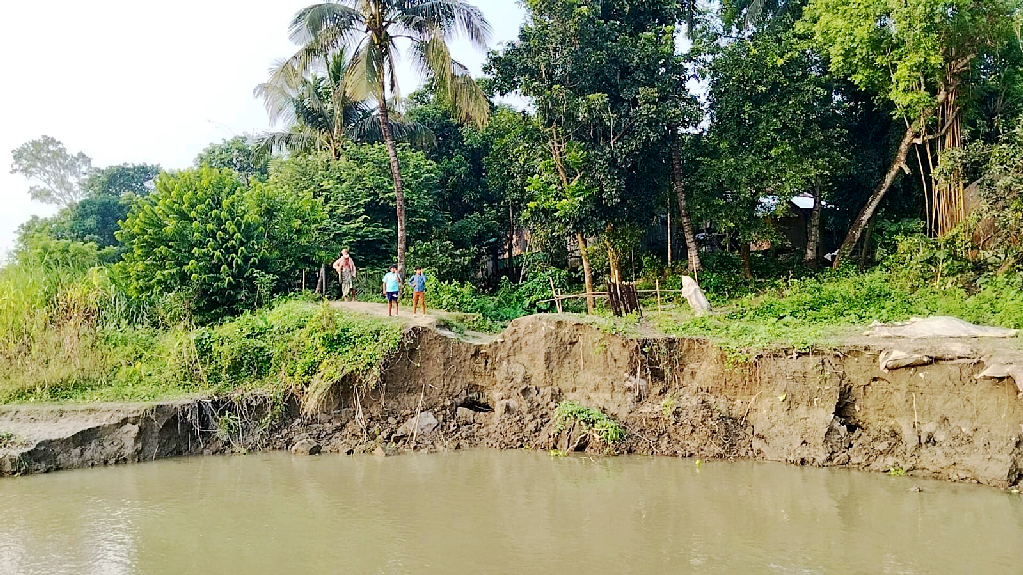
Sudden erosion by the old Dhaleshwari and the Kaliganga rivers in Ghior upazila of Manikganj has swallowed at least 15 homesteads in the past month. Twice that number of homesteads have been partially damaged. More than 50 houses, farmland and important structures now face erosion.
Residents of the riverbanks say erosion appearing at this off-season time, as the river water recedes, has left them worried. The absence of a permanent embankment has increased the risk further, they say.
By local residents' count, over the past decade more than 600 families in different parts of the upazila have lost their homesteads to the rivers, along with over a thousand bighas of cultivable land.
A recent visit to the erosion-hit areas found the banks of the old Dhaleshwari and the Kaliganga scarred by erosion. In places the soil of homesteads is caving in; elsewhere farmland is merging into the river. Several houses stand in a precarious state on the riverbank.
Erosion has appeared at various points of the old Dhaleshwari from Jabra Bazar through Ghior Sadar and Sridharnagar in Poyla union to Begun Narchi. The situation is also alarming at Kellachar, Purba Kumolli and Nakibbari in Baniajuri union on the Kaliganga's bank.
According to locals, in the last 10 years at least 150 houses and about 250 bighas of farmland have been lost to the river at Kellachar and Nakibbari. The Kaliganga's erosion has taken about 45 bighas of land and the homesteads of the families of Sajjad Hossain and Samsu Munshi. Parts of the houses of Isak, Majnu, Robel and Abdul Mannan now hang over the river.
Sajjad Hossain, one of those affected, said: ‘Our family's 45 bighas of land have gone into the Kaliganga. We have been forced to live elsewhere. No permanent embankment has been built yet to stop the erosion. We demand a permanent embankment quickly.’
The risk is also rising at Ghior Sadar. Locals say the geo bags dumped east of the new bridge and at the Kusta cremation ground area are not enough. About 100 bighas of farmland have been lost at Kusta north bank, and erosion continues at various points from the Kusta three-road junction to Sridharnagar.
In Baliakhora union, Dhaleshwari erosion has taken about 50 homesteads in the Kusunda south and north bank areas and one important paved road over the past five years. More than 50 further houses and several hundred bighas of land are now at risk. Taslim Mia lost his homestead along with one and a half bighas of land two years ago; Masud Mia, Chan Mia and many others have been affected the same way.
Rabeya Akter and Firoza Khatun, who lost their homesteads, said: ‘When the monsoon comes, many people come to see the river erosion and give assurances. But after the monsoon, no one checks on us. Our last shelter for our heads has gone into the river. And now the river is eroding even after the monsoon. We do not want relief, we want a permanent embankment.’
Riverbank residents allege that unplanned sand extraction through dredging is changing the rivers' courses and increasing the erosion risk. The administration occasionally raids illegal dredging, but it starts again afterwards, they claim. The residents have demanded effective measures to protect the banks with geo bags and concrete blocks and to restore navigability.
To prevent the erosion, the Water Development Board has sent a development project proposal costing about 49 crore taka to the Ministry of Water Resources. The project, titled riverbank protection works at risky points of the old Dhaleshwari in Ghior upazila of Manikganj district, has been proposed for the 2026–27 fiscal year. It identifies six risky points and plans three permanent and three temporary protection works. Alongside homesteads, these areas contain four bridges built by the Local Government Engineering Department, educational institutions, markets and other important structures.
If implemented, the project is expected to protect about 300 hectares of farmland, important structures and the communications system. Muhammad Akhtaruzzaman, executive engineer of the Manikganj Water Development Board, said the project is currently at the scrutiny stage at the Ministry of Water Resources, and that a large part of Ghior would be saved from erosion once approval and allocation are received. Local people, however, are worried about delays in approval and implementation; if work does not start quickly in the dry season, they fear losing more homesteads, farmland and important structures before the next monsoon.