No Majority for Anyone in Israel Exit Polls, Arab Parties Could Become Kingmakers
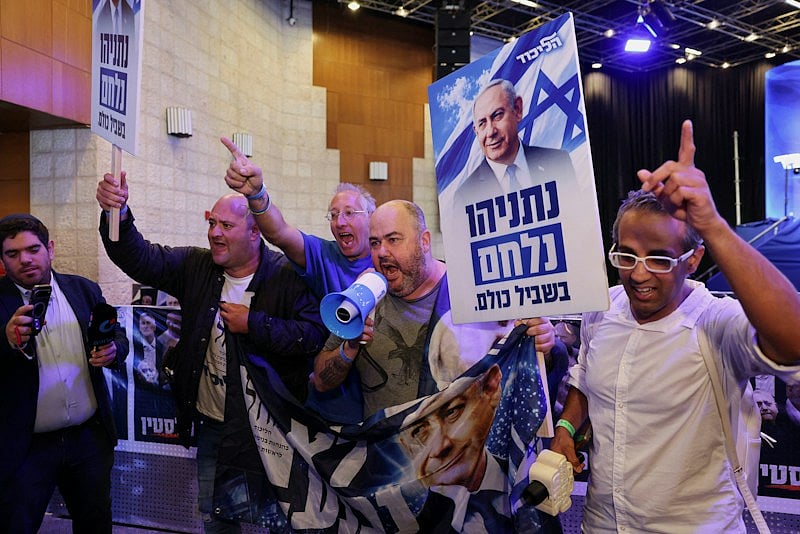
Exit polls from Tuesday's election for Israel's parliament, the Knesset, indicate that no political party or bloc has won an outright majority. That has raised the question of how the country's new government will now be formed, and who will be prime minister.
Citing Israel's Channel 12, Al Jazeera reported that Prime Minister Benjamin Netanyahu's right-wing bloc won 52 seats. The opposition bloc led by former army chief and Yashar leader Gadi Eisenkot won 49 seats. The Arab List won 19 seats.
In the 120-seat Knesset, 61 seats are needed to form a government. On the exit poll figures, no side can secure that number on its own.
The result could open the way to weeks or months of political bargaining over forming Israel's next government.
The Arab-led parties, which belong to neither bloc, produced a remarkable result. If other parties agree to build a coalition with them, they could play the decisive role of kingmaker in forming the government.
Gadi Eisenkot said the exit polls made clear that there is a 'crisis of trust' in Netanyahu among the public.
Current opposition leader Yair Lapid said Netanyahu's bloc had faced a 'crushing defeat' and that people had told them to go home.
Foreign Minister Gideon Sa'ar, a politician from Netanyahu's Likud party, called the opposition's remarks 'premature celebration'. In a social media post he wrote, 'Likud is Israel's largest political party. Learning from the past is always good.'
Addressing his party's supporters gathered in Jerusalem on Wednesday, Netanyahu said, 'Likud is the country's largest political party. We will form a strong new national government.' The Likud leader has served as Israel's prime minister for almost 19 years and has survived at the center of power through various political crises over the past three decades.
Ehab Jabareen, a Palestinian political analyst and researcher living in Israel, said the exit polls showed a 'clear weakness' in Netanyahu's bloc. He cautioned, 'The time has not yet come to say either that Netanyahu has ultimately won or that his political life is over.'
Jabareen added that if no side can form a government for lack of a majority, Netanyahu could remain in power as head of a caretaker government while talks continue.
The final results of Israel's election will be known on November 4. President Isaac Herzog will then call in the leaders of the political parties for consultations and ask whom they want to see as the next prime minister.
The president will then invite the candidate he believes has the best chance of forming a government. That person is not guaranteed to be the leader of the party with the most Knesset seats. With the parties of Netanyahu and Eisenkot in the strongest positions, the two are seen as the main rivals.
Once invited to form a government, that leader will have up to 42 days — 28 days at first, with a possible 14-day extension from the president. During that time parties will negotiate over policy demands and ministerial posts.
If a candidate fails to build a 61-seat coalition, he could try to form a minority government relying on the support of smaller parties, or a power-sharing deal under which the premiership rotates. A new government must win a vote of confidence in parliament to be sworn in.
If the president's first nominee fails, the president will invite another member of the Knesset, who will also receive 28 days. If that nominee also fails, a majority of Knesset members can propose a third candidate, who will have 14 days to form a government. If the deadlock still remains, the Knesset will be dissolved and a new election held within 90 days, with a caretaker government — headed by the current prime minister — running the country in the meantime.
Such a deadlock has happened before. Because of prolonged stalemate in the Knesset, Israelis had to vote in three elections between April 2019 and March 2020. That produced a power-sharing deal between Netanyahu and his then main rival Benny Gantz, under which they were to rotate as prime minister. But that coalition government collapsed after a year when it failed to pass a budget.