
UCB Publishes Banking Sector's First Web-Based Interactive Sustainability Report, Disbursing Tk 17,927 Crore in Sustainable Finance
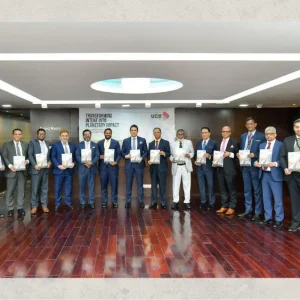
United Commercial Bank (UCB) has published its 2025 sustainability report with a web-based interactive edition, a first in Bangladesh's banking sector. The report presents the bank's environmental and social impact, governance, climate risk management and sustainable finance activities.
Titled "Transforming Intent into Planetary Impact," this is UCB's third sustainability report. It was released recently at a ceremony at the bank's corporate office, where Chairman Sharif Zahir was the chief guest, with board members and senior officials present.
The report was prepared following the international reporting standards IFRS S1 and S2. It details the bank's environmental, social and governance activities in 2025, along with climate risk management and sustainable finance.
According to the report, UCB disbursed Tk 17,927 crore 9 lakh 50 thousand in sustainable finance in 2025, which is 72.29 percent of its total loan disbursement. Bangladesh Bank's set target for sustainable finance was 20 percent.
In the same period, the bank disbursed Tk 488 crore 67 lakh in green finance, which is 30.40 percent of its term loan disbursement, against a set target of just 5 percent. At year-end, the outstanding balance of green finance stood at Tk 2,744 crore 37 lakh 30 thousand.
As part of supporting environmentally friendly industrialisation, UCB financed 27 LEED-certified green industrial enterprises, of which 12 are platinum-certified and 13 gold-certified. The bank also provided more than US$3 billion in export facilities to the country's readymade garment sector.
The report also contains the bank's carbon emission measurements. With the support of Ernst & Young Advisory Services, UCB calculated its direct emissions and energy-related emissions, Scope 1 and Scope 2. Financed emissions, Scope 3, were measured using the framework of the Netherlands-based Joint Impact Model (JIM) Foundation.
By this calculation, carbon emissions associated with UCB's financing in 2025 were 1,912,212.06 tonnes of carbon dioxide equivalent. The emission intensity was 37.52 tonnes per crore taka of loans.
The bank is considering environmental risk in loan assessment and financing activities to address climate change risks, and is strengthening management of both the physical risks of climate change and the risks associated with the transition to a low-carbon economy, the report said.
At the ceremony, UCB Chairman Sharif Zahir said that as a bank operating in a country facing climate risk, UCB believes capital must act as the main catalyst for ecosystem restoration and sustainable economic progress.
Alongside environmental initiatives, UCB is also working to expand financial inclusion. The bank currently has 34 solar-powered branches and four solar ATMs. It also runs 630 agent banking outlets across the country's 64 districts and 50 specialised sustainable finance help desks to support rural and urban entrepreneurs.
The report said loans disbursed by UCB helped create more than 200,000 jobs across various sectors of the country, with women workers accounting for about 30 percent of those jobs. The bank also deposited Tk 18,030 crore 55 lakh into the national exchequer in 2025.
The bank's chief executive officer, Mohammad Mamdudur Rashid, said UCB does not see sustainable banking merely as a corporate obligation; rather, it considers it an essential foundation of long-term economic resilience and institutional governance.
Through the launch of the web-based interactive edition, UCB wants to present information on its sustainable activities and progress more accessibly to readers, investors, regulators and other stakeholders.


