Dhaka Tenants Get January Rent-Hike Notices Before the New Year, Families Fear the Squeeze
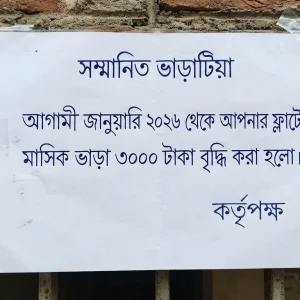
Many families in the capital, already struggling with the cost of living, have received notices raising their house rent from January. A landlord has informed Mohammadpur resident Rafiqul Islam by notice that his flat's monthly rent will rise by Tk3,000 from January.
Rafiqul Islam has worked at a private marketing company for seven years. His salary has been stuck at Tk40,000 for two years. Yet over the past year the price of rice has risen by Tk15 per kilogram and his son's school fees have risen by Tk1,500 — and now the extra rent notice has arrived.
The picture is not Mohammadpur's alone. From Mirpur to Jatrabari and Badda to Dhanmondi, landlords across the capital are issuing notices. Some rents are rising by Tk2,000, others by Tk5,000 — on average by 15 to 20 percent.
Schoolteacher Nahida Akter, who lives in Malibag for Tk22,000, says both earners in her household are private-sector employees. Her husband's office paid half the Eid bonus last time, saying the company's condition is not good. She says if the rent rises by Tk5,000, she will have to stop her daughter's singing classes.
Jamal Uddin, 62, has lived in the same home in Jatrabari for 15 years. His Tk14,000 rent has risen to Tk18,000. He asks where, at this age, he will find the money for a new home, another advance payment and truck hire.
Sumi Akter, who lives in a sublet in Badda, says working women are willing to pay Tk1,000 to Tk2,000 more for a safer home. She says landlords know this, and also know that women will not easily leave such a home.
According to the Bangladesh Bureau of Statistics (BBS), average house rent in the country rose by about 27 percent in the four years from July 2022 to July 2026. Rent rose 5.25 percent year-on-year in the second quarter of 2026 and 5.19 percent in the latest quarter. In Dhaka Division, rent rose by about 5.48 percent over a year.
Three-room flats in different parts of the capital now rent for between Tk18,000 and Tk50,000 depending on the area. On top of that comes an additional service charge of Tk3,000 to Tk7,000.
According to the Consumers Association of Bangladesh (CAB), five years ago house rent and food took 35 percent of a middle-class person's income; now that has exceeded 60 percent. A house rent control law has existed since 1991, but while it remains on paper, it is not followed in practice.
Landlords, for their part, say their costs have also risen. A Dhanmondi landlord, a retired schoolteacher who did not give his name, says painting a flat used to cost Tk15,000 and a painter now asks Tk28,000; water motor pumps, lift servicing and gas and electricity bills have all risen too.
Amin Mohammad, a landlord on Nurjahan Road in Mohammadpur, says when the government raises the pay scale, everyone in the market assumes people have more money and shopkeepers raise prices. In his words, people arrive in Dhaka every day and demand for homes is high; if he does not raise the rent, the neighbouring house does. He says he is not forcing anyone — those who can afford it will stay and those who cannot will leave, and there is no shortage of tenants now.
CAB president A H M Safiquzzaman says house rent in Dhaka is high because demand for rental homes exceeds the population's supply; without that demand it would stay at a tolerable level. He says there is no system to check whether landlords' reasons for raising rent are reasonable. He therefore says rules under the house rent control law are urgently needed, and that rent matters can be settled through a legal framework.
Rafiqul Islam says he is happy if government employees' salaries rise. But he asks how private employees will survive if the price of everything rises without their salaries rising, and asks whether it would have caused much harm not to raise house rent for at least one year.