Turkic states summit in Ankara: plans to deepen cooperation on transport, energy and trade
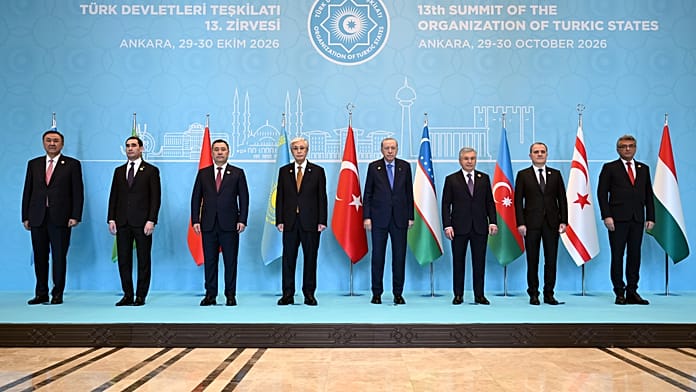
Turkic states have set out plans to deepen cooperation on transport, energy and trade at a summit in Ankara, as the ongoing crisis in the Middle East continues to raise new opportunities for them, including Asia-Europe transport projects.
In a surprise move during the summit, Kazakhstan's President Kassym-Jomart Tokayev suggested inviting Russia to participate in the Organization of Turkic States (OTS) through its OTS Plus format or as an observer, 'in order to enhance the standing and credibility of our Organisation.' No agreement on Russia's participation was announced.
The organisation's 13th summit, hosted by Turkish President Recep Tayyip Erdoğan, concluded with the adoption of the Ankara Declaration.
The OTS comprises Turkey, Azerbaijan, Kazakhstan, Kyrgyzstan and Uzbekistan. The gathering also included Turkmenistan's President Serdar Berdimuhamedov, representing an observer state, while Azerbaijan was represented by Foreign Minister Jeyhun Bayramov. Turkey assumed the organisation's rotating chairmanship from Azerbaijan.
Erdoğan stressed the importance of unity among Turkic states amid growing geopolitical uncertainty, but focused much of his address on practical cooperation in cybersecurity, space technologies and digital trade. He proposed a common digital trade platform and a shared Turkic large language model covering the Oghuz, Kipchak and Karluk language groups.
The Ankara Declaration called for progress on a cybersecurity agreement and consultations on establishing an OTS Cybersecurity Council. It welcomed the completion of a joint 12U CubeSat and the signing of a framework agreement on space-industry cooperation.
Uzbek President Shavkat Mirziyoyev called for expanding the OTS's international partnerships through an 'Organization of Turkic States Plus' format involving third countries. He proposed the 'Turkic World – 100' programme, encompassing 100 strategic joint investment and industrial projects, with emphasis on full processing of rare and strategic minerals, localisation of green-energy equipment production and manufacture of high-value-added products.
On transport connectivity, Mirziyoyev called for transforming the Middle Corridor and connected routes into an integrated economic system, supported by jointly managed logistics hubs. His other proposals included a multilateral agreement on mutual legal assistance in commercial matters, a Turkic Tourism Alliance and simplified cross-border travel using national identity cards.
Tokayev highlighted the growing importance of the Middle Corridor, which connects Central Asia with Europe through the Caspian Sea and the South Caucasus. He reported that freight volumes along the route had increased by 30% during the first nine months of the year, transit shipments had risen by 90%, and rail freight between Kazakhstan and OTS countries had approached 40 million tonnes.
For European markets, the route offers an alternative to transport links crossing Russia, although port capacity, border procedures and infrastructure gaps remain significant constraints. Tokayev also called for closer coordination on cybersecurity and reiterated that the OTS is not, and should not become, a military alliance — Kazakhstan's position.
Kyrgyz President Sadyr Japarov stressed the need to connect the China-Kyrgyzstan-Uzbekistan railway with the Middle Corridor and proposed hosting an informal OTS summit on 5-6 August 2027. Berdimuhamedov said Turkmenistan was ready to use the infrastructure of its Turkmenbashi port to expand transit across the Caspian Sea.
Ahead of the summit, Erdoğan held separate bilateral talks with the presidents of Uzbekistan and Kazakhstan. In talks with Tokayev, Erdoğan reaffirmed the two countries' ambition to increase bilateral trade to $15 billion (approximately €13.5 billion). The summit named Uzbekistan's Mirvokhid Azimov as the incoming OTS secretary general.