NCP joins Khulna long march only in limited form, stressing its own politics within the alliance

Even while remaining in the Jamaat-e-Islami-led 11-party unity, the National Citizen Party (NCP) wants to strengthen its independent political position. To that end, the party is taking part in alliance programmes only on a limited scale while giving priority to its own party programmes and political agenda. The clearest reflection of this was seen in the 11-party unity's long march towards Khulna. Several of the party's leaders had been speaking informally about the matter for days.
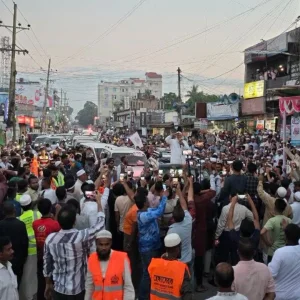
On Saturday morning, the inaugural rally of the 11 parties' long march was held at the south gate of the Baitul Mukarram National Mosque in the capital. No NCP leader was present at the time — even though NCP convener Nahid Islam had been scheduled to speak there as a special guest. Later, however, several central leaders of the party joined the long march motorcade as NCP representatives.
NCP senior joint convener Nasiruddin Patwary and senior joint member secretary Sarjis Alam said that three important leaders of the party's political council — senior joint convener Hasnat Abdullah, joint convener Abdul Hannan Masud and Ariful Islam Adeeb — along with several other central leaders had joined the long march.
Several central NCP leaders, speaking on condition of anonymity, said the party wants to emphasise its independent politics while keeping the 11-party unity intact. That is why its participation in the Khulna-bound long march was limited. In the earlier long marches towards Chattogram and Rangpur, by contrast, the party's convener and member secretary had been present.
According to NCP sources, the party is stressing its own programmes over alliance programmes in order to make its independent political identity and position clear. The upcoming local government elections are a major reason behind the new party's decision.
A leader of the NCP's political council, its highest policymaking forum, said on condition of anonymity that the party did not get the response it had hoped for from Jamaat over seat-sharing in the city corporation elections. Even after the NCP announced Asif Mahmud as its candidate in Dhaka South City, Jamaat introduced Sadik Kayem as its own candidate. It was mainly from that point, the leader said, that the NCP decided to follow a 'walk alone' policy.
Even so, most of the party's leaders are not in favour of leaving Jamaat right now, given the overall political calculations and the party's comparatively limited capacity as a new organisation. In this situation, to underline its distinctiveness, the NCP held a mass protest programme at Shahbagh in Dhaka on Friday, the day before the 11-party unity's Khulna divisional long march.
Party sources say a section of the NCP's central leaders believes that by joining every alliance programme with equal weight and strength, the NCP is failing to build its own ideological position firmly and is being overshadowed by Jamaat. Those leaders argue the party should focus on its own distinct programmes.
On the matter, NCP joint convener Atik Mujahid said: 'Our relationship with Jamaat-e-Islami is issue-based. We have a working relationship with them on various issues including the reform agenda. But there is no ideological relationship. We want to do politics with an independent political identity.'
Atik Mujahid said the NCP will continue working on its own programmes and political agenda, and that the party is preparing to contest the coming elections on its own.
NCP member secretary Akhtar Hossain said much the same. 'The NCP is preparing on its own for the local government elections,' he said. 'There will be single NCP candidates in upazilas, unions and city corporations. We have already published lists of NCP-supported candidates for city corporation and upazila levels in some places. Our own preparations are ongoing.'