
Day of Violent Wage Protests in Industrial Zones; PM Orders Action Against Unrest Creators
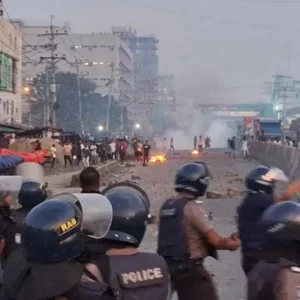
The garment workers' movement demanding a minimum wage of 30,000 taka suddenly turned violent on Sunday (November 1). Industrial areas in the capital's Mirpur, in Savar-Ashulia and in Gazipur saw daylong protests, road blockades, clashes, vandalism and arson. Traffic was disrupted and production halted at a huge number of factories.
According to information available until 3:30 p.m., workers had walked out of 529 factories across five major industrial zones. Around 987,000 workers of those factories did not join work. Alleging a "conspiracy" behind the unrest, the government warned of tough action.
Meanwhile, the government has formed a new six-member minimum wage board for the garment sector. The labour ministry says there is no reason to continue the movement after the board's formation. Workers, however, say it is difficult to meet living costs on the current wage. Labour organisation leaders also call their demand justified. At the same time, allegations of third-party intrusion into the movement have surfaced.
The situation had remained peaceful for the past few days but heated up on Sunday. Several people, including police members, were injured while bringing the situation under control. Metro rail services also had to be suspended for a few hours because of the clashes in Mirpur.
Worker protests began on Sunday morning in various areas of Savar and Gazipur. As the day wore on, tension spread. In Ashulia's Narsinghapur, workers of several factories took to the road and chanted slogans demanding a wage increase. Later, holidays were declared at nearby factories including Sharmin Group, Ha-Meem Group and Newage. In Kaliakair's Safipur Bazar area, workers of several factories also occupied the highway. Later, a pickup van and a jhut (fabric scrap) warehouse of a garment factory were set on fire in the Chandra Palli Bidyut area.
In the afternoon, protesting workers attacked and vandalised a factory of AKH Group in Savar's Hemayetpur. After smashing the factory's glass and several vehicles inside, they set tyres on fire and blockaded the Dhaka-Aricha highway, halting traffic on both sides. A local journalist was also beaten while filming the incident. The factory authorities later declared a holiday, and police persuaded the protesters to leave the road.
Dhaka district's additional superintendent of police Jahangir Alam said protesters threw brickbats and carried out vandalism at various places. Whether outsiders or workers were involved had not yet been identified, he said, adding that there was no looting and the situation was under control.
"You can do nothing with 12,500 taka," said garment worker Arifur Rahman, an operator at a factory who joined Sunday's movement in Mirpur. His basic pay is 12,500 taka; with overtime he earns 17,000 to 18,000 taka a month. Arif said: "All in all I get 17-18 thousand taka. I enter duty at 8 in the morning and leave at 8 at night. There is no proportion between the labour I give and the pay I get. Besides, with commodity prices and house rent as they are now, nothing can be done with this money."
He said: "We cannot live in a good house. Rent has gone up even in the house where we live. Given how hard a garment worker labours, with a 30,000 taka salary plus overtime, one could live a little better." On the clashes with police, Arif said: "While we were holding a fair movement, the police attacked. If the police had not attacked, nothing would have happened." Asked whether anyone was instigating him, he said: "Nobody instigated me. I came of my own will."
Another worker, Shamsul Islam, said much the same: "The demand we have made is not excessive. We stand with fairness. But I condemn the way the police baton-charged to suppress our movement." He said: "No government has ever properly raised our pay. We have had to protest again and again, and only then has the government raised wages." Asked why clashes continued even after the wage board was formed, Shamsul said: "The police started it first. We were peaceful."
Talking to workers, the picture that emerged is that at the centre of the anger lies the mismatch between income and the cost of living. The garment sector's minimum wage was set at 12,500 taka in December 2023. Workers complain that over the past few years the prices of food, house rent, transport and healthcare have all risen. House rent that was 2,500 taka a few years ago has now reached 7,500 taka. Even earning 19,000-20,000 taka including overtime, they struggle to cover household expenses.
On the other side, the government and law enforcement agencies have alleged instigation by banned organisations and anti-government groups behind the movement. Dhaka Metropolitan Police's Detective Branch (DB) has arrested 11 leaders and activists of the Awami League, Jubo League and Chhatra League on allegations of mixing with the ongoing garment workers' movement in Mirpur-10 and nearby areas and carrying out sabotage and arson. Law enforcers also said Sajmul Islam, organising secretary of Chhatra League's Jagannath University unit, was accused of leading a procession in Gazipur's Kaliakair, from where 9 people of the Awami League, Sramik League and Chhatra League were arrested.
Sammilito Garments Sramik Federation president Nazma Akhtar said: "Behind this anger lies long-standing neglect. Many times the owners make promises and do not keep them, which creates an extreme trust deficit among ordinary workers." She said: "From today's picture, a third party has entered the movement to reap benefits. The workers' demand is fair. But are fire, looting and vandalism a solution? The government's formation of the wage board is positive. We expect a good outcome."
Labour leader Taslima Akhtar said: "Workers do not take to the streets for fun. With the prices of rice, lentils and oil in the market, they have to run every month on loans with the current wage. Their current demand is not unreasonable. But to realise this demand, our worker brothers and sisters must stay alert so that no side can spread confusion." She also said: "The government has formed the wage board. So let there be no more violent movement, and let no one step into instigation even if instigated."
Md Ashrafuzzaman, organising secretary of the central committee of Jatiya Garments Sramik Jote Bangladesh, said: "The workers' demand is that the minimum wage must be 30,000 taka. But peaceful programmes must be held to realise the demand. Programmes that harm people's lives and property or create public suffering must be avoided."
Dhaka Metropolitan Police (DMP) joint commissioner Mohidul Islam said: "An anti-government or anti-state circle is trying to join the protesting workers and deteriorate the law and order situation. We have already found some evidence of it. We have already arrested several people. They are mixing with the protesting garment workers and trying to carry out sabotage."
Meanwhile, amid the worker unrest, Prime Minister Tarique Rahman met concerned officials on Sunday evening in the Cabinet Division's meeting room at the Secretariat. Present were Home Minister Salahuddin Ahmed, Labour and Employment Minister Ariful Haque Chowdhury, State Minister for Local Government Mir Shah Alam, prime minister's adviser Mahdi Amin, and Shamsur Rahman Shimul Biswas, chief coordinator of the BNP's labour organisation Jatiyatabadi Sramik Dal.
At the meeting, the prime minister directed that a minimum wage be determined to protect garment workers' interests and improve their living standards. At the same time, he directed the home ministry to take legal action against those involved in creating the violent situation in Mirpur, Savar and Gazipur by using the workers' movement.
Home Minister Salahuddin Ahmed said: "We have received instructions to take legal action against those who are trying to create unrest in the country by using the workers' movement. All forces have already been given that instruction. We have been observing for several days that many of the banned Awami League are involved in creating this unrest. Some Awami League-supporting businessmen also instigated it. We have identified them." He also alleged instigation "from across the border."
The home minister said: "A conspiracy is under way to disrupt the country's export trade and production by using innocent garment workers. The government will deal with such activities with a strong hand. We have noticed that many masked people have entered at various stages of the movement to serve their own vile interests. The information we have is being analysed." He said those involved in violent activities have already been brought under the law, and that police and other law enforcement agencies will take a strict position against any mischief.
After the meeting, Labour and Employment Minister Ariful Haque Chowdhury told journalists that a group not connected with the workers is engaged in conspiracy through various organisations, keeping December in view, and the government will deal with it politically. He said the meeting discussed the formation of the workers' wage board and the proper running of industrial factories, and that the main issue is ensuring public safety and restoring a stable situation.
Several responsible government sources said the government had been observing the garment workers' movement for several days, trying to understand whether it was an expression of workers' genuine discontent or whether political activity lay behind it. The government's position is that it has become certain of the involvement of the banned Awami League and its front organisations behind the movement. According to the sources, most of the garment factories owned by Awami League-supporting businessmen were shut in the morning, giving workers the opportunity to take to the streets.
In this situation, Labour Minister Ariful Haque Chowdhury met the prime minister at noon on Sunday, where the ongoing worker unrest in the garment industry and the overall situation were discussed. The labour minister also cancelled his visit to the United Arab Emirates because of the movement situation. Earlier in the morning, at a press conference at the Secretariat, the labour minister announced the formation of a new wage board to determine garment workers' minimum wage. Noting that the government had already said the wage board would be formed on Sunday, he called on the protesting workers to return to their workplaces.


