Garment workers' protests continue despite wage board formation as PM orders worker protection and uninterrupted exports

Garment workers protested throughout the day in Mirpur in the capital, Ashulia in Savar and Gazipur, demanding a minimum wage of 30,000 taka. In the face of the movement, general holidays were declared at 277 garment factories in Ashulia and Gazipur. On the same day the government formed a six-member minimum wage board, but protests did not stop after the announcement.
The workers' main demand is a monthly minimum wage of 30,000 taka. The current minimum is 12,500 taka, set in November 2023 and effective from December that year. Workers also demand payment of arrears, an end to arbitrary layoffs, an end to blacklisting, and protection of workers' rights in the workplace.
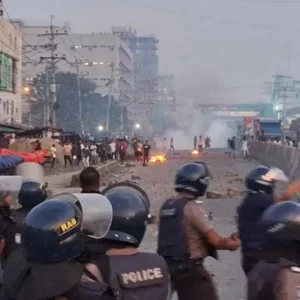
On Sunday morning, workers from various garment factories blocked roads in the Mirpur-10 area. Protests later spread to Mirpur-11, Mirpur-12 and nearby areas. Clashes with police began at around 11.15am. Police used baton charges, teargas, water cannon and sound grenades to control the situation. At one stage a police vehicle was set on fire in Mirpur-11. The Mirpur-10, Mirpur-11 and Pallabi metro rail stations were kept temporarily closed because of the clashes. Traffic returned to normal in the afternoon.
In Ashulia's Nishchintapur area, workers of Al-Muslim, Trouser Line and New Age garment factories began a work stoppage. They later left the factories and took position on the road, and workers from other factories joined the movement. At around noon, clashes occurred when workers took position in front of Ananta Garments in Narsinghapur. At around 3.30pm workers blocked the Dhaka-Aricha highway at Hemayetpur bus stand. Police removed them from the road at around 5pm. Considering the situation, 177 factories in Savar-Ashulia were declared closed.
In Gazipur, workers protested from the morning at Pallibidyut, Harinhati, Mouchak and Konabari and at various points of the Dhaka-Tangail highway. At one stage wood and bamboo were set on fire on the road. Vehicles and businesses were vandalised and a police box and a vehicle were set on fire. Repeated clashes took place with police. Authorities temporarily closed 100 factories in Gazipur for security reasons.
The movement, which began on 31 October, saw road and highway blockades, clashes with police, vandalism and arson at various places. On the first day, work was stopped at about 50 factories in Ashulia and Gazipur and at almost all garment factories in Mirpur. Six police members and several others were injured in clashes in Ashulia. Workers blocked the Dhaka-Tangail highway at Chandra in Gazipur for about three hours.
The demand for a 30,000-taka minimum wage was first raised at a workers' rally in Gazipur at the beginning of October. Implementation by 1 December was demanded, with a warning of a nationwide movement otherwise. Protests began in Uttara on 14 and 15 October. At that time the Directorate of Labour sent letters to owner and worker organisations seeking nominations for wage board representatives.
A recent amendment to the labour law reduced the wage revision period from five years to three years. Worker leaders say rising prices of food, house rent, treatment and transport have made it difficult to live in the city with a family on the current wage.
On 31 October, Labour and Employment Minister Ariful Haq Chowdhury met representatives of BGMEA and BKMEA at Shram Bhaban in Bijoynagar. After the meeting he said the wage board would be formed on Sunday. Payment of workers' arrears and regular payment by the 7th of every month were also discussed.
Following that, on 1 November the Ministry of Labour and Employment formed the six-member minimum wage board through a separate gazette. Justice Sheikh Asfaqur Rahman was made chairman. BGMEA director A B M Shamsuddin was included as an owners' representative. Bangladesh Garments and Industrial Workers Federation general secretary Babul Akhtar became a workers' representative. Dhaka University public administration professor Dr Mosleh Uddin Ahmad was made a neutral member, Bangladesh Employers' Federation joint secretary general Asif Ayub an owners' representative, and Bangladesh Jatiyatabadi Sramik Dal president Anwar Hossain a workers' representative. The board was formed under the 2026 amended provisions of the Bangladesh Labour Act, 2006.
On Sunday night, an emergency meeting to review the situation in the garment industry was held at the Secretariat chaired by Prime Minister Tarique Rahman. After the meeting, Home Minister Salahuddin Ahmed and Labour and Employment Minister Ariful Haq Chowdhury spoke to journalists. The prime minister directed the authorities concerned to protect garment workers' interests, improve their living standards and increase their financial capacity, while keeping production and export activities normal. He also directed law enforcement agencies to take necessary measures to continue factory production and ensure the safety of people's lives and property.
The home minister said the prime minister advised the wage board and asked the labour ministry to take effective steps to ensure workers' interests. The government wants peace, discipline, development and progress. Development of the garment industry, increased export earnings and expanded worker employment are among the government's goals, he said. The path of discussion, not violence, remains open, he said, adding that setting fire to police vehicles, attacks, vandalism of vehicles and arson at factories in the name of movement are in no way acceptable.
Combined Garments Workers Federation president Nazma Akter said the government has done its duty and workers should now return to work. Discussions will be held with the government on behalf of the organisation and the worker representative on the wage board will discuss wages, she said. National Garment Workers Federation president Amirul Haq Amin also said he does not support the movement and called on workers to return to work. On the other hand, Garment Workers Trade Union Centre vice-president Jolly Talukder believes the government's delay pushed workers into an unstable and uncertain situation.
Formation of the board does not by itself mean a wage increase. Owner, worker and neutral representatives must discuss and the board must recommend before a new wage is set. The new wage will then take effect through a formal government decision.