Garment Workers Clash With Police in Mirpur, Three Metro Stations Closed

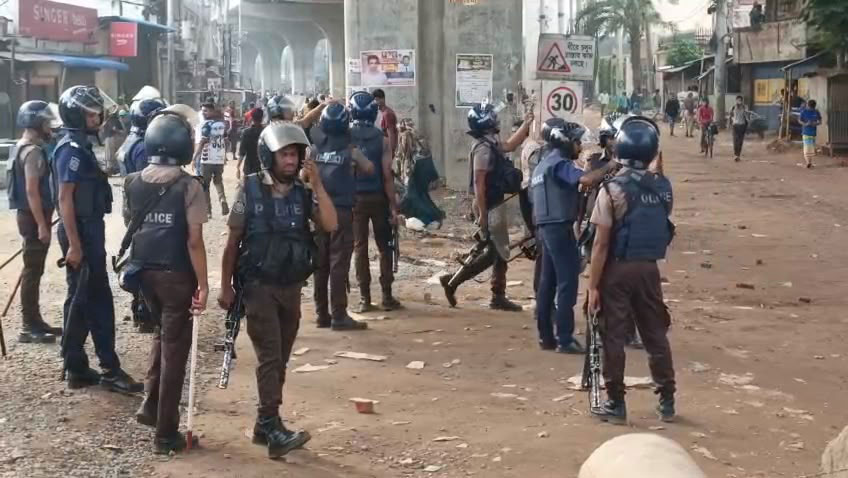
Garment workers demanding a minimum monthly wage of 30,000 taka clashed repeatedly with police in Dhaka's Mirpur on Tuesday morning (November 3), in rounds of chases and counter-chases. Amid the tension, the Mirpur-10, Mirpur-11 and Pallabi metro rail stations were temporarily closed for passenger safety.
Local residents said workers from various garment factories began protesting in the morning by blockading the Mirpur-10 roundabout and nearby roads, while another group took position on the road in the Mirpur-11 area. When police tried to remove the protesters from the streets, chases, counter-chases and brick-throwing began between the two sides.
Police used tear gas and sound grenades to control the situation. At one point, angry workers took position beneath the Mirpur-11 metro station. Media reports noted the wage protest had entered its fourth consecutive day.
The Dhaka Mass Transit Company Limited (DMTCL) authorities temporarily closed the Mirpur-10, Mirpur-11 and Pallabi stations. Trains continued to run on the Uttara-Motijheel route but did not stop at those three stations. The MRT Police control room confirmed the suspension of Mirpur-11 station, saying commercial operations were paused for the overall safety of passengers and the station after the situation turned violent, and that the station would reopen once the situation is under control.
With garment workers occupying the roads in Mirpur, traffic movement came to a near standstill and passengers fell into suffering. Police were trying to remove the protesting workers and restore normal traffic.
The workers' demand is to raise the current minimum wage from 12,500 taka to 30,000 taka — more than double the present rate. For the past few days, workers in industrial areas including Mirpur, Gazipur and Narayanganj have stopped work and protested for this demand.
Earlier on Sunday, police fired tear gas and stun grenades to disperse a protest in the Jamgora area of the Ashulia industrial belt on Dhaka's outskirts and arrested dozens of workers. The Bangladesh Garment Manufacturers and Exporters Association (BGMEA) said Sunday's demonstrations disrupted operations at 529 factories and affected nearly a million workers. The same day, the government announced the formation of a six-member wage board to review the workers' demands.
On Monday, despite the wage board's formation, workers returned to the streets for a third straight day. That day workers blockaded the Dhaka-Tangail highway in Gazipur, several vehicles were vandalised and torched, and clashes with police were also reported from the neighbouring Mirpur district.
One of the protesting workers is Laili Begum, 37, an experienced sewing operator at Virtual Bottoms Limited, a factory near Dhaka. She earns around 15,000 taka a month, which sometimes rises to 18,000–20,000 taka with overtime. Unable to run her family on this income, she had to take her 15-year-old daughter and 12-year-old son out of school earlier this year. She said there are days when the family barely manages one proper meal; one morning they had only puffed rice and a dry snack, with nothing for lunch.
Laili Begum lives with her mother and two children in a single room rented for 3,500 taka a month. Her father, in their village in Sirajganj district, also depends on her income. Unable to afford a gas cylinder costing about 2,200 taka, she cooks by burning discarded paper and other materials. In her words, the government only makes promises and has not said when wages will rise or by how much. She said wages must rise, but food prices must also come down.
Rasel Khan, 30, a garment worker in Ashulia, earns 18,000–20,000 taka a month including overtime, which he said is no longer enough to support his family — his mother, younger brother, wife and child. As living costs soared, he has accumulated debt of about 100,000 taka to meet his needs; in his words, prices keep rising and the family has to borrow money just to survive.
On the government's side, Prime Minister Tarique Rahman convened an emergency meeting of top officials on Sunday. On Monday, Home Minister Salahuddin Ahmed met garment factory owners and assured them a new minimum wage would be fixed through negotiations. Labour Minister Ariful Haque Choudhury urged the workers to resume work, saying the wage board would begin its deliberations shortly.
Babul Akhter, a workers' representative on the wage board, demanded that the new wages take effect with January 2027 salaries. Alongside calling on demonstrators to return to work, he demanded the release of arrested workers and the withdrawal of cases against them.
The last revision of the minimum wage in the garment sector took place in December 2023. Labour laws were then amended to cut the wage review cycle from five years to three years, and the current three-year period ends in December. Official data put annual inflation at 8.34 percent in September — 7.22 percent for food and 9.30 percent for non-food items.
Zahid Hussain, former lead economist at the World Bank's Dhaka office, said persistent inflation over the past five years has sharply eroded the purchasing power of low-paid workers; when real income falls, they have to cut their daily living standards because they have no surplus income. He said the question is not whether wages should be adjusted, but by how much, and that immediate negotiations involving workers, employers and the government are needed.
About four million garment factory workers work in Bangladesh, half of them women. Bangladesh is the world's second-largest apparel exporter after China, and the sector accounts for more than 80 percent of export earnings, which touched $39 billion last financial year. By comparison, Cambodia's minimum wage for garment workers is $210 a month, Vietnam's ranges from $140 to $210, and wages in China's Guangdong manufacturing hub range between $286 and $378.
Sheikh Hossain Muhammad Mustafiz, a BGMEA official and managing director of Cute Dress Industry Ltd, said workers deserve wages that support a decent standard of living, but without fair purchasing prices from international brands, significant wage increases could pressure factories and threaten employment. In his view, sustainable wage growth cannot be achieved by manufacturers alone — international brands must also contribute through fair pricing and responsible purchasing practices.