Legal action against those inciting garment worker unrest: home minister; 12 BGB platoons in Gazipur-Narayanganj, 40 arrested

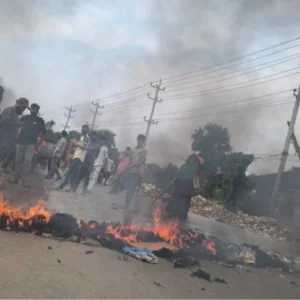
Fresh tension has spread across industrial areas over unrest among garment workers. On Tuesday, garment workers clashed with police in Dhaka's Mirpur, where Jubo Dal and Chhatra Dal also took to the field 'to prevent sabotage'. In Gazipur, police personnel were chased by workers and ran into a police station.
Twelve platoons of BGB have been deployed in Gazipur and Narayanganj in response to the worker unrest.
The DIG of Dhaka Range has said outsiders are instigating the worker movement. Forty people have been arrested in connection with the unrest.
Meanwhile, Home Minister Salahuddin Ahmed has warned that any attempt to create disorder or instability in the garment industry for political gain will be resisted firmly and met with legal action. He gave the warning while answering reporters' questions on Tuesday after an inter-ministerial meeting on shrimp mahal management at the Land Ministry's conference room in the Secretariat. Referring to the recent protests by workers in industrial areas, he said the government would take legal action if anyone carried out provocative activities to shut down garment factories.
The home minister said some quarters were inciting garment workers for political purposes in an attempt to close factories. Legal action will be taken against those involved in such activities, he said.
Asked about workers blocking roads while keeping production suspended, he said arrangements would be made to reopen the factories very soon. Noting that some miscreants were trying to carry out attacks, he said the workers' demands had been met, a wage board had been formed, and the workers were satisfied.
Referring to discussions with worker leaders and factory owners in the garment and knitwear sector, the minister said both sides were in agreement on the current situation. The work of the newly formed minimum wage board has already begun in full swing, he said, and the necessary bargaining between the two sides will take place there. He added that the government has also requested the board to set the minimum wage in a way that considers improvements to workers' living standards.
Salahuddin Ahmed said that in the current context there was no logical scope for fresh disorder or unrest in industrial areas, and that these incidents were being carried out for political purposes. He claimed that some quarters linked to the defeated fascist forces were plotting to create this instability to serve narrow political interests, and said the government would suppress it with a firm hand.
Separately, Dr Jahed Ur Rahman, the prime minister's adviser on information and broadcasting, expressed concern that there could be a conspiracy to create an unstable environment in the country by exploiting the unrest in the garment sector. He made the remarks while answering reporters' questions at a regular press briefing on the overall progress of government activities, held at the Press Information Department's conference room in the Secretariat on Tuesday noon.
The adviser said such subversive activities were not limited to the coming December; he commented that such conspiracies could continue for as long as ousted former prime minister Sheikh Hasina is alive. But he expressed determination that the government would resist these attempts at any cost.
Noting that the government was treating very seriously the rise in workers' daily living costs due to inflation and fuel price hikes, the adviser said wages are usually reviewed every five years, but considering the workers' real crisis, the government has formed a new wage board ahead of schedule. As a result, he said, the path to a positive resolution of the movement's main demand has opened.
Claiming, however, that the violent form seen on the streets could in no way be the behaviour of ordinary working people, he said that according to investigations by agencies under the home ministry, instigation from across the border lay behind this anarchy. He also commented that the Awami League no longer had the capacity to do anything by taking to the field as an active political force, but said plots were under way to create sabotage in different parts of the country using the huge amount of money the party has accumulated.
On the strategy of law-enforcement agencies in controlling the movement, the adviser made clear that the government does not want to handle the situation through force or repression as in the past. Noting that the young people on the streets are also citizens of the country, he said the administration was moving towards a solution based on intelligence, keeping public suffering and damage as limited as possible. He added that, breaking completely with the past practice of using lethal weapons to suppress movements during the Awami League government's tenure, the police have been given strict instructions to apply minimum force, in accordance with the law and the scale of any confrontation.