Clashes Again on Tuesday in the Tk 30,000 Wage Movement, 306 Factories Closed; BGMEA Meets in Uttara
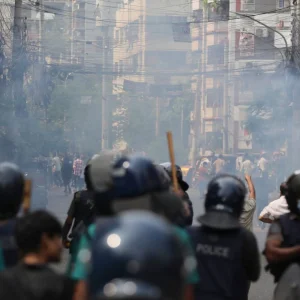
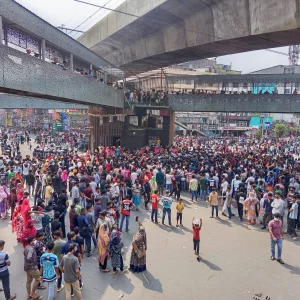
The garment workers' movement demanding a minimum wage of Tk 30,000 did not stop on Tuesday (November 3) either. In various areas of Mirpur in the capital, Gazipur, Savar-Ashulia and Narayanganj, there were repeated clashes, chases and counter-chases and road blockades between workers and police. In some places police used tear gas shells and sound grenades to bring the situation under control. More than a hundred people, including police and workers, were reported injured in these incidents.
According to BGMEA, on Monday (November 2), 679 garment factories in the country's three main industrial areas were closed. The 1,680,572 workers employed in these factories returned home without working. By 11 am on Tuesday, production was stopped at another 306 factories; about seven hundred thousand workers are employed in these factories.
By 11 am on Tuesday, production was closed at 161 factories in the Gazipur and Mymensingh region. In Savar, Ashulia and Jirani areas 93 factories were closed, and in Mirpur in the capital 52 factories. Of BGMEA's 2,134 member factories, 1,828 were running at that time.
Garment industry entrepreneurs are worried over the worker unrest, work stoppages and vandalism at factories. On Tuesday afternoon, current and former leaders along with several top entrepreneurs met at the BGMEA office in Uttara in the capital on whether production can be kept running if the situation does not normalise. Related sources said factory security, continuing production and even a hard decision like closing factories if needed were discussed at the meeting. The meeting's decisions were supposed to be announced at a press conference in the evening, but that did not happen.
Earlier, at BGMEA's emergency meeting on Sunday (November 1), closing factories indefinitely if workers did not return to work was discussed. Several entrepreneurs were in favour of keeping factories closed from Monday, but most owners were in favour of continuing production.
Under section 13(1) of the Bangladesh Labour Act, 2006, if a factory's normal activities are disrupted because of an illegal strike, the owners can keep the establishment or a part of it closed; in that case there is a provision not to pay the concerned workers wages for the closed period. The application of this section — closing factories on a 'no work, no pay' basis — is also getting importance in the owners' discussions.
BGMEA President Mahmud Hasan Khan had earlier said they hope workers will return to work peacefully after the wage board is formed. But if vandalism and chaos continue in the name of movement, it will have to be considered as having a different motive.
In the face of the workers' movement, the government formed a new six-member minimum wage board last Sunday (November 1). Senior District and Sessions Judge Sheikh Ashfaqur Rahman, chairman of the Minimum Wage Board, has been made chairman of the board. ABM Shamsuddin and Babul Akhtar have been given responsibility as representatives of the owners and workers respectively. The board also has Asif Ayub and Anwar Hossain as permanent members and University of Dhaka Professor Mosleh Uddin Ahmed as the neutral member.
But as no date for the first meeting has been fixed even after the board was formed, discontent remains among workers. The board's chairman has said preparations are under way to hold a meeting quickly and that it will not take a long time like the previous occasion. Babul Akhtar, the workers' representative on the wage board, has also called for a quick meeting to advance the wage-fixing process. He expects that if the work is finished quickly and a new wage structure can be fixed by December, workers can get the new pay from next January.
Former BGMEA director Mohiuddin Rubel said he has no information so far of non-cooperation by the owners on wages. The owners have agreed with the workers on re-fixing wages within three years instead of five years, as per the law. He said this will create financial pressure on the owners, but they are in a position to accept it. However, vandalism and arson can in no way be part of a normal movement.
Shoeb Islam, a worker who took part in the movement in Mirpur, said the movement will continue until their demands are met. Denying allegations of sabotage, he said workers are moving for their fair demands. If any worker is unjustly arrested or harassed, they will protest that too. Another woman worker named Shefali Begum said they can no longer be sent back to work with assurances alone; a wage increase must be announced and workers unjustly detained in the movement must be released.
The workers allege that with the current pay it has become difficult to run a household coping with the increased prices of essentials. Many are falling into debt meeting house rent, food, treatment and children's education costs. That is why they are demanding a minimum wage of Tk 30,000. They say forming a wage board alone is not the solution to their demands; they want a quick announcement of a new pay structure and a specific timeframe for its implementation.
Police and a section of worker leaders have alleged infiltration by outsiders and political instigation in the workers' movement. Dhaka Range DIG Md Mostafizur Rahman said 40 people have been arrested on allegations of creating chaos in various areas; he claims none of those arrested are garment workers. Dhaka District Police Superintendent Shamima Parveen has also alleged that a group wearing burqas and helmets is inciting workers; police are working to identify their financiers. But no specific proof in support of these allegations has been published.
Nazma Akter, president of the Sammilito Garments Sramik Federation, said the workers' demand for a wage increase is justified. But vandalism, arson and looting can in no way be a solution; one party is trying to take advantage of the movement. She called on workers to remain calm and return to work. Taslima Akter, chief of Bangladesh Garments Sramik Sanghati, also said the government has formed a wage board, so workers should remain calm and return to work; at the same time she emphasised finishing the wage-fixing process quickly.
Meanwhile, because of road blockades in various areas of Gazipur, Savar and Narayanganj, traffic on the Dhaka-Tangail, Dhaka-Mymensingh, Dhaka-Aricha and Dhaka-Narayanganj link roads has been disrupted. Passenger buses and goods vehicles had to remain stuck for hours.