
Exports worth Tk 850 crore disrupted in two days: how much damage faces the garment industry from the workers' movement
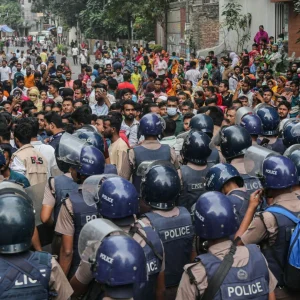
The country's readymade garment industry faces major losses from the continuing movement by garment workers demanding a minimum wage of Tk 30,000. Hundreds of factories have had to stay closed amid days of protests, work stoppages, road blockades and clashes. Export activity worth hundreds of crores of taka has been disrupted. Factories, vehicles and various establishments have also been vandalised and set on fire. However, the amount of direct damage to assets in these incidents has not yet been assessed.
According to the BGMEA, the garment factory owners' organisation, production was stopped at 529 factories on November 1 because of the movement. Export activity worth about 30 million dollars was disrupted, equivalent to about Tk 373 crore. The next day, November 2, production was stopped at 690 factories in Dhaka and nearby industrial areas, disrupting a further 40 million dollars of export activity. Over the two consecutive days, export activity worth about 70 million dollars, or Tk 850 crore, was affected in total.
Separately, the BGMEA said the movement in Gazipur over the past six days caused financial losses of about Tk 850 crore. However, part of that figure may cover the same period as the earlier two-day export disruption figure. Adding the two figures together would therefore not give a correct total loss.
With production stopped, uncertainty has also arisen over shipping goods on time, alongside the immediate disruption to export activity. If products cannot be delivered on schedule, it will be difficult to meet obligations to foreign buyers. If goods have to be sent by air, transport costs could rise several times over. Concern has also arisen over international buyers' confidence and future orders.
BGMEA vice-president (finance) Md Mizanur Rahman said that although workers came to factories in the morning, production could not be run at many establishments as they joined the movement. Export activity worth about 40 million dollars was disrupted. Vandalism and arson also took place at several factories. However, the amount of direct damage to assets has not yet been determined.
Meanwhile, worker protests and road blockades continued in various areas of Gazipur on November 3 as well. According to the Industrial Police, holidays were declared at another 55 factories in different areas that day. The previous day, Monday, 150 factories were reported closed. Keeping production stopped for security reasons has increased the factories' financial pressure further.
During the movement, alongside production stoppages, factories, vehicles and establishments in various industrial areas were attacked and vandalised. A police box was set on fire in the Konabari area of Gazipur. Vehicles were vandalised and set on fire at various places. A bank was reported vandalised in the Palli Bidyut area. A Mondol Group factory in the Palli Bidyut area of Kaliakair was set on fire. A fire was also reported at the waste warehouse of Tropical Knitex Limited in the Chandra area.
Police stations reported at least 15 vehicles vandalised in Gazipur. Several people, including police, journalists and workers, were injured in these incidents. Several police vehicles were also set on fire.
The situation was tense in the capital's Mirpur as well. Workers protested and clashed with police at various places including Mirpur-10, 11, 12 and 14. A police vehicle was set on fire in the Mirpur-11 area. Because of the situation, trains temporarily stopped halting at Mirpur-10, Mirpur-11 and Pallabi metro rail stations. Ordinary passengers suffered as a result.
Even when factories are closed, entrepreneurs have to bear various operating costs, including electricity, gas, machinery maintenance and administrative expenses. Every day of stopped production therefore creates additional financial pressure. Sparrow Group managing director Shovon Islam said production had to be stopped at two of his company's factories because of the workers' movement. Running the two factories, which have 45 production lines, costs about 90,000 dollars a day. That cost has to be borne whether the factories are open or closed.
Shovon Islam said that with the production schedule disrupted, delivering products to buyers on time has also become difficult. To deliver goods on time, the production shortfall may later have to be made up by working overtime. That will raise production costs further.
Industry entrepreneurs say timely delivery of products is extremely important in the garment industry. If goods cannot be shipped on schedule, a company's image with foreign buyers is damaged. In some cases buyers may decide to source products from alternative countries. That puts not only current exports but also future orders at risk. November to February in particular is an important period for international buyers' garment orders and deliveries. If production is disrupted during this time, there are fears of a negative impact on Bangladesh's export competitiveness.
BKMEA executive president Fazlee Shamim Ehsan said the country's garment industry is already under pressure from various domestic and international crises. On top of that, production being disrupted by violence puts employment at risk. Alongside damage to the country's image, there are fears that international buyers' confidence will also weaken.
Although the financial loss figures from the movement are mainly calculated around production and export activity, the impact has also fallen on workers, the transport sector, small traders and ordinary people. When factories are closed, uncertainty arises over workers' regular income and employment. Shops, food hotels, transport and other service businesses around factories are also harmed. Because of blockades on important roads including the Dhaka-Tangail and Dhaka-Aricha highways, traffic stays stopped for hours. Passengers, transport workers and goods vehicles suffer as a result.
Amid the movement that began with the demand to raise workers' minimum wage from Tk 12,500 to Tk 30,000, the government has formed a six-member wage board. The new wage structure is due to take effect from December 1. However, protests and clashes continued in various industrial areas even after the board was formed.
On Wednesday, the first meeting of the board formed for the readymade garment industry was held at the Minimum Wage Board office in the capital's Segunbagicha. After the meeting, board chairman Syed Azad Subhani said the second meeting will be held next week. There, the owners' and workers' sides will submit their wage proposals in writing. A neutral member will also give a proposal. Efforts will be made to finalise the recommendation quickly after reviewing these proposals.
The board's worker representative and Bangladesh Garments and Industrial Workers Federation general secretary Babul Akhtar said there was consensus with the owners' representative on setting the new wage structure by December and paying salaries at the new rate from January. Owners' representative and BGMEA director ABM Shamsuddin also agreed to complete the wage revision work within the set time. However, the amount of the new wage has not yet been determined. Uncertainty therefore remains over how far the workers' main demand will be met.
Meanwhile, the government and the owners have taken various initiatives to keep factories running and ensure workers' safety. Dhaka Range Deputy Inspector General (DIG) Mustafizur Rahman said those who want to work in factories will be given security at their workplaces, homes and on their way to and from work. However, if anyone tries to create disorder in the name of the movement, action will be taken according to the law.


