India Wants to Run Freight Trains Inside Bangladesh; Dhaka Sets Liability Condition
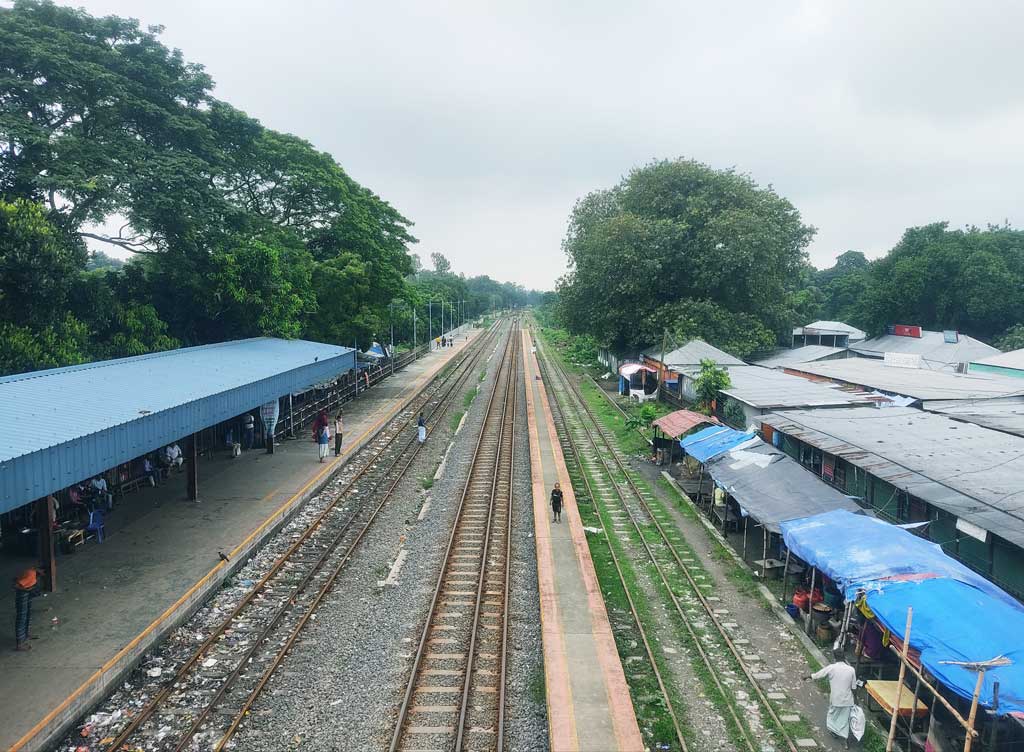
Neighbouring India wants the opportunity to carry goods on its own private container trains inside Bangladesh, using Bangladeshi rail lines. To that end, it has sought permission for its private container train operators to run businesses in Bangladesh. India has also proposed round-the-clock freight trains on three cross-border routes, greater capacity for receiving trains, and direct booking for freight. Bangladesh, for its part, has said that if any Indian private company operates trains on this country's lines, Indian Railways must take full responsibility and liability for it.
The two sides' positions emerged in the minutes of the 38th Inter-Governmental Railway Meeting (IGRM) between Bangladesh and India, held in Dhaka from 8 to 10 September. The minutes, signed by the heads of the two delegations, reached the newspaper Ajker Patrika through railway ministry sources. They show that Bangladesh has asked India to submit formal proposals and technical information so that several proposals can be examined, and in some areas has stated its position in favour of keeping the current arrangements.
At present, India's government and private container trains bring containers up to the Indian side opposite the Benapole border. Once the containers enter Bangladesh, they are taken by local trailer trucks to ICDs or other destinations. According to the minutes, Indian authorities want their private container train operators (CTOs) to be allowed to enter Bangladesh directly and travel to the relevant destinations.
In reply, the Bangladesh side restated the position it had given at the 37th IGRM in New Delhi in January 2025: if any Indian private container train operator is permitted to operate trains in Bangladesh, the Indian government railway authority must bear the entire responsibility and liability. Bangladesh said the matter could be discussed in an appropriate forum.
At the meeting, the Indian side requested freight trains around the clock, instead of from sunrise to sunset, on the Darshana-Gede, Petrapole-Benapole and Rohanpur-Singhabad routes. Bangladesh said freight movement on these routes had declined over the past two years but is now rising again, and steps could be taken considering the volume of cross-border trade.
India also pressed Bangladesh to speed up train reception on the Rohanpur-Singhabad route, complaining that slow reception leaves Indian Railways' wagons and engines stuck for long periods. Bangladesh replied that 57 rakes were received through five interchange points in August 2026, and that receiving more rakes on the Rohanpur-Singhabad route is difficult because of engine, manpower and line constraints. As an alternative, Bangladesh proposed running more rakes through other interchange points.
India further requested greater capacity at freight loading and unloading stations in the western region. Bangladesh said steps have been taken to increase the 'clear standing length' at 12 freight unloading stations, and capacity work is under way at Sirajganj Bazar, Ibrahimabad, Nawapara, Faridpur and Ullapara stations. Steps have also been taken to coordinate yard capacity and manpower to bring the turnaround time of Indian wagons below five days.
To reduce congestion at the border, direct booking from Indian Railways' freight stations to Bangladesh's freight stations has also been proposed. Bangladesh said introducing this system would require amending the basic and supplementary rules governing rail traffic exchange between the two countries, and that limited wagon-receiving capacity at domestic stations could add further pressure. It therefore favoured keeping the current re-booking system for now.
India proposed raising the authorised carrying capacity of BCN and BCNA wagons to 63 and 66 tonnes respectively. Bangladesh said not all rail lines, bridges and culverts in the western region can bear such heavy loads, though a formal proposal for a specific route could be examined.
India also sought acceptance of full-length 45-wagon trains at Benapole for container operations, a review of freight charges, and permission for open-top containers. Bangladesh said full-length trains can be received at Benapole, but there is no equipment for unloading goods from open-top containers. On customs facilities at four stations including Jashore, Bangladesh disagreed in Jashore's case and spoke of a feasibility study for Nawapara. The proposal to carry goods from Kamalapur ICD to India will be considered after the new ICD at Dhirasram opens.
The meeting also discussed the possibility of freight trains from Chattogram port to Nischintapur near Agartala, capital of India's Tripura state, and a passenger train from Dhaka to Nischintapur, to increase rail connectivity between the two countries. Bangladesh asked India to send a demand forecast for import-export freight and a formal proposal.
Bangladesh blamed the slow progress of the Kulaura-Shahbazpur rail link project on the Indian contractor's financial crisis, shortage of construction materials and cost complications. India, meanwhile, requested payment of 45 crore taka in VAT owed to the contractor. On a request for quick supply of construction materials for the Dhaka-Tongi-Joydebpur project, India gave assurances.
There are also discrepancies in the accounts of wagon-use dues between the two railways. India claims its dues stood at 390 crore 99 lakh rupees in June 2026, while Bangladesh's calculation puts the net dues to Indian Railways at 213 crore 84 lakh taka. There are dues in passenger train accounts as well. Bangladesh said steps have been taken to pay India 50 crore taka, and the two sides agreed to update accounts regularly and reconcile the dues.
India made several proposals on passenger trains too: end-to-end customs and immigration services on the Bandhan Express, and running the Maitree Express over the Padma Bridge. Bangladesh said a decision on the Bandhan Express would follow a review of passenger demand and ground realities, and India was asked to submit a formal proposal through diplomatic channels for the Maitree Express over the Padma Bridge. Bangladesh proposed attaching luggage vans or VPUs to passenger trains for parcel transport; India agreed in principle but asked for a formal proposal.
Bangladesh placed no proposal at the meeting to restart three important and popular passenger trains that remain suspended. Asked about this, Md Ziaul Haque, additional secretary of the railway ministry who led the Bangladesh delegation, told Ajker Patrika: 'That is the government's decision. We discussed the matters that were on the table from Bangladesh's side.' The meeting also covered railway electrification, updating rules, station development and training. The next inter-governmental railway meeting is scheduled to be held in India in September 2027.
BUET professor and transport expert Shamsul Hoque said: 'Political disputes and economic interests must be viewed separately. Whatever is profitable in the country's interest should get priority in international discussions. But because of a lack of specialised knowledge and research in the ministries, it is becoming difficult to take effective decisions and bargain in the country's interest.'