Austagram-Bajitpur submersible road: potholes in the repaired stretches, suffering for thousands across three upazilas
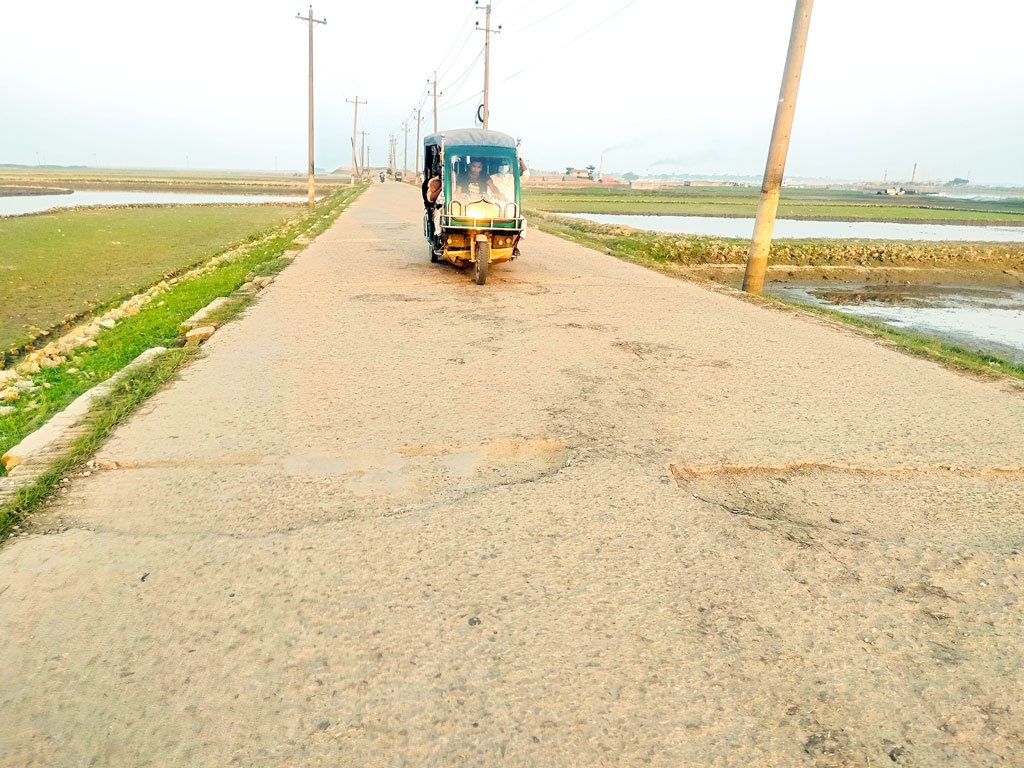
The Austagram-Bajitpur submersible road, the first road link between the haor-surrounded Austagram upazila and the Kishoreganj district town, has itself become a source of suffering. On this road, opened in 2014, the concrete and cement have worn away precisely in the stretches that were repaired, creating several hundred potholes. Vehicles now travel daily over these broken stretches at risk, and thousands of people across three upazilas are suffering.
The 17-kilometre submersible road, including three bridges, was built between 2011 and 2014 under the Kishoreganj office of the Roads and Highways Department at an allocation of Tk 126 crore. During the monsoon the road goes under water, and when the water recedes in the dry season road communication resumes — which is why it is called a submersible road, or 'dubo sorok' in Bangla.
This road is the main and fastest route for several hundred thousand people of three haor upazilas — Austagram, Itna and Mithamain — travelling to Dhaka, Chattogram, Bhairab and other urban areas. Every day several thousand people, including patients, travel this route, and goods for the hats and bazaars of the three upazilas are transported along it.
Within just three years of construction, about nine kilometres of the road had to be repaired. Local residents allege that the repair was done with a cement-concrete casting only one to one-and-a-half inches thick over the RCC casting. Now the stones, concrete and sand of that casting are coming loose and forming potholes, and the repaired stretches have been breaking down for two years.
A visit to the spot found potholes at various points from Bahadurpur in Austagram upazila to the eastern end of the Karanal bridge, and from the five-road junction at Humayunpur to Humayunpur Mor in Bajitpur upazila. Vehicles are forced to slow down on the broken road, and the jolting has increased the suffering of drivers and passengers.
Enquiries found that the work order for building the 17-kilometre road was awarded to the contractor SEL, MBEL and JI Joint Venture Limited, but the project was implemented from 2011 to 2014 by Dhaka-based Spectra Engineers Limited.
Hafiz Mia once drove an autorickshaw on this road every day. He says he does not bring his vehicle onto this route unless he is forced to. The jolts damage the vehicle's battery more often, its joints come apart frequently, and the journey takes longer. His demand is that either the road be repaired, or the upper cement-concrete casting be removed — that would make the road somewhat level and allow peaceful travel.
Anwar Khatun, returning home to Austagram after receiving treatment in Bhairab, says that sitting in an autorickshaw on this road increases her back pain because of the jolts, and her whole body aches. She says that if this road is not fixed, it will become difficult for them to travel at all.
Sources at the Kishoreganj Roads and Highways office said the road construction project's tenure ran until 2018. After the road was damaged, the building firm itself repaired it; since then the department has not implemented any repair project on it.
Austagram Upazila Nirbahi Officer (UNO) Sathi Das said the relevant department has been informed about repairing the submersible road, and she hopes they will take the necessary steps.
Shakil Mohammad Faisal, executive engineer of the Roads and Highways Department's Kishoreganj office, said that as far as he knows no separate repair project has been implemented on this road; probably the contractor itself carried out the repairs. He said he has learned of people's suffering due to the potholes. Officials will be sent for an on-the-spot inspection, and if the road can at least be made fit for vehicle movement through temporary repairs, that will be done quickly; otherwise, necessary steps will be taken following the advice of senior officials, he said.