Despite redrawn maps, Black voter surge in the South powered Democratic wins in Alabama, Texas and Florida
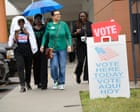
Black voter turnout surged across US southern states where Republicans were accused of redrawing electoral maps to diminish Black political power. Democrats flipped or held seats in Alabama, Texas and Florida with the support of this voting bloc.
Ashley K. Shelton, CEO and president of the Power Coalition for Equality and Justice in Louisiana, said the redistricting drive 'blew up' in Republican lawmakers' faces. In her words, there is nowhere to go but up from there.
Shelton added that voters overcame unbelievable voter suppression across the country, and in particular in the south, to make sure they were able to cast their vote and have their voice heard. She said the fight to protect representation must continue.
The situation began in April, when the supreme court effectively gutted a major section of the Voting Rights Act (VRA) in the Louisiana v Callais decision. It rendered ineffective the last remaining powerful provision of the 1965 civil rights law that prevents racial discrimination in voting.
Even before Callais, Republican lawmakers in Texas, following directives from Trump, had redrawn maps in an attempt to consolidate their party's political power. With the supreme court decision, multiple southern states, including Alabama, Tennessee and Louisiana, did the same, redrawing majority-Black districts.
Voters and voting rights groups across the south were incensed, both by the supreme court decision and by the actions of Republican lawmakers, leading to protests across the region, including All Roads Lead to the South in Alabama, which drew thousands of people from across the country.
Tuesday's midterm elections provided the first opportunity to see the impact of redistricting efforts on voters.
Ashley England-Albright, co-founder and legal director of Black Voters Matter, said there is a direct correlation between the Callais decision, the behavior of these state assemblies, and Black voters turning out during the primary, and then the results seen on Tuesday.
In 2024, Black voters in Alabama celebrated when Shomari Figures, who is Black, was elected as the first congressman in the state's then-newly drawn, majority-Black second congressional district. The district includes most of the state capital of Montgomery.
But after Callais, Alabama swiftly reinstated an old map that reverted Figures's district to one that a court previously found diminished the influence of Black voters in the state's Black belt. Still, facing a tougher election contest after his district was redrawn to be more favorable to Republicans, Figures, a Democrat, won by nearly eight points on Tuesday.
Majority-Black counties in Alabama, like elsewhere in the south, had distinctively high turnout this election. Voter turnout increased on average by 65 percent across the state, from 28 percent in 2022 to 44 percent in 2026. Black-majority turnout in Figures's district increased by 81 percent. The three counties with the highest voter turnouts in the district were Black-majority.
Nadine Smith, president and CEO of Color of Change, said this administration has spent two years rolling back the protections that give people access to the ballot, while simultaneously flooding them with propaganda telling them that voting does not matter. But Black voters showed up anyway. Even in early voting, the surge was visible.
A study from July that analyzed voter turnout in the south during the primaries indicated that Callais, even then, was spurring increased participation from Black voters. Alabama's Greene County surpassed 50 percent turnout in the primary election. Bullock, Lowndes, Macon and Montgomery counties also experienced significant turnout. Bullock County, which is more than 70 percent Black, had the third-largest turnout in the state.
In Louisiana, which triggered the Callais decision, Black voters made up 35.7 percent of the primary electorate during the primaries, despite making up only 32.1 percent of the population. Louisiana maintained increased Black voter turnout through to this week's midterms, when more Black voters cast early ballots than in any other midterm or gubernatorial election in the past decade.
Sarah Whittington, advocacy director of the American Civil Liberties Union (ACLU) of Louisiana, said the turnout and the exit polling they were hearing from partners and the boots on the ground was that folks were not going to allow the court decision to undermine the power and the authority they had with their votes.
Organizers in the south have been working for decades to mobilize voters. Five months prior to the VRA being signed, about 600 people who marched in support of voting rights on the Edmund Pettus Bridge in Alabama were brutally attacked by law enforcement officers, who confronted them with teargas, billy clubs and other weapons. 'Bloody Sunday,' as the march is remembered, was a turning point in the civil rights movement.
Smith said the lesson of the south is the power in community, in connecting with each other. HBCU students were seen marching to the polls. In her words: 'I vote not simply about the candidates in front of me. I vote as an expression of my love for my community, for my people, for my family.'