US carries out new limited strikes on Iran as Trump claims progress in talks
The United States military carried out new limited airstrikes in southern Iran on Friday night, further raising fears across the Middle East and among Gulf states of a resumption of all-out war, but Qatar and the US insisted that negotiations for a diplomatic settlement are continuing.
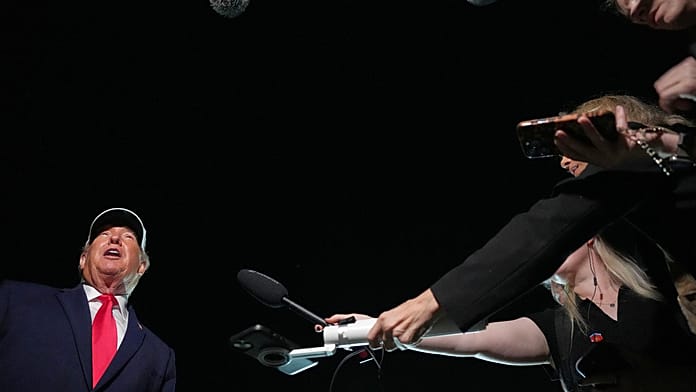
US President Donald Trump told the media on Friday evening that a "minor" military action targeted Iranian air defence systems on Qeshm Island. "They built a little bit of an anti-aircraft device and we knocked it out in about 15 minutes, maybe five," Trump said.
Trump insisted that "we are not fighting" and made it clear that in parallel with the "minor strike", the US has made "a lot of progress with Iran". "We're dealing with them now. They want to make a deal," he said.
Iranian state-run media reported that two missiles hit the Suza area of Qeshm Island without identifying the targets or the damage, while locals went on social media reporting the explosions. Earlier on Friday, the Iranian Revolutionary Guard (IRGC) claimed that it shot down a US military drone over southern Iran, but the US did not confirm the claim.
It was the first strike since the Democrats' big midterm election win, a result that officials and analysts have linked to voters' opposition to Trump's decision to go to war with Iran. The attack followed another series of what the US military called defensive strikes on Monday, when explosions were heard on the islands of Qeshm and Hengam in the Strait of Hormuz and in the nearby mainland area of Bandar Abbas.
In an earlier speech in Florida on Friday, Trump appeared to defend his Iran war decision by stating that "if I allowed Iran to have a nuclear weapon, today there would be no Israel," and that "Israel would have been wiped off the face of the Earth."
Qatar rushed to deny conflicting reports circulating on Friday night about the purported collapse of the negotiations, insisting in a statement that "Qatari mediators remain in close coordination with the United States and Iran to support ongoing negotiations."
Earlier on Friday, two Middle East government officials told AP that Iran was reviewing proposals presented by Qatar aimed at addressing differences with the US about Tehran's nuclear programme. But one of the officials stressed that the Iranians, at least at the moment, remain unwilling to engage in negotiations with the Trump administration over their atomic activities until the US agrees to several core conditions that Iran has been demanding be part of any ceasefire agreement.
Among the core demands Iran says must be met before engaging in nuclear talks are the ending of the US military blockade on Iran's ports, lifting sanctions, unfreezing its assets, issuing compensation for war damage and ending hostilities throughout the region, including Israeli military operations in Lebanon.
Meanwhile, a flurry of diplomatic phone calls between leaders in the Gulf and beyond indicates intense efforts to prevent the resumption of an all-out war. Trump called Qatar's Emir Sheikh Tamim bin Hamad Al-Thani on Friday night to discuss the ongoing diplomatic efforts aimed at de-escalating tensions in the region and paving the road for reaching a comprehensive agreement that resolves the crisis and ensures security and stability in the region, according to Qatar's national news agency. Also on Friday, US Secretary of Defence Pete Hegseth spoke with his Qatari counterpart, Sheikh Saoud bin Abdulrahman Al Thani, according to the Qatari government.
In parallel, Qatar's Prime Minister and Minister of Foreign Affairs Sheikh Mohammed bin Abdulrahman bin Jassim Al Thani told an Oxford University event on Friday that "for the past couple of weeks, we have worked with colleagues in the US administration who have very genuine intentions to find a way to contain the situation and de-escalate it," as this crisis "cannot be left unresolved". He insisted that the ongoing negotiations aim "to prevent the situation from spiralling out of control," and that "thanks also to some wise voices in Tehran, we have prevented that from getting out of control."
"We will never have a perfect peace deal, but we cannot just wait for this moment of a perfect deal and avoid having a good deal," Qatar's prime minister said. "Our engagement did not stop and will not stop."
Meanwhile, Iranian Foreign Minister Abbas Araghchi said he also held phone calls with no less than 12 foreign ministers over the last two days to explain Iran's "fundamental positions". In an Instagram post, Araghchi called for "regional security arrangements without the interference of superregional powers". Iran's military continued its threatening rhetoric on Saturday, with army spokesman Brigadier General Mohammad Akraminia warning that "we will never allow the enemy's bases in the region to be rebuilt," Iran's Fars news agency reported.
Former head of Israel's military intelligence research department and Iran specialist Danny Citrinowicz said in a post on X that "Tehran is not intimidated by the prospect of another confrontation with the United States and Israel." "If attacked, Iran is likely to seek to expand the war from the outset, targeting Gulf states it views as a vulnerable pressure point against Washington," he said. "Tehran is also improving its missile capabilities and preparing its regional partners, including Hezbollah, the Houthis, and Iraqi Shiite militias, for possible involvement." In his words, "The central danger is that Washington may envision another short military operation, while Tehran is preparing for a much broader and potentially prolonged regional war."