'If newcomers keep claiming July 24 as theirs alone, they will remain newcomers': Home Minister

Home Minister Salahuddin Ahmed has said that if anyone treats the July 24 movement as their sole achievement or claim, its benefits and the spirit of July will not last long.
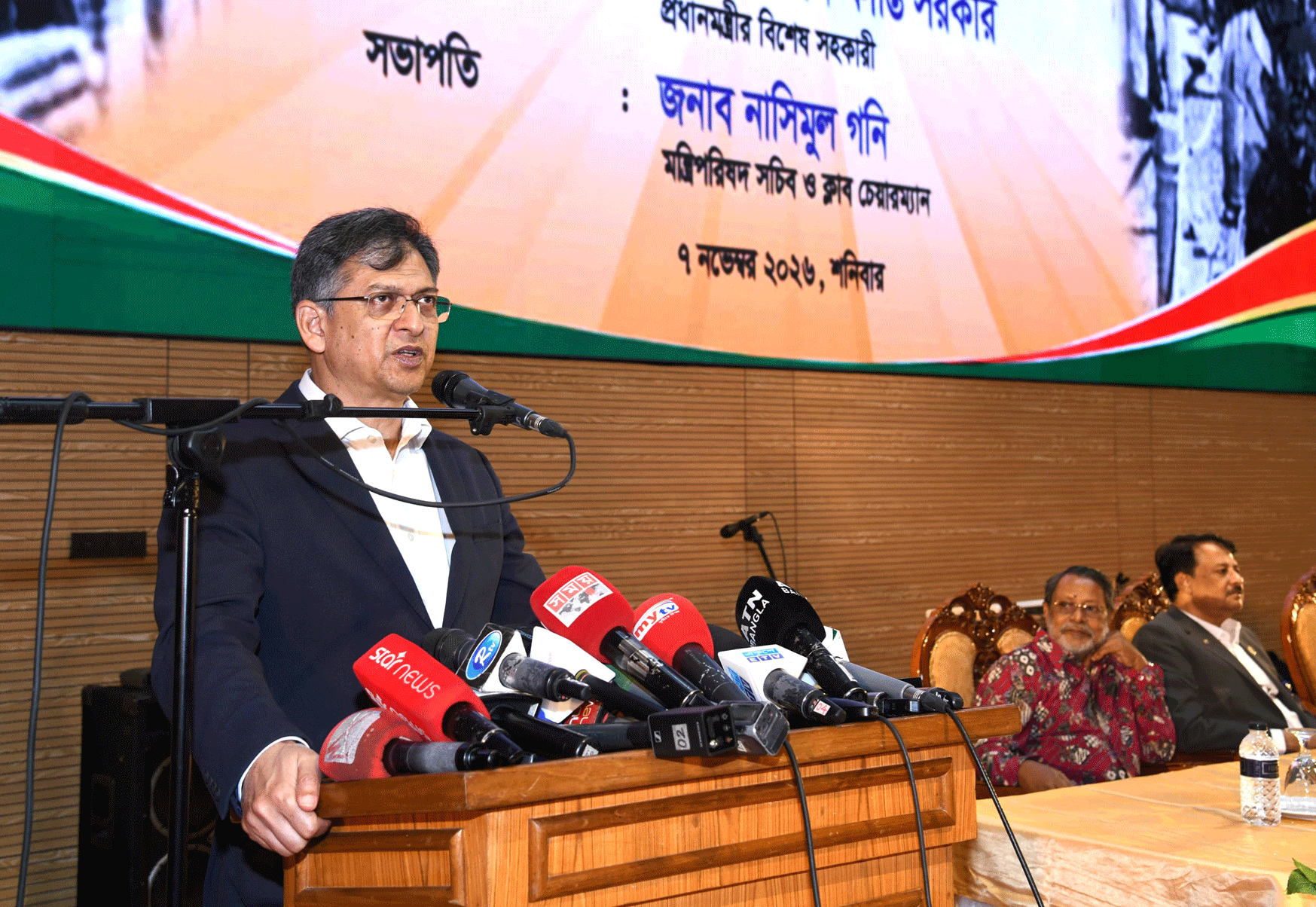
Speaking at a discussion at the Dhaka Officers' Club on Saturday (7 November) on the occasion of National Revolution and Solidarity Day, he said that if newcomers to politics keep repeating "July 24 is ours" and claiming ownership of it, in the end it will not last for anyone, and through it they will remain confined within their own circle.
The Home Minister said the spirit of July is not the property of any single group. For the benefits of the movement to reach everyone, the spirit of unity must be preserved rather than dividing over its ownership.
It may be noted that the anti-discrimination student movement, which began with the quota reform movement in July 2024, led to the fall of the then government in a mass uprising on 5 August. Later, the frontline leaders of the uprising formed the National Citizen Party-NCP and took part in the thirteenth election.
The discussion was chaired by Cabinet Secretary and Officers' Club President Nasimul Ghani. Also speaking were Bijon Kanti Sarkar, special assistant to the Prime Minister; ABM Abdus Sattar, principal secretary and general secretary of the club; and former secretary Md Mashiur Rahman.
On the same day, another discussion was held at the Liberation War Museum in Agargaon in the capital to mark National Revolution and Solidarity Day. Liberation War Affairs Minister Ahmed Azam Khan said there that everyone must work together to strengthen democracy and national unity.
Ahmed Azam Khan said 7 November is a day of special significance in Bangladesh's national history. One of the core pledges of independence was to establish democracy and social justice. At various times after independence, obstacles arose in the practice of democratic rights.
He said Ziaur Rahman not only protected the country's independence but, taking charge of the nation at a critical moment, revived the democratic system. Through economic reconstruction, the development of state institutions and consolidated progress in various fields of national life, he made an important contribution to building the foundation of modern Bangladesh.
The meeting at the Liberation War Museum was chaired by Md Abul Hashanat Humayun Kabir, acting secretary of the Liberation War Affairs Ministry. Special guests included Ishraque Hossain, member of parliament for Dhaka-6 and former state minister for liberation war affairs; Abdul Hai Shikder, editor of the daily Jugantor; Ishtiaq Aziz Ulfat, president of the Bangladesh Nationalist Freedom Fighters Party; and Iliyas Khan, advisory editor of the Daily Times of Bangladesh and former general secretary of the National Press Club.
Earlier, on Friday (6 November), former adviser to the interim government Brigadier General (retd) Dr M Sakhawat Hossain said at a seminar titled "National Unity: The Spirit of 7 November" at the National Press Club that without Ziaur Rahman's leadership in the historic events of 7 November, Bangladesh might not have survived with its present existence.
Sakhawat Hossain said national unity was built around Ziaur Rahman on 7 November. He was a natural leader. His honesty, courage, leadership qualities and nationalism made him popular with everyone.
He further said that during the events of 7 November, soldiers of the Two Field Artillery freed Ziaur Rahman from captivity. Soldiers of the Four Bengal were also with them at the time. He was freed and taken to the office of the commanding officer of the Two Field Artillery. He described the popular account of Colonel Taher's role as wrong.
Speaking on national unity, Sakhawat Hossain said Ziaur Rahman took the initiative to remove the division between freedom-fighter and non-freedom-fighter soldiers in the army. At the time there was a shortage of uniforms, shoes and other essential equipment for army members. Alongside changing the structure and capability of the army, he tried to establish national unity. Even in the interest of national unity, he invited the Awami League to talks.