Patgram town choked by auto-rickshaws and hawkers, walking itself a struggle
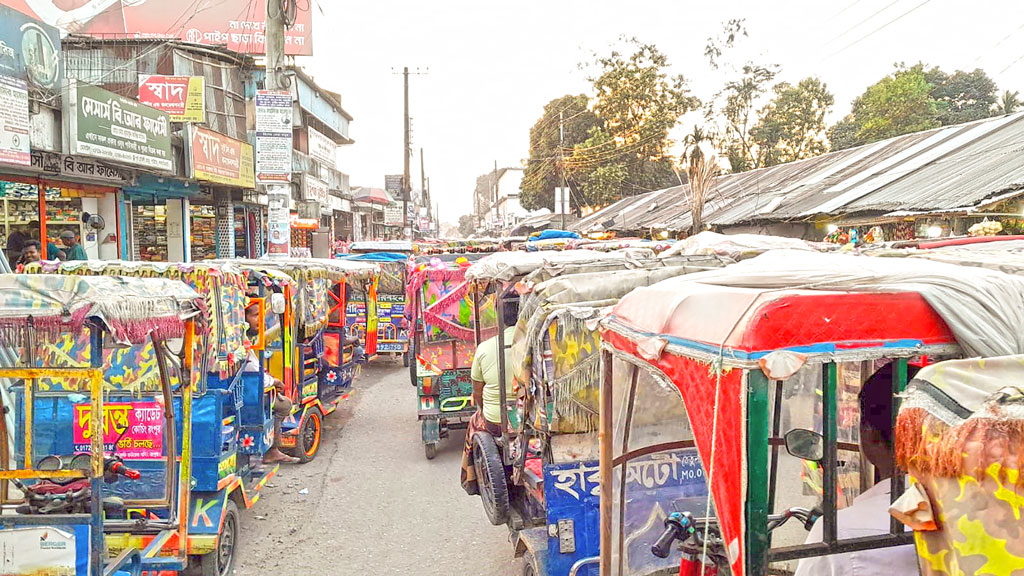
From the main road to the narrow lanes of Patgram town in Lalmonirhat, auto-rickshaws rule everywhere. At the same time, hawkers are competing to set up temporary shops by occupying roads and footpaths. Because of these two pressures, severe traffic jams persist on the roads, and sometimes even walking becomes difficult.
A visit to the town found hundreds of battery-run and CNG-run auto-rickshaws plying almost every road, including the main road. With no regard for traffic rules, they stop anywhere to pick up and drop off passengers.
The floating shops and congestion are worst in the stretch from the eastern four-road junction (Chowrangi) to the western four-road junction. The pressure of auto-rickshaws is also very high on the Tentultala-to-municipality road, the western Chowrangi-to-bypass road, the rail gate, the railway station, the old kachabazar, the old bus stand and the thana road west of the land office.
Temporary shops stand in rows, occupying five to seven feet on both sides of the roads. Small traders sit on the road selling fruits, shoes and sandals, onions and garlic, clothes, ducks and chickens, paan and supari, and wooden and iron furniture.
Buyers stand for long periods in front of these temporary shops. On one side the uncontrolled auto-rickshaws, on the other the crowd of hawkers and buyers, create jams on the road. School and college students, workers and ordinary people suffer the most.
The pressure rises especially on the weekly market days, Sunday and Thursday, when thousands of people come to town from the upazila's eight unions. The crowds of people and vehicles in the town and market areas grow, and the jams become even worse.
Several hawkers on the road said they cannot afford the large advance needed for a permanent shop. They are forced to pay two to three lakh taka to a permanent shop owner in exchange for just 10 to 12 feet of space on the road and footpath in front of that shop. Even setting up in front of someone else's shop costs them 1,000 to 3,000 taka a month in rent.
The hawkers said that if they are evicted without arrangements for their rehabilitation, their families will fall into severe hardship.
Jahangir Alam, a resident of Patgram municipality, said: 'The footpaths are occupied anyway. There are so many auto-rickshaws on the road that there is no way to move. We are in great trouble. The authorities should take action.'
Student Mehedi Hasan said: 'Many students travel to school and college along the town's roads. Because of reckless auto-rickshaws and traffic jams, it has become quite risky for students to walk on the roads. I doubt there are this many rickshaws anywhere else in the country! The footpaths need to be freed quickly.'
The upazila administration has conducted several drives to ease congestion and free the footpaths. Yet the auto-rickshaws cannot be reined in. The administration has used loudspeakers to instruct the auto-rickshaws to carry passengers only from designated stands, but the drivers do not follow the instruction.
Patgram Upazila Nirbahi Officer (UNO) and municipality administrator Farzana Akhtar said: 'The occupation of footpaths and the traffic jam in this town is a long-standing crisis. We have taken removing this long-standing suffering of the public as a challenge. Maximum effort will be made to solve it.'
Residents believe a long-term and sustainable initiative is needed to control the congestion. Drives and loudspeaker announcements alone are not solving this crisis.