
Eisenkot Set to Get Mandate to Form Government, Ahead of Netanyahu
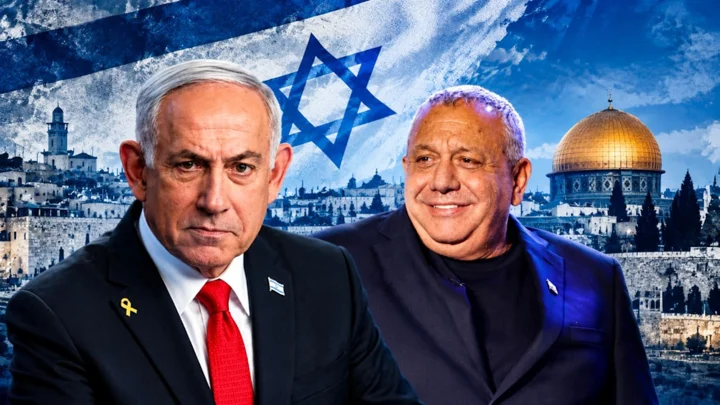
Israeli President Isaac Herzog is set to ask opposition leader Gadi Eisenkot to form a new coalition government, the BBC has reported.
In last week's election, neither Prime Minister Benjamin Netanyahu's bloc nor the bloc led by Eisenkot won a majority in the Knesset, Israel's parliament. President Herzog then held talks with the various political parties and decided to give Eisenkot the first opportunity to form a government.
Eisenkot will now have 28 days to form a government. That period can be extended by a further 14 days if needed.
In a post on the social media platform X, the former military chief wrote that now is the time to form a national emergency government. He added that he would do everything to ensure he is worthy of the responsibility.
No political party in Israel has ever won a parliamentary majority on its own. As a result, every government in the country has been formed through a coalition.
In the election, Netanyahu's right-wing Likud party and its far-right and ultra-Orthodox Jewish allies won 53 seats in the 120-seat Knesset. Eisenkot's centrist party and three other Jewish opposition parties in his bloc won 48 seats.
The two Arab-led blocs, the United Arab List and the Joint List, together won 19 seats. They achieved the unprecedented result as voter turnout among Arab voters rose significantly.
Their role could therefore prove decisive in forming a government. Before the election, however, all but one of the Jewish parties had pledged not to form a government together with the Arab parties.
President Herzog said that after a week of talks with all the political parties, he had decided to give Eisenkot the first opportunity to form a government. A statement from the president's office said the decision had been conveyed to both Eisenkot and Netanyahu.
The statement also said that after talks with the delegations of the new Knesset members, Eisenkot had received 67 recommendations in favour of him becoming prime minister. Netanyahu received 46 recommendations.
The president has wide discretion over whom to entrust with forming a government. He can give the task to whoever he believes is most likely to succeed in building a coalition. There is no requirement that the leader of the party with the most seats must be given the task.
The election result points to three possible paths to a government. The first is a national unity government involving both Netanyahu and Eisenkot. The second is a right-wing coalition led by Netanyahu, with some members joining from Eisenkot's bloc. The third is a government led by Eisenkot and supported by the Arab parties.
All but one member of Eisenkot's bloc had previously refused to form a government with the Arab parties. But there is speculation that a compromise could be reached. Eisenkot could also try to reach an understanding with the ultra-Orthodox Jewish parties, though that path would not be easy either.
There is precedent for a national unity government in Israel. In 2020, after three consecutive elections, Netanyahu and his centrist rival Benny Gantz agreed on a power-sharing deal under which the two took turns as head of government.
During his talks with the political parties, President Herzog said he hoped the parties and their representatives would understand that not all promises and pledges can be fulfilled in the current reality, in the interest of avoiding another election and forming a stable government.
The period from 2019 to 2022 was one of the most divided in Israeli politics. During that time, Netanyahu and his rivals repeatedly failed to reach agreement, and five elections were held in the country.
After a meeting between President Isaac Herzog and representatives of the political parties on Thursday, it emerged that 67 lawmakers in the Knesset had expressed support for Gadi Eisenkot as Israel's next prime minister.
The Joint List, a coalition of Arab-led political parties, announced on Thursday (5 November) that it supported giving opposition leader Gadi Eisenkot the task of forming a government after last week's general election in Israel.
In the occupied West Bank, meanwhile, attacks by Israeli settlers and various restrictions have made it difficult for Palestinian farmers to harvest olives. In this situation, several former Israeli military officers have stood beside the Palestinian farmers.
