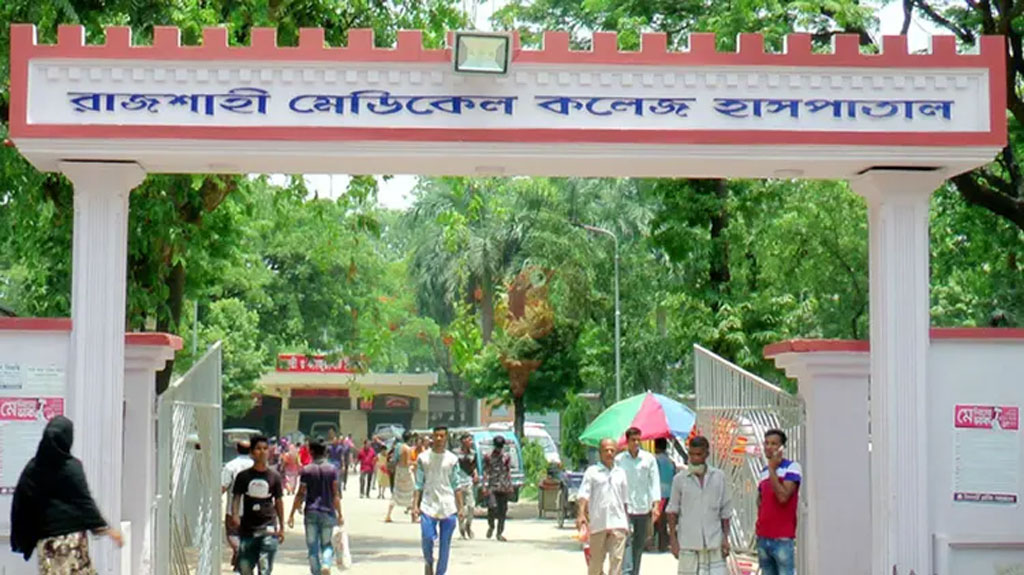
Fake X-ray films in Fuji packaging, substandard tubes supplied at Rajshahi Medical College Hospital, allegation says

Allegations of irregularities have surfaced in the supply of vital diagnostic materials at Rajshahi Medical College (RMCH) Hospital. Two contracting firms supplied fake X-ray films in Fuji Film packaging and substandard vacutainer tubes instead of the specified brand. These materials are now being used at the hospital, and the process of releasing their bills is under way.
Hospital sources said contractor Motiur Rahman of Rajshahi received the work order to supply X-ray films. On 26 September, he was instructed to supply 200 packets of 10-by-14-inch films and 85 packets of 14-by-17-inch films. He delivered the films to the hospital on 10 October.
Each smaller packet costs 25,625 taka and each larger packet 25,000 taka. Altogether, the contracting firm has submitted a bill of 7.25 million taka.
Although the packets carry the Fuji Film logo, Medi Graphic Trading Limited, the sole distributor of Fuji Film in Bangladesh, has claimed that these films were not supplied through them.
Officials of the company recently visited RMCH and inspected the supplied films. Rifat Hasan, deputy manager (sales and marketing) of Medi Graphic Trading Limited, said they are the only distributor of Fuji Film in Bangladesh. Wherever this brand's films are supplied in the country, they should go through them, but the films given to RMCH are not theirs.
Rifat Hasan claimed that fake films are made in different countries using Fuji packaging and are available at about 40 percent less than the price of the genuine product. They believe the films supplied to RMCH are of that kind.
He said images taken on such films are of poor quality and can fade within a short time. He added that using these films could even damage the X-ray machines.
Denying the allegation, contractor Motiur Rahman said films are never fake. If there is any doubt, the hospital authorities can send samples to Dhaka for testing.
Asked why the films were collected from another source instead of Fuji Film's authorised distributor, he said he is currently in Manikganj and would be able to explain the matter if met in person.
Meanwhile, allegations of irregularities have also been raised against another contractor, Gateway International, in the supply of vacutainer tubes used for collecting blood samples. The firm received a work order on 26 September to supply 250,000 tubes and delivered them to the hospital on 10 October.
Under the work order, tubes of the JMI or ANC brand were to be supplied. But of the 250,000 tubes, 140,000 were supplied in the Chinese GR brand, including 70,000 red tubes for blood serum tests and 70,000 purple tubes for complete blood count (CBC) tests.
Hospital sources claimed GR brand tubes cost about 30 percent less than those of JMI or ANC. The firm has already submitted a bill of 2 million taka, meaning it has begun the process of collecting payment despite supplying cheaper products.
Sohel Rana, proprietor of Gateway International, said JMI tubes were supposed to be supplied, but at that time the company did not have enough stock. On the other hand, the hospital urgently needed tubes.
He said that after discussing the matter with the hospital, GR brand tubes were given in the first phase, and JMI tubes were also supplied later.
Hospital sources alleged that the tender evaluation committee for these purchases was chaired by the hospital's deputy director, Dr Hasanul Hasib, with assistant director (finance) Dr Golam Rabbani as a member. It is alleged that the two contracting firms got the opportunity to supply substandard products after reaching an understanding with them.
Sources claimed that for supplying Fuji films, it is mandatory to submit the necessary documents of the authorised distributor in Bangladesh, but Motiur Rahman's firm received the work order without the distributor's authorisation letter. It has also been learnt that Dr Sabera Khatun, head of the pathology department, had agreed to accept GR brand tubes citing urgent need.
Asked about the allegations, Dr Hasanul Hasib, chairman of the tender evaluation committee and deputy director of the hospital, said goods are purchased through tender and accepted when the documents are in order. For anything more, he said, one should speak to the hospital spokesperson or the director.
Despite several phone calls from Saturday morning (7 November) until noon, the hospital spokesperson, Dr Sheikh Shamim Ahmed, could not be reached for comment. When the hospital director, Brigadier General PKM Masud-Ul-Islam, was later phoned, he advised speaking to the spokesperson.
When told that the spokesperson was not answering the phone, the director said he had spoken to him a short while ago and that he would receive the calls. Even after several more calls, the spokesperson did not respond. As a result, no official statement from the hospital authorities on the allegations could be obtained.