
Rotten hilsa caught in defiance of ban brought to landing stations, part of it sold
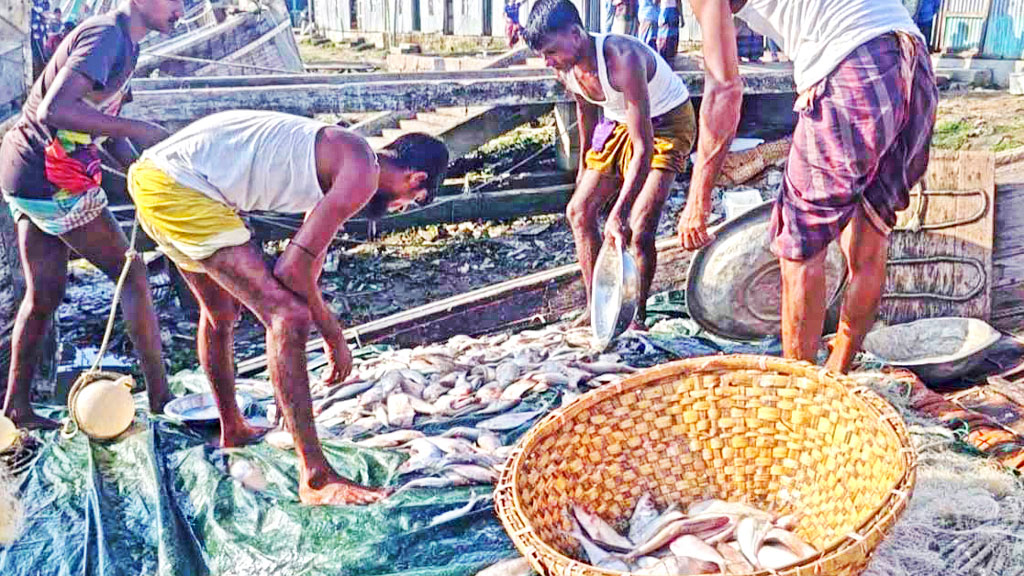
An investigation committee has found it true that the 50 to 60 maunds of hilsa brought to the landing stations in a rotten condition, loaded on trawlers, at Kalapara in Patuakhali and Charfashion in Bhola, were caught in the sea in defiance of the fishing ban.
As soon as the 22-day ban on hilsa fishing was lifted, unscrupulous fishermen returned to the landing stations with the fish. The investigation also found that a portion of this rotten fish, which is harmful to public health, was bought by traders dealing in salted hilsa.
On enforcing the ban in the sea as well as in the rivers, the Barishal Department of Fisheries says it has no control over the sea.
On the night of 29 October and on the morning of 30 October, fishermen returned to the coast with trawler-loads of rotten hilsa at the Mahipur and Alipur fish landing stations in Kalapara upazila of Patuakhali, and in Charfashion upazila of Bhola.
The government's 22-day ban to protect mother hilsa ended at midnight on 29 October. The incident drew criticism of the mother-hilsa protection drive at the time and anger among buyers.
On the instructions of the Department of Fisheries, its Barishal divisional office formed a three-member investigation committee into the incident. The report was submitted last Thursday.
The head of the investigation committee, Md Anisuzzaman, Senior Assistant Director of the Barishal divisional fisheries office, confirmed this information.
Anisuzzaman said he carried out an on-the-spot investigation at Alipur and Mahipur in Patuakhali, together with the district fisheries officers of Bhola and Patuakhali. After the ban ended, 50 to 60 maunds of hilsa arrived by trawler at these two landing stations. Most of it was rotten.
The trawlers had been at sea. Without ice, the fish rotted for lack of proper preservation. The investigation also confirmed that rotten hilsa was unloaded at the landing stations. A section of fishermen brought in, in a rotten state, fish they had caught by violating the ban. The same thing happened in Charfashion, Bhola. A large syndicate is involved in the incident.
Md Zahirunnabi, the Kalapara upazila fisheries officer in Patuakhali, said, 'I was with the investigation committee too. The traders said, "Rotten hilsa had been brought in; it came from Bhola and Hatiya. The traders did not accept it and sent it back."'
Muhammad Delowar Hossain, the Bhola district fisheries officer, said, 'According to the traders, the amount of rotten hilsa brought to the Samraj ghat in Charfashion was 200 to 300 kilograms. This hilsa was caught on the last day of the ban.'
Speaking about the investigation report, Md Kamrul Hasan, Director (in charge) of the Barishal divisional fisheries office, said, 'The investigation found that about two tonnes of rotten hilsa had arrived at the Mahipur and Alipur fish landing stations. A portion of it was sold to salted-hilsa traders.'
Noting that the Department of Fisheries has no control over the sea, Kamrul Hasan said, 'This rotten hilsa was brought from the sea. But we have no scope to control the sea.'
Dr Moniruzzaman Khan of Barishal Sher-e-Bangla Medical College Hospital said, 'Eating rotten hilsa or any rotten food can cause stomach problems, indigestion and stomach pain.'
Indrani Das, Assistant Director of the Barishal divisional office of the Directorate of National Consumer Rights Protection, said, 'If the Department of Fisheries had informed us about this rotten hilsa, the people involved could have been fined up to 50,000 taka under Section 45 of the Consumer Rights Act.'

