Two dust rings found around a dead star, offering a glimpse of the solar system’s future
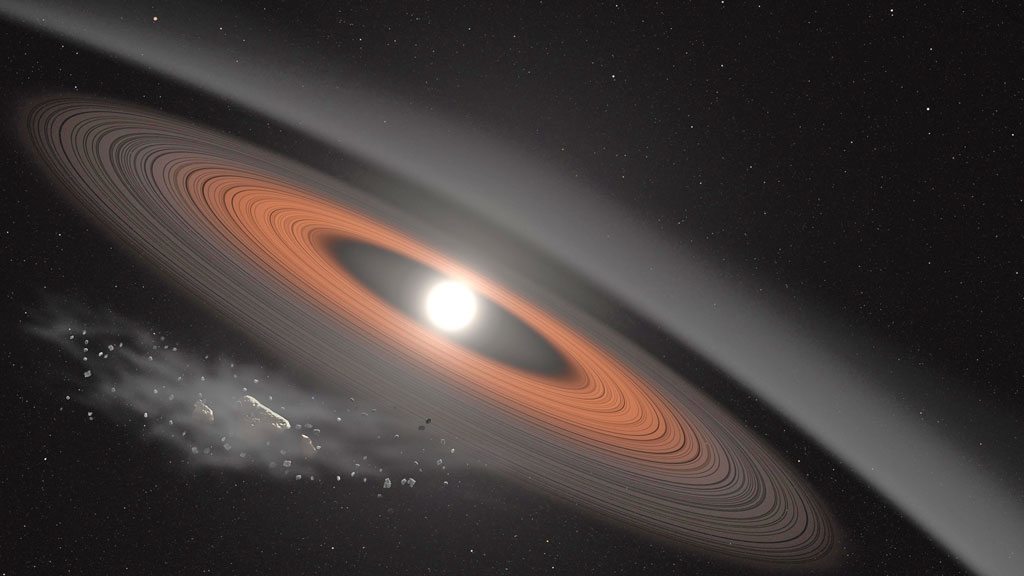
Scientists have discovered two separate rings of dust and gas around a dead star named J1328-1450, about 1,600 light-years from Earth. The discovery offers new insight into exactly what happens when a star like the Sun runs out of fuel, and it also presents a possible picture of the distant future of our own solar system.
J1328-1450 is a white dwarf, a dead star whose fuel has run out. Stars like the Sun eventually become white dwarfs in this way once their fuel is exhausted. Scientists say this star, too, once had its own planets.
Billions of years ago, when the star’s fuel ran out, its inner planets were shattered in a violent explosion. That debris now orbits the star in the form of rings. Normally, only a single ring of such debris is seen around a dead star.
But to the scientists’ surprise, two separate rings are orbiting this star. Researchers believe such a sight has not been seen before, and the presence of two rings raises new questions about how the star died.
The researchers think two small rocky asteroids or fragments, similar in size to Pluto, survived the star’s death and are still present inside the two rings. Their gravitational pull is believed to have divided the dust into two neat rings.
There is also some difference in the composition of the two rings. Researchers say the outer ring contains less magnesium than the inner ring. This difference is expected to reveal more about how the rings formed.
In about five billion years, our Sun will also exhaust its fuel and swell into a giant star, a red giant. Scientists believe Mercury and Venus will then burn to ash completely.
Whether Earth will survive is a matter of disagreement among scientists. But distant planets like Jupiter and Saturn are thought more likely to survive. This transformation of the Sun would completely change the appearance of the solar system.
When the Sun eventually shrinks and becomes a white dwarf like this dead star, the surviving fragments of the solar system could come very close to the Sun and break apart in the same way. The remains of our familiar solar system could then form similarly beautiful rings.
This discovery by scientists unveils a mystery of space and also offers a small glimpse of our own future. Researchers hope further study of J1328-1450 will give a clearer understanding of how rings form around dead stars.