Patients queue from midnight at the National Cancer Institute in Mohakhali, with radiotherapy slots dated May 2027
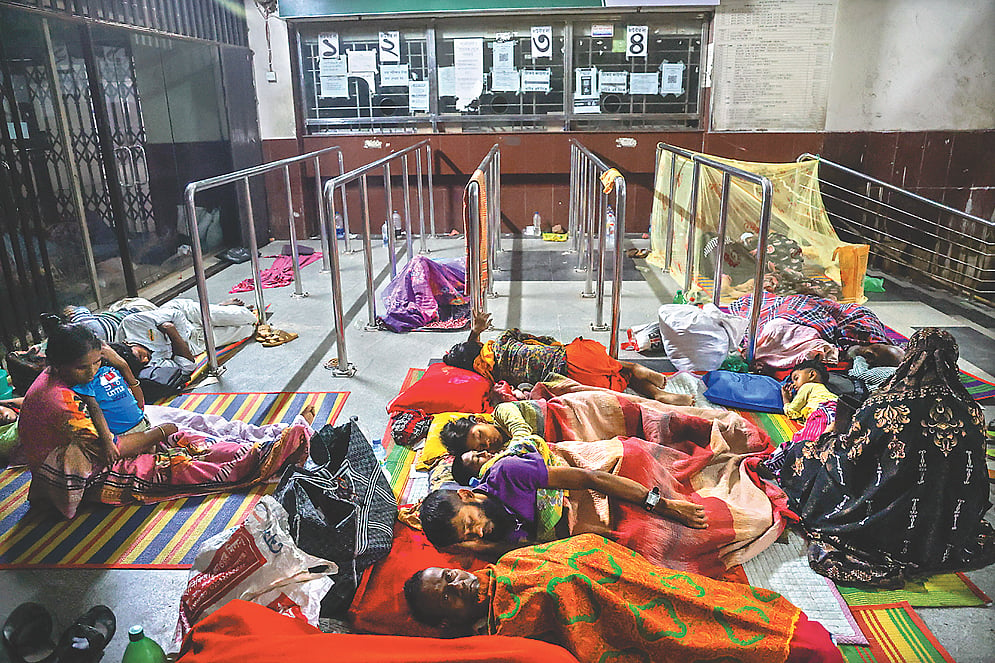
At the National Cancer Research Institute and Hospital in Mohakhali, Dhaka, relatives of patients have to queue from the previous midnight to secure a slot for diagnostic tests. On 15 October, before 4:30 in the morning, about fifty people had gathered in front of the collapsible gate of the hospital's administrative building. Some were lying on mats spread on the floor, some without mats were lying directly on the floor; a few had hung mosquito nets and coils were burning near some patients' feet.
One of the patients lying on a mat on the floor was Ismat Ara Begum, aged over sixty. Her nephew Faruk Hawlader said they had come from Bikrampur (Munshiganj) and that Ismat Ara has cervical cancer. After arriving in Dhaka they first went to Dhaka Medical College Hospital, from where they were sent to the Cancer Institute three days earlier.
Faruk Hawlader said that for three days doctors have been prescribing various tests, and relatives must queue from the previous midnight to get a test slot. Ismat Ara has not yet been admitted; doctors have said she will be admitted after the test results are seen. At night he stays with the patient in front of the administrative building. In the morning, when the hospital's Ansar members blow their whistles, the place has to be vacated, and the patient is then carried inside the building and laid on the floor.
Faruk Hawlader said: 'If we keep the patient like this, how will she survive? It is because we are poor that we have come to this government hospital.'
Mohammadpur resident Tipu Sultan described the same struggle over a radiotherapy slot. His wife, Majeda Khatun, has breast cancer. After the cancer was detected last year she was first given chemotherapy, and in September she underwent surgery at the Cancer Institute. Since then Tipu Sultan has been waiting for a radiotherapy slot; the date he has been given is May 2027.
On 22 October last year Tipu Sultan wrote on Facebook: 'Radiotherapy is needed now, yet I have been given a date in May 2027. How can a cancer patient wait this long for treatment?' Contacted on 10 November, he said his Facebook post had come to the notice of the Institute's director, who had asked to meet him. On 10 November the CT simulation test, the preparatory stage before radiotherapy begins, was completed; he now hopes he may not have to wait until May 2027.
The National Cancer Institute is the country's largest and most specialised cancer treatment institution. Cancer patients and suspected patients from government hospitals at upazila and district level across the country are referred there. Because test and medicine costs are low and treatment is free, it is the last resort for poor patients.
Yet while the hospital's beds have increased over the past decade or so, its manpower has not, and part of its medical equipment has long been out of order. The Institute's director, Professor Mostofa Aziz Sumon, said that for a patient who needs radiotherapy now, being given a slot in 2027-2028 is the same as not being given one at all. That is why relatives are asked to make contact every six weeks, in case a slot opens up. He said radiotherapy is now given in three shifts until night to cope with the pressure, yet the patient load is not falling.
Director Professor Mostofa Aziz also said that handling the patients is a big challenge. Although treatment is everyone's right, the Institute's doctors have to choose which patients have a higher chance of survival, and the doctors themselves acknowledge this.
According to the latest (2024) figures from Globocan, the World Health Organization's cancer agency, 187,000 people are diagnosed with cancer in the country every year and 138,000 die of it annually. Some 358,000 people are living with cancer (patients from the last five years). That means an average of 21 people are diagnosed every hour and 16 die. However, there are no exact national statistics on how many people have cancer, how many die each year and how many are newly diagnosed; no national-level survey has been done.
According to Globocan, 32 types of cancer are prevalent among people in Bangladesh. The top five are cancers of the oesophagus, lung, stomach, lip and oral cavity, and cervix. For women the top five are cervical, breast, oesophageal, lung and stomach cancers; for men they are oesophageal, lung, stomach, lip and oral cavity, and hypopharyngeal cancers.
Experts say a population-based cancer registry is what gives a country its true picture. A team of researchers led by Md Khalequzzaman, associate professor in the Department of Public Health and Informatics at Bangladesh Medical University, is carrying out such registration work in Hossainpur upazila of Kishoreganj district. Among 250,000 people there, 116 have been diagnosed with cancer, and the researchers have found that 7.4 percent of patients take no treatment at all after diagnosis. Md Khalequzzaman said that if this population-based registration were done in 8 to 10 regions of the country, the national situation could be understood.
Several cancer specialists have said the country needs one cancer treatment centre for every one million people, with at least one radiotherapy machine, because at least 60 percent of cancer patients need radiotherapy. An official of the World Health Organization's Dhaka office, speaking on condition of anonymity, said the country lacks systems for cancer screening and early detection, has a shortage of reliable testing institutions and trained manpower, and has far fewer treatment centres than needed.
National Cancer Institute director Professor Mostofa Aziz said the country needs 200 to 250 radiotherapy machines but has only 31, of which 7 belong to the government. Apart from the Institute, government radiotherapy machines are at Bangladesh Medical University, Dhaka Medical College Hospital, a unit run by the Atomic Energy Commission in Savar, Osmani Medical College Hospital in Sylhet, Chattogram Medical College Hospital and Rajshahi Medical College Hospital. The remaining 24 machines are in private hospitals, almost all of them in the capital; altogether, cancer treatment is largely Dhaka-centred.