College Students Rally on More Than 40 US Campuses in Support of Starbucks Baristas' Boycott
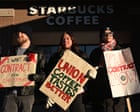
Starbucks baristas, students, elected officials and allies are holding rallies at more than 40 college campuses across the US on Thursday to support the Starbucks Workers United boycott campaign, as the union nears five years of deadlock with the company over contract negotiations.
Starbucks Workers United is seeking better pay and stronger staffing levels, including a 17-dollar-an-hour minimum wage for baristas and a minimum staffing of three workers per store. It has called on the public to boycott Starbucks until its first contract is reached.
More than 700 Starbucks stores have voted to unionize, representing more than 12,000 baristas. It typically takes over 450 days for a new labour union to negotiate and reach its first contract, but it has been nearly five years since the first Starbucks store in Buffalo, New York, voted to unionize in December 2021.
Starbucks Workers United began to focus on college campuses in 2023, calling on campuses to cancel their contracts with Starbucks in protest against the company's response to union-organizing efforts. In response, Cornell University and Pomona College did not renew their contracts with the company, while UCLA stopped offering Starbucks products in their cafes.
Rallies and events will take place at private and public universities across the country, including the University of Pennsylvania, Northwestern and the University of Washington.
The union push comes ahead of the company's busy holiday season, including Starbucks' Red Cup Day on 17 November, when customers receive a reusable holiday cup.
Andrew Trinklein, a barista participating in an event at the University of Texas at Austin, said Starbucks has been fueling the working class for decades but is failing the workers who fuel its profits. He said they are trying to push and get support from college campus students in joining the boycott.
Trinklein's store recently unionized, and he expressed shock at how the company hired pricey union avoidance consultants in attempts to deter workers from unionizing. Starbucks has reportedly spent tens of millions of dollars related to union avoidance, though it has not disclosed the full costs relating to its union-organizing efforts.
Trinklein emphasized that employees are currently employed at-will, meaning they have no just-cause job security protections. He said they could be fired tomorrow for something like not writing on a cup, referring to the company's policy requiring employees to write friendly messages on cups for customers, but with a contract that would not be possible and they would have protections.
Efforts to pressure Starbucks to negotiate were temporarily paused when the union and Starbucks reached an agreement on a path forward in February 2024. But negotiations broke down shortly after Brian Niccol took over as Starbucks CEO. Niccol previously served as CEO of Chipotle from 2018 to 2024, and under his tenure the company agreed to pay 240,000 dollars to former workers as part of a settlement over a store closing in Maine after it unionized, which the National Labor Relations Board said was illegal. Chipotle has denied wrongdoing.
In recent years, Starbucks has been found guilty of violating federal labour law by the NLRB in several cases regarding its responses to union-organizing efforts.
In a statement, a Starbucks spokesperson said Workers United represents approximately 5% of its US partners, and the company believes actions like these divert attention from the work at the bargaining table. The spokesperson said that based on experience with prior similar actions, they do not expect any meaningful disruption. The company said that according to independent research, Starbucks offers the best overall pay and benefits in the industry, worth on average more than 30 dollars per hour and including comprehensive healthcare, 100% upfront tuition coverage, company stock and up to 18 weeks of paid parental leave for partners working as little as 20 hours a week, and that nearly 3 million people applied to wear the green apron last year.