Lawyers Divided on Whether Sheikh Hasina Can Still Appeal: Verdict Will Be Executed If She Returns, Says Chief Prosecutor
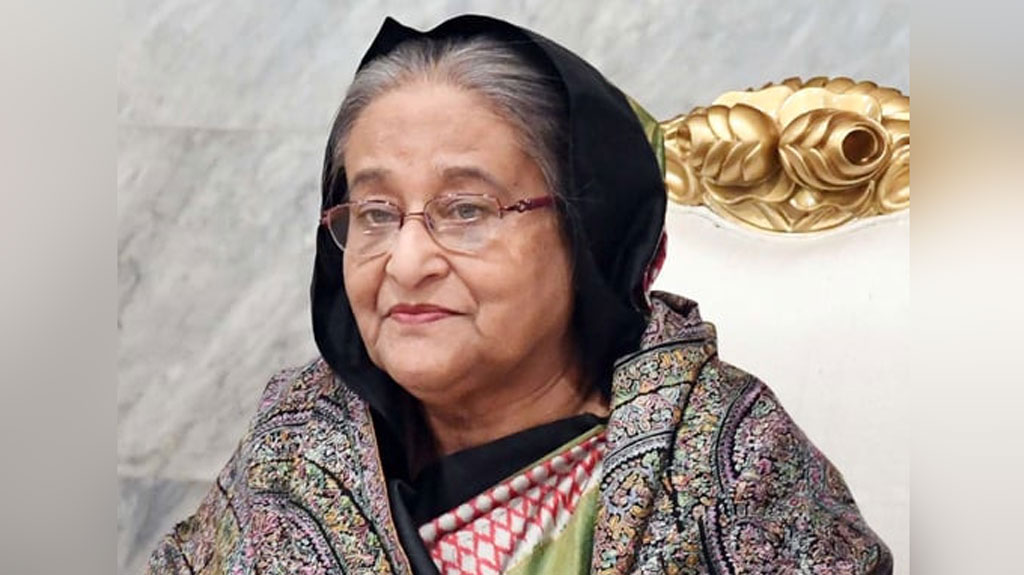
Ousted in a mass uprising during the anti-discrimination movement, then prime minister Sheikh Hasina fled to India. She has already been sentenced to death in a case over the killings during the July–August movement. Trials and investigations in several more cases against her are ongoing at the tribunal. In addition, more than five hundred cases have been filed against her across the country.
Lawyers have recently given mixed reactions on her return to the country and on appealing to legally challenge the death sentence.
On the matter, Md Aminul Islam, Chief Prosecutor of the International Crimes Tribunal, told Ajker Patrika that there is no legal scope for the Bangladesh government to give a passport to Sheikh Hasina, who is staying in India. To return, she would have to come under the extradition treaty. Although there were 30 days after the verdict was published, she filed no appeal. She has no legal scope to file an appeal in the future either. So if she returns to the country, her verdict will be executed. There is no alternative.
On appeals, Section 21(3) of the International Crimes (Tribunals) Act, 1973 says an appeal must be filed within 30 days of the date of conviction and sentencing, or of acquittal or sentencing. Once that time limit expires, no appeal will be acceptable.
Supreme Court senior lawyer Monzil Morshed said that if someone wants to come to the country and face the case, they should be given a travel pass. And there is no precedent in Bangladesh of an execution being carried out without going to the Appellate Division, because under Article 104 of the Constitution the Appellate Division can pass whatever orders are necessary in the interest of complete justice. Condonation of delay in such a case is entirely the Appellate Division's jurisdiction. He therefore believes that claiming the execution will be carried out without a chance to appeal is simply bypassing the law.
Article 104 of the Constitution says the Appellate Division may issue such directions, orders, decrees or writs as may be necessary for doing complete justice in any case or matter pending before it, including orders for securing the attendance of any person or the discovery or production of any document.
In a crimes against humanity case filed over killings across the country during the anti-discrimination movement, the International Crimes Tribunal on 17 November last year sentenced former prime minister Sheikh Hasina and former home minister Asaduzzaman Khan Kamal to death. It also ordered all their assets confiscated in favour of the state and given as compensation to the families of the July–August martyrs.
The case's five charges were divided into two parts: the death sentence was given in one part and imprisonment until death in the other. After the full copy of the verdict was published, on 15 December last year the prosecution applied to the Appellate Division to convert the life-until-death sentence into a death sentence. That application is still pending.
Asked about the prosecution's application pending before the Appellate Division, the Chief Prosecutor said Sheikh Hasina has already been sentenced to death, so hearing that application is not urgent for executing the sentence. If needed, the application before the Appellate Division can be withdrawn at any time. He also said Sheikh Hasina would not get the benefit of the complete justice principle under Article 104 of the Constitution.
Earlier, the International Crimes Tribunal had sentenced Maulana Abul Kalam Azad to death in 2013 on charges of crimes against humanity in 1971. He was a fugitive at the time. After the Awami League government fell in 2024, he returned to the country and on 6 July this year filed an appeal along with a plea for condonation of delay. He also sought a stay on the tribunal's death sentence until the appeal is disposed of. His appeal went through the chamber court to the regular bench of the Appellate Division for hearing. It is still pending.
Asked about the matter, Attorney General Barrister Ruhul Quddus Kajol told Ajker Patrika that if Sheikh Hasina wants to return to the country, she will have to return following the law. The legal position of a convicted person has become clear in Maulana Abul Kalam Azad's case itself, because Abul Kalam's appeal has not yet been accepted.
Meanwhile, a letter has already been sent to the Ministry of Home Affairs to implement the verdict confiscating the assets of Sheikh Hasina and Asaduzzaman Khan Kamal. On 3 November, the letter, signed by the Chief Prosecutor of the International Crimes Tribunal, was sent to the Senior Secretary of the Ministry of Home Affairs.
Supreme Court senior lawyer Motahar Hossain Saju told Ajker Patrika that the precedent exists of the opportunity the government gave Maulana Abul Kalam Azad under Section 401 of the Code of Criminal Procedure. So if Sheikh Hasina wants to return, she should be given that opportunity. And if she can return, she will also get the chance to appeal. Whether the Appellate Division grants leave to appeal is a matter for the Appellate Division.
However, Supreme Court senior lawyer Mohammad Shishir Monir said there is no open path for Sheikh Hasina to come to Bangladesh outside the extradition treaty. He said that if someone's passport is cancelled, an appeal has to be filed; one cannot apply for a fresh passport to be issued. And a fugitive accused cannot file any application under the law. Sheikh Hasina is in India on humanitarian asylum.
Citing Syria as an example, Shishir Monir said that when Bashar al-Assad fled the country in a mass uprising, the Russian government gave him shelter. Later he was sentenced to death. The Syrian government then requested Russia to hand Assad over, but Russia refused. Here, the Bangladesh government has made a request but the Indian government has taken no decision. In this situation, a person who has received asylum on humanitarian grounds cannot take any decision on their own.
Section 6(1)(c) of the Bangladesh Passport Order, 1973 says a passport or travel document may be refused if the applicant, within the five years immediately preceding the date of the application, has been convicted by a court in Bangladesh of an offence involving moral turpitude and sentenced to imprisonment for not less than two years.