As tall as the Statue of Liberty: New York is running out of room for its waste
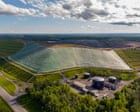
The largest active landfill in New York state, Seneca Meadows, is already the height of the Statue of Liberty, and its operators are seeking to raise it even further, to the consternation of nearby residents.
Situated in the scenic Finger Lakes region in the northern reaches of the state, the landfill has grown since the 1980s to now sprawl across 350 acres of deposited trash, mounded up to a height of around 300ft — roughly the same height as the Statue of Liberty.
Mark Pitifer, a marketing administrator at Waterloo Containers, a glass packaging company that sits next to the landfill, said: 'All around the lakes is pretty flat until you see this monster of a hill. I mean it's incredible, it's like being in downtown New York City only instead of a building, it's trash.'
Locals in the nearby towns of Waterloo and Seneca Falls — the latter famed as the birthplace of the women's rights movement in the US — had hoped the bulging landfill would be closed when its permit expired last year. But the operator, Texas-based Waste Connections, has proposed extending the life of the landfill for several more decades via 47 acres of newly lined disposal cells and adding another 70ft to the trash heap's height.
As state authorities consider the expansion, the landfill has become a focus of grievance over its pungent smell, water pollution and planet-heating pollution. Seneca Meadows is now the largest source of methane, a potent greenhouse gas, in the state, according to a study last year based on researchers using aircraft measurements.
Seneca Meadows receives around 6,000 tons of trash each day from across New York, with 1,500 of those tons originating from New York City, which sends its rubbish to landfills hundreds of miles away that are rapidly filling up and are set to be completely full within the next 16 to 25 years.
New York City residents still create around 12,000 tons of trash a day. The city does not send residential trash to Seneca Meadows — although some private contractors do. A spokesman for the city's sanitation department said: 'As capacity continues to shrink in the region, we will likely export trash to further locations. Our commitment to rail export makes this much easier than trucking.' The city has also pointed to recent efforts such as the pickup and composting of organic matter, which makes up around a third of what is left as trash.
Emily Gallagher, a Democratic member of the New York state assembly who recently toured the Seneca Meadows site and has convened a hearing on the state's waste storage policies, said: 'We are at the precipice of a crisis. There is this huge mountain of trash that is off gassing almost 24 hours a day … contaminating the Finger Lakes, contaminating the groundwater. People we met in town are in really bad shape, we need to shut this expansion attempt down now.' She estimated 80% of the Seneca Meadows contents could be recycled.
Yvonne Taylor, co-founder of the Seneca Lake Guardian environmental group, said residents routinely text her to say they have had to remove their children from the nearby school because the smell had sickened them, or of ruined outdoor birthday parties. Pitifer said Waterloo Containers has had to install filtration equipment to help employees deal with the stench. Taylor said: 'We certainly don't want to push this burden onto another community and say, oh, we just don't want it here, you guys take it. That's not our philosophy at all. Our philosophy is that we need to start somewhere, and that somewhere is with Seneca Meadows.'
Waste Connections did not respond to questions from the Guardian. On its website it says it is dedicated to the preservation and advancement of the environment and has an exemplary compliance record. Its protections include a double composite liner and a collection system for rainwater that has contacted waste; landfill gas is captured and burned to generate electricity, and state-of-the-art equipment is used to capture odors. The New York state department of environmental conservation was also contacted for comment and did not respond.