SS United States, Larger Than the Titanic and the Fastest Ocean Liner, Sunk in the Gulf of Mexico
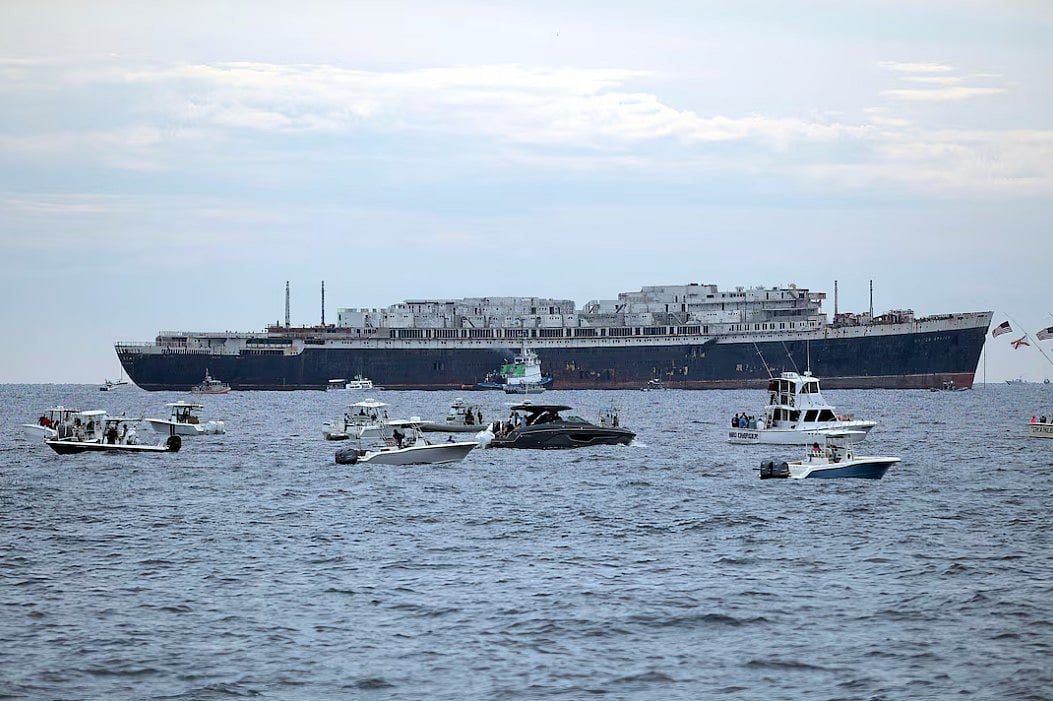
The historic American passenger ship SS United States has completed its final voyage. The nearly 1,000-foot (302-metre) ship was the world’s fastest seagoing passenger liner. It was sunk at sea last Wednesday.
The deliberate sinking of a ship in this way is called ‘scuttling’. Beforehand, the ship’s hull was hollowed out so that it would stay on the seabed. Over five hours, water slowly entered the ship. At the final moment it listed to one side and sank to the floor of the Gulf of Mexico, off Destin, Florida.
The ship was built between 1950 and 1951. It was larger even than the famous Titanic. The Titanic was 882 feet 9 inches (269.1 metres) long, while the SS United States was nearly 1,000 feet (302 metres). The ship was known mainly for its speed, its sturdy structure and its luxurious facilities.
Beginning service officially in 1952, the ship made history on its maiden voyage by setting the speed record for crossing the Atlantic Ocean. It crossed the Atlantic in 3 days, 10 hours and 40 minutes, at an average speed of 35.59 knots, or about 66 kilometres per hour. No other passenger ship has yet broken that record.
For 17 years the ship carried thousands of passengers. Among them were former US presidents John F Kennedy, Bill Clinton, Harry Truman and Dwight Eisenhower. Hollywood stars Marilyn Monroe, Elizabeth Taylor and Marlon Brando also travelled on the ship, as did surrealist painter Salvador Dalí and jazz musician Duke Ellington.
Passenger service on the ship was discontinued in 1969. After that, the ship lay idle for years.
According to the county’s website, preparations were made for a year to make sinking the ship as an artificial reef safe for the environment. The county said all the standards set by regulatory agencies were followed.
In a statement, the county said an artificial reef prepared in this way benefits the marine ecosystem rather than harming it. Such reefs create habitat where none existed before and help a diverse environment to develop. Marine life, the fishing industry and the whole tourism sector benefit, it said.
Those involved hope this artificial reef, the world’s largest, will attract divers interested in exploring the sunken ship, creating further tourism opportunities in Florida.
According to a 2007 report by UNESCO, the UN’s educational, scientific and cultural agency, an estimated three million ships lie sunk on the floors of the world’s seas and oceans. Many of them naturally become habitats for marine life.