Solar power saves 14 postal centres nearly Tk 13 lakh, over 48,000 units sent to grid
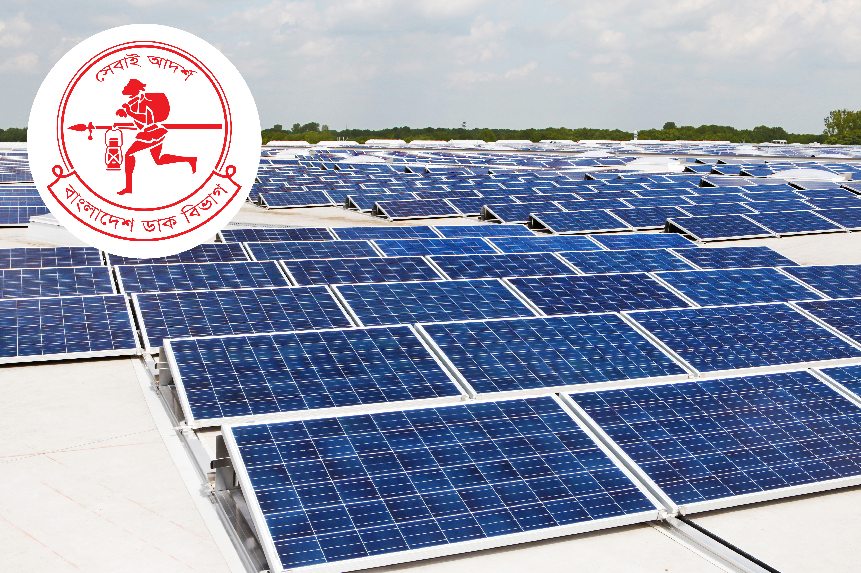
Using solar power, 14 mail processing centres (MPCs) of the postal department have saved nearly Tk 13 lakh in electricity bills. According to the Directorate of Posts, without solar power the centres' electricity bill would have been about Tk 20.86 lakh; after meeting their own demand and supplying surplus power to the national grid, net metering brought the bill down to Tk 7.94 lakh, a saving of about 62% of the possible cost.
According to the directorate, the saving was made from 2023 to October this year. At a time when the government is stressing wider use of solar power in all government offices, the experience of these 14 centres has become a practical example of renewable energy use in government installations.
In this period, the solar panels of the 14 MPCs produced a total of 86,141 units of electricity. Of that, 37,417 units were used directly to meet the centres' own demand.
The remaining 48,724 units were supplied to the national grid through net metering. In other words, the centres themselves used about 43% of the solar power produced, and the remaining about 57% went to the national grid.
The centres with solar power systems are the Tejgaon, Chattogram, Noakhali, Habiganj, Mymensingh, Rajshahi, Ishwardi, Rangpur, Dinajpur, Barishal, Jashore, Khulna, Kushtia and Gopalganj MPCs.
The buildings of these centres were built at a cost of Tk 78.50 crore under the Mail Processing and Logistic Service Centre construction project. With 35 types of modern furniture and necessary equipment installed, the centres were made fully operational. Solar panels with net metering facilities are an important part of this infrastructure development.
By the directorate's calculation, without solar power the 14 centres would have had to take a total of 139,097 units of electricity from the grid. At Tk 15 per unit, the bill would have stood at Tk 20,86,455.
But after solar production and supply to the grid, adjustment through net metering put the centres' actual payable electricity at 52,956 units, against which the bill came to Tk 7,94,340. The saving was Tk 12,92,115, which is 61.93% of the possible cost without solar power. On this calculation, each centre saved on average about Tk 92,000.
Director General of the Directorate of Posts Kazi Asadul Islam said the use of solar power is not only an electricity saving but also an important step toward building a sustainable and environment-friendly future. He said: 'By adding surplus electricity to the national grid through net metering, it is possible to make government installations part of a more fuel-efficient system.'
Kazi Asadul Islam also said the experience of the 14 centres has proved that solar power in government installations is effective not only for the environment but also for saving public money. A government institution is producing its own electricity and also giving surplus power to the national grid, which could be followable for other government offices.
The initiative also has environmental benefits. According to international data-based platform Low Carbon Power, from April 2025 to March 2026, producing each unit of electricity in the country's grid emitted on average about 582 grams of carbon dioxide. At that rate, the solar power produced by the 14 MPCs reduced carbon emissions by an estimated 50 tonnes.
However, because solar production depends on the weather, output falls on rainy days and in dense fog, when the centres have to rely on grid electricity. According to the directorate, in this period the centres took a total of 101,680 units of electricity from the grid.
Additional Director General (Planning) Khan Hasan Mohammad Iqbal Masud said solar power depends on the weather, so grid electricity has to be taken on rainy and foggy days. Still, because a large part of the power produced could be supplied to the grid, the centres' electricity cost fell significantly. He said that if regular maintenance is ensured, this saving will increase further in the long term.
The directorate said there was a plan to start solar activities at the centres from July 2022, but because the technology was new in the country, clearances from various government agencies had to be taken after the panels were installed, and time was needed to fix net metering accounting and financial adjustment. For these reasons, solar activities began in phases at the centres from 2023. The director general said the path has now been created, and using this experience it will be possible to introduce solar power at other postal installations more quickly and in a planned way in future.