
17 Years After Aila, Zia Gain and Minti Still Live on an Embankment Slope as Adaptation Funding Falls Tk 56,000 Crore Short a Year
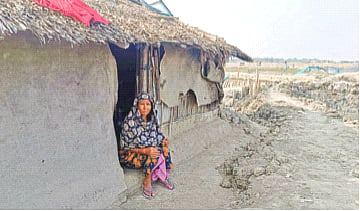
Seventeen years after Cyclone Aila, the homestead of Md Zia Gain and his wife Shamima Begum in Mathbari village of Koyra upazila, Khulna, remains under the water of the Shakbaria River. A channel about three kilometres long and 250 metres wide, carved by tidal currents after the embankment breached, took their home; they now live on the embankment slope.
The home of Minti Sana, who is over sixty and from the same village, also stood where the river now runs. The land was never recovered after Aila. Ismail Gazi, Yunus Ali, Elias Gazi and many others in the village share the same story — they have lived on the embankment slope for 17 years since losing their homesteads.
On the coast, lost homes, rising salinity and a shortage of safe water are changing people's lives. How to cope with these conditions is being discussed at the COP31 climate summit in Türkiye. The UN Environment Programme's (UNEP) Adaptation Gap Report 2026, published ahead of the summit, laid out the shortfall in adaptation finance.
Under Bangladesh's third Nationally Determined Contribution, or NDC 3.0, implementing its adaptation priorities requires 8.5 billion dollars a year. The same document puts the average annual flow of adaptation finance at about 4 billion dollars. The gap is therefore 4.5 billion dollars — about Tk 56,138 crore at 124 taka 75 paisa to the dollar.
NDC 3.0 says the annual adaptation need could rise to 12 to 14 billion dollars by 2035. At the same exchange rate, that is about Tk 149,700 crore to Tk 174,650 crore.
Bangladesh's National Adaptation Plan (NAP) puts the total cost of 113 initiatives from 2023 to 2050 at 230 billion dollars. Over 27 years, that averages about 8.5 billion dollars a year. The initiatives cover water, agriculture, fisheries and livestock, urban development, disaster management, biodiversity and institutional capacity.
UNEP's report says international public adaptation finance from developed to developing countries was 28.7 billion dollars in 2024, up by only 1 billion dollars from the previous year.
Developing countries' annual adaptation need could reach about 305 billion dollars by 2035. COP30 called for adaptation finance to at least triple by 2035. By UNEP's calculation, even meeting that target would cover only 20 to 29 percent of developing countries' likely need.
The type of finance also matters. In 2024, 55 percent of international public adaptation finance to developing countries was loans and 44 percent was grants. About half of the loans were market-based or without concessional terms. Experts say Bangladesh needs more grants and long-term low-interest finance so that meeting adaptation costs does not add further pressure to public debt.
Climate finance expert Hasib Muhammad Irfanullah said reports published before a COP help in understanding changes in the type and flow of adaptation finance and in using them in negotiations. But a large gap remains in money moving from developed to developing countries.
UNEP's report says Bangladesh gave at least 400 million dollars from its revenue budget to the Climate Change Trust Fund between 2010 and the 2017-18 fiscal year. In that period, 512 projects from 18 ministries were approved; at least 45 percent of the fund, more than 180 million dollars, was spent on adaptation. But that amount is small compared with a possible need of 12 to 14 billion dollars a year.
The climate budget report for 2026-27 puts climate-related spending for 25 ministries and divisions at Tk 51,746 crore, of which Tk 38,906 crore is for adaptation. The national budget proposes Tk 100 crore for the Climate Change Trust Fund. However, the total is not a separate allocation for new adaptation projects; it is an accounting of spending identified across ministries' and divisions' budgets.
Adaptation can reduce risk, but it cannot prevent all losses. In the first round of the loss and damage fund, 119 developing countries applied for 2.8 billion dollars. The fund's initial money was 342 million dollars — about one-eighth of the demand. A complex application process and limited capacity are also barriers to receiving support.
Farah Anjum, Bangladesh country lead of the Global Strategic Communications Council, who is at the COP31 summit, said Bangladesh's contribution to global emissions is small although its risk is high, yet the country still has to bear the large cost of adaptation largely from its own resources. In her view, developed countries should go beyond their pledges and provide grant-based finance that is easy to access, along with technology transfer and technical support. It must also be ensured that allocated money reaches people at risk and actually reduces losses.
