In Barishal, 30 Women of Stadium Colony Earn from Bags and Quilts Made of Discarded Cloth under Students' 'Project Prerona'
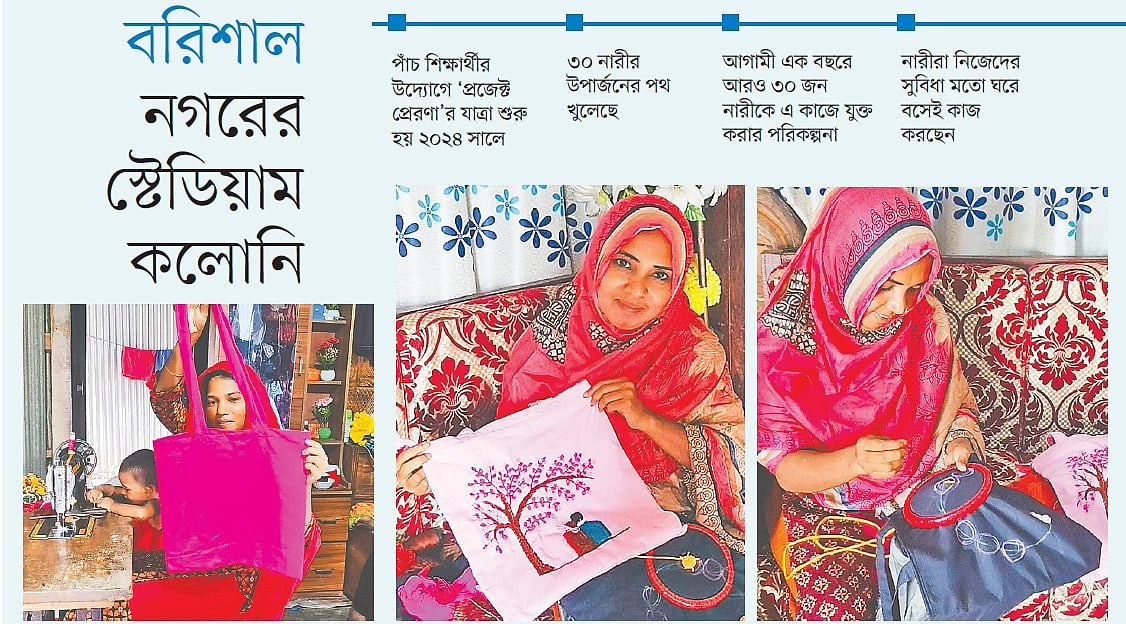
In Stadium Colony on the bank of the Kirtankhola River in Barishal city, an initiative by five students called 'Project Prerona' has changed the lives of 30 women. Under the initiative, started two years ago, the women make bags, nakshi kantha quilts and various handicrafts from discarded cloth and earn while working from home.
Housewife Riamoni Akter's husband is a day labourer, and his income was not enough for their six-member family. She knew sewing but had no opportunity to earn. More than two hundred women of the colony were in the same situation.
A visit to Stadium Colony found Riamoni making bags on a sewing machine at home. In some homes nakshi kantha were being made, in others bags were being coloured and designed, and some women were packaging finished products. In this way, 14 women are working regularly from their own homes.
Their products are sold online. Organisations including BRAC and the social platform Bohnishikha also buy these products, according to those involved in the initiative.
Riamoni earlier could only sew dresses and women's blouses. She has now learned bag making as well. She said she is paid 80 taka for cutting and sewing one bag, and now earns 9,000 to 10,000 taka a month. However, thick cloth cannot be sewn on their machines, and she said she could do more work if she had a better machine.
Housewife Sathi Akter has no sewing machine. For now she has done hand sewing and nakshi kantha work, and with the money she earns she stands beside her husband and children in running the family.
Project Prerona has so far trained 30 women. Of them, 14 work regularly: seven make bags, five do embroidery and nakshi kantha work, and the remaining two wash bags and do packaging. The other 16 trainees work in their own way.
One of the organisers, Abir Mahmud Muntahir, a philosophy student at Government Brojomohun College, said, 'Those who work here are not our workers, they are our partners.'
Project Prerona began its journey on November 10, 2024. Abir Mahmud said that in the first year about 127 bags were made and sold for about 30,000 taka. This year, 1,200 bags have been sold for about 200,000 taka. Income is also coming from nakshi kantha sales, and after costs about 30 percent of sales remains as profit.
The other four entrepreneurs of Project Prerona are Imran Hossain, a final-year economics student at Government Brojomohun College; Bithi Akter, a third-year student at Dhaka Art College; Md Siam, a third-year mass communication and journalism student at Barishal University; and Nandini Tithi, a final-year Bangla student at Barishal Government Women's College.
In 2024 they took a one-month training under BRAC's 'Amra Notun Network' youth platform. They then started Project Prerona with only 4,500 taka in capital, and are running the activity with money from orders received from different places, without taking any loan.
Md Siam said, 'We saw that many women of the colony want to work but have no opportunity. At first we trained 10 women. We had not yet been able to build an institution then. We went from home to home to train the women.'
Bithi Akter herself grew up in the Stadium slum and saw the financial hardship of its women from close quarters since childhood. She designs the bags herself. She said, 'A friend bought our first bag for 150 taka. From that encouragement, we never sat back again.'
Entrepreneur Nandini Tithi said their plain single-colour bags sell wholesale at 120 taka, hand-worked bags at 300 to 800 taka, and hand-painted bags, made to customer choice, at 500 to 1,000 taka. Each nakshi kantha sells wholesale at 4,000 taka.
For lack of advanced sewing machines, many bags of thick cloth cannot be made, and some orders have to be turned away despite demand. Project Prerona aims to add another 30 women in the next year. They have also taken an initiative to build a mini production house with machines and necessary equipment, where women can come and work at times convenient to them.
Sajjad Parvez, assistant director of the Barishal district social services office and principal of the department's regional training centre, visited the initiative in Stadium Colony. He said they are ready to provide any kind of cooperation needed to take the work forward.