Unknown Cave in Italy's Dolomites Holds a Huge Store of Extinct Cave Bear Skeletons
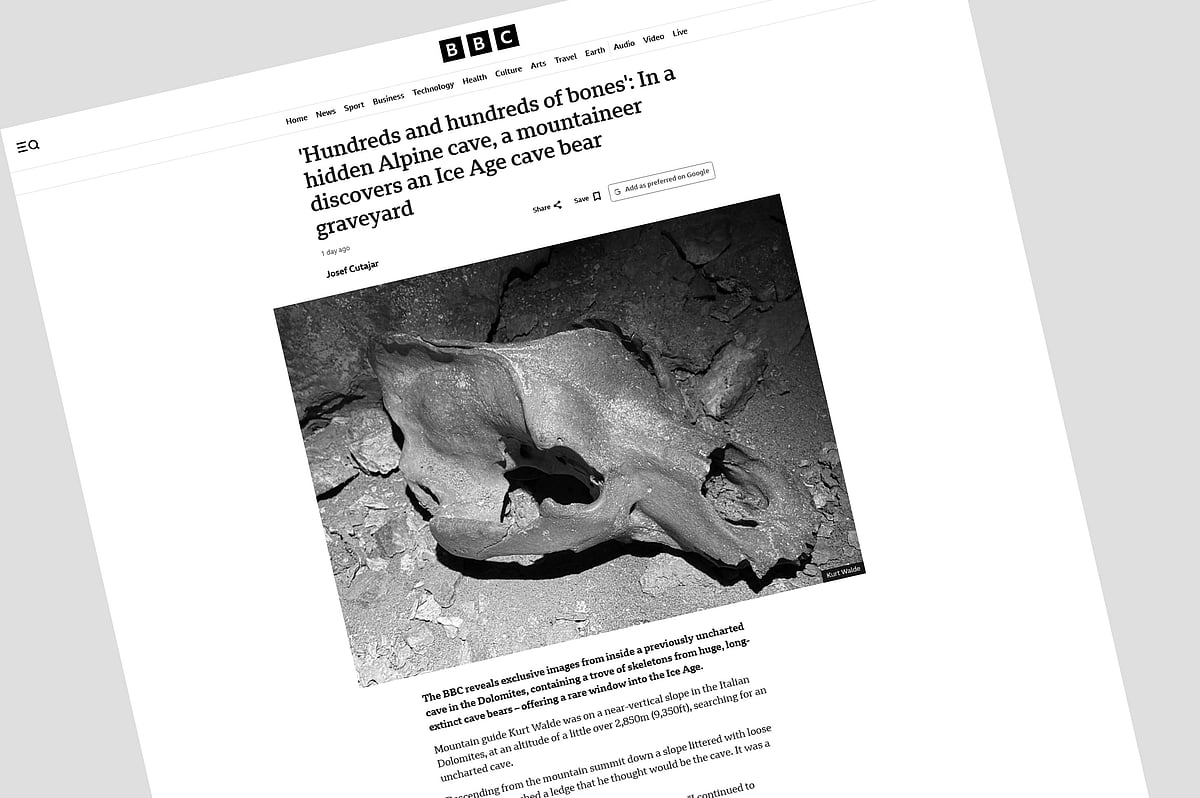
An unknown cave in Italy's Dolomites mountains has opened a door to the Ice Age. Inside it lies a huge store of skeletons of the giant cave bear, extinct long ago. The BBC recently published special photographs from inside the remote cave.
Mountain guide Kurt Walde was that day on an almost vertical slope of the range. At a height of a little over 2,850 metres, his eyes were searching for the trace of an unknown cave.
Walde climbed down a slope filled with fallen rocks to a narrow flat place on the mountainside. He had thought the cave mouth would be found there, but that hope was wrong. Somewhat disappointed, he still kept descending until he reached the end of his rope.
Walde had not been feeling well that morning. Even so, he had taken a 22-kilogram backpack on his shoulders. He crossed the last few metres without the help of the rope and reached the mouth of the cave.
Inside, the light of his headlamp fell on a vast burial ground of Ice Age skeletons. Experts believe these are skeletons of the cave bear species 'Ursus ladinicus'. The species became extinct about 24,000 years ago.
The new cave is located on the opposite side of the famous Conturines cave in Fanes-Sennes-Braies Natural Park, and it holds many more bones than Conturines. The discovery of the Conturines cave in 1987 changed what people knew about cave bears.
The giant cave bears found at Conturines weighed about 1,200 kilograms and were three metres long. The bears lived only on the herbs, leaves and grass of the Alps region.
Walde has worked as a mountain guide for 41 years. He believed much remained to be discovered at Conturines. Three and a half years ago, a black mark on the mountainside caught his attention, and in July 2026 he set out on the expedition to see the place.
Entering the cave, Walde was startled by its resemblance to Conturines. The first 60 metres of the cave run straight, and there he noticed a bone lying on a table-like layer of rock. Going further inside, he found countless bones and skulls, including one skull still joined to neck vertebrae.
Researchers believe the bones at Conturines are 46,000 to 50,000 years old. Scientists named the species Ursus ladinicus after the local Ladin people. The cave's mineral layers hold 60 lakh years — six million years — of climate history.
A huge number of bones are scattered in the new cave. Scientists think they may belong to various Ice Age animals. In other caves of the Alps, scientists have previously also found remains of cave lions, hyenas and leopards.
Walde informed Christian Terzer of the discovery. Terzer became director of the Bolzano archaeology department at the start of August. Fearing the cave's remains could be contaminated, the archaeology department sent equipment by helicopter to prevent unauthorised entry. Workers installed a gate 20 metres inside and sealed the area with tarpaulin.