Bangladesh can adapt Singapore's experience to its own reality, speakers say at UIU seminar
Overcoming limited natural resources, a small land area and various political and ethnic crises, Singapore is today one of the world's leading developed economies. Behind that progress lie skilled leadership, a corruption-free administration, a merit-based system, long-term planning and national unity. But speakers said Bangladesh should not copy that success wholesale; it should apply Singapore's experience according to its own reality.
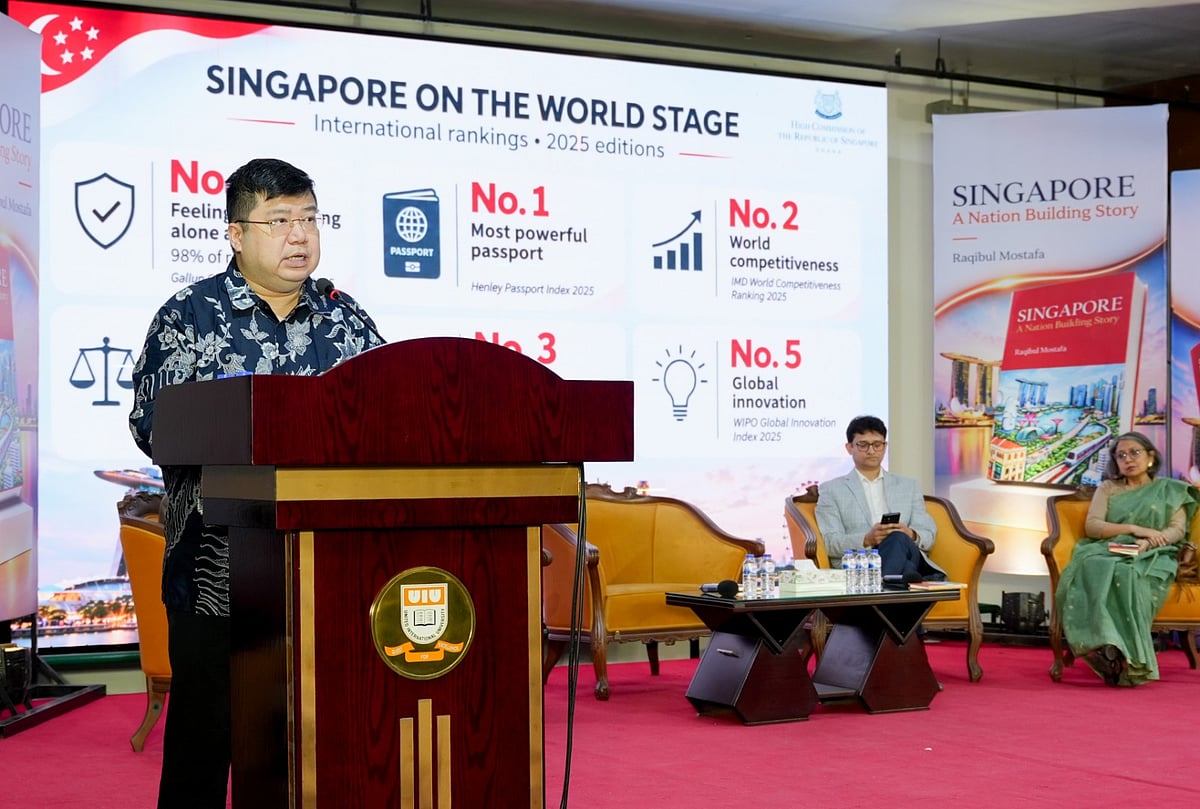
The speakers made the remarks on Tuesday at a seminar held at United International University (UIU) in Badda, Dhaka. The university's School of Business and Economics organised the seminar, titled 'Revisiting the Singapore Story: Lessons in Nation Building'.
At the event, a book titled 'Singapore: A Nation Building Story', written by Rakibul Mostafa, a professor in UIU's Department of Electrical and Electronic Engineering, was unveiled.
The chief guest at the seminar was Philip Ong, Chargé d'Affaires at the Singapore High Commission in Dhaka. He said Singapore's development is not the work of a single generation; since the Second World War, the efforts of several generations have brought the country to where it is today.
Philip Ong said that after passing through the hard road of colonial rule, communism and ethnic conflict, the country adopted independence, democracy, multi-ethnic coexistence and a merit-based system as the founding principles of the state.
He said Singapore's experience is not a template that other countries can follow directly. Every country's history and reality are different. Bangladesh can therefore adapt subjects such as efficient institutions, good governance, national unity and long-term planning in ways that suit itself.
The moderator, Professor M. Niaz Asadullah, said the book, written from the personal experience of an engineering teacher, has a distinctive quality. How Singapore overcame its limitations to become a high-income country is also important for Bangladeshi students, he noted.
Professor Asadullah said Singapore's experience can help answer questions such as how to move from agricultural production to exporting high-value manufactured goods, and how to invest in education and health. Such discussions also create an opportunity to bring students, teachers, diplomats and publishers together at the university, he added.
Former Bangladesh High Commissioner to Singapore, Ambassador Md Mustafizur Rahman, said effective institutions, compliance with rules and civic responsibility are important lessons Bangladesh can take from Singapore's experience. Drawing on his own experience, he said the experience can also help increase policy learning and mutual understanding between the two countries.
The book's author, Professor Rakibul Mostafa, said it took him more than five years to write the book. He is an engineer and a teacher by profession. In the book he has presented accounts of his personal experience and realisations from his time spent in Singapore.
The book's publisher, Mahrukh Mohiuddin, said it is not a research book in the conventional sense. But it reflects the author's deep observation and interest. Such books help readers learn about different countries and societies in new ways. Bringing Singapore's experience to Bangladeshi readers was also one of the reasons for publishing the book, she said.