65 percent of adults now in formal finance, Sylhet division lags furthest behind: RAPID survey
About 65 percent of adults in the country are now within formal financial services. They have at least one account with a bank, a financial institution, a mobile financial service (MFS), a microcredit institution, an insurer or a capital-market intermediary. But 35 percent of adults still remain outside these financial services.
Among that 65 percent, at least 28.8 percent have a bank account and 44.7 percent hold an MFS account. Many people, however, have both a bank account and an MFS account.
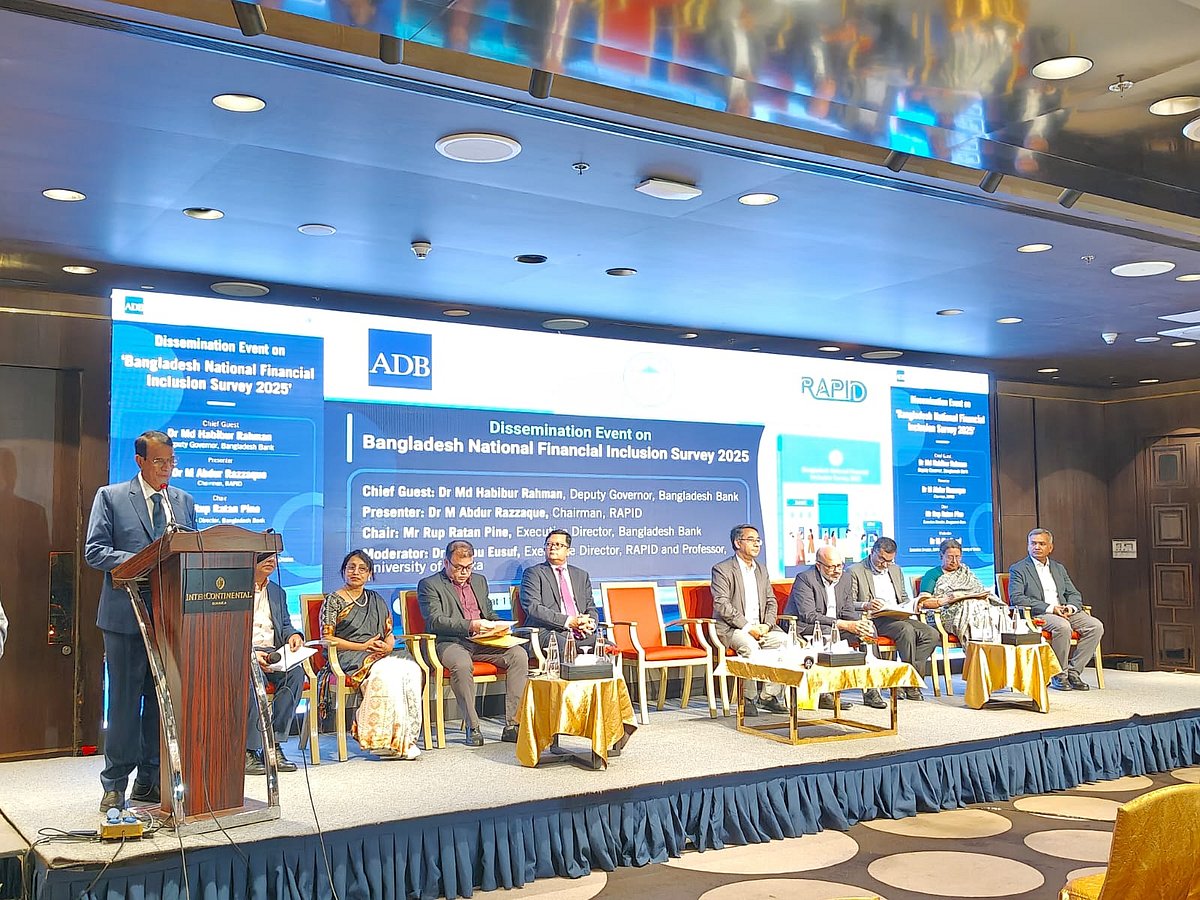
The survey, titled 'Bangladesh National Financial Inclusion Survey 2025', was conducted by the private research organisation Research and Policy Integration for Development (RAPID). Data were collected from about 7,000 households between 26 January and 24 March 2025.
RAPID chairman Abdur Razzaque presented the survey findings and policy recommendations at an event at Hotel InterContinental in Dhaka on Wednesday. Bangladesh Bank and RAPID jointly organised the event.
RAPID said this is the first survey of its kind conducted by a local organisation in the country. Earlier the World Bank did this work; its 2024 Findex survey put financial inclusion at 43 percent, compared with 53 percent in its 2021 survey.
By division, financial inclusion is highest in Dhaka division at 67.7 percent. Sylhet division lags furthest behind at 54.9 percent. The other divisions stand at 67 percent in Chattogram, 64.9 in Rangpur, 64.2 in Mymensingh, 64 in Barishal, 63.5 in Khulna and 60.1 in Rajshahi.
Nationally, 69.5 percent of men and 60.9 percent of women are within financial services, the survey found.
Saving emerged as the main purpose of using a bank account. Among bank account holders, 58.4 percent of men and 62.7 percent of women use their accounts for saving.
MFS use, by contrast, is mainly limited to sending and receiving money. Among MFS account holders, 90.3 percent of women and 83.1 percent of men use the service to receive money. For sending money, the rates are 77 percent for women and 61 percent for men.
But use of MFS for shopping bills, utility bill payments and saving through mobile banking is still below 4 percent of users. In rural areas, 37 percent of MFS users receive social safety allowances or government benefit money through it. Only 20.5 percent of customers use MFS apps.
The survey also covered service quality. Some 31.8 percent of MFS users are dissatisfied with service fees. For insurance, only 44 percent of customers are satisfied with claim settlement time, and satisfaction with insurers' complaint management is only 10.6 percent.
Knowledge of financial products is also limited. Only 33 percent of bank account holders know how much interest they receive on their deposits. For microcredit institution customers, the rate is 15 percent.
Speaking as chief guest, Bangladesh Bank deputy governor Md Habibur Rahman said the survey has brought out inside information on the financial sector, which will help policymaking. He also noted that the gender disparity issue needs work.
Special guest and bKash chief executive officer Kamal Quadir said MFS spread because it can be used on ordinary mobile phones without an app. There are about 12,000 bank branches, but 40 percent of customers said their bank branch is 5 kilometres away, so agent banking needs to expand, he said.
BRAC Bank managing director and CEO Tareq Refat Ullah Khan said having an account alone is not enough; customers must be connected to all transactions, and inclusion cannot rise without growing the digital ecosystem. RAPID chairman Abdur Razzaque said services and products must be created for women to raise their participation, and revenue cannot rise if inclusion does not rise.