
Draft Consumer Law Adds Health Care and Digital Commerce, but Three Big Questions Remain Over Its Definitions
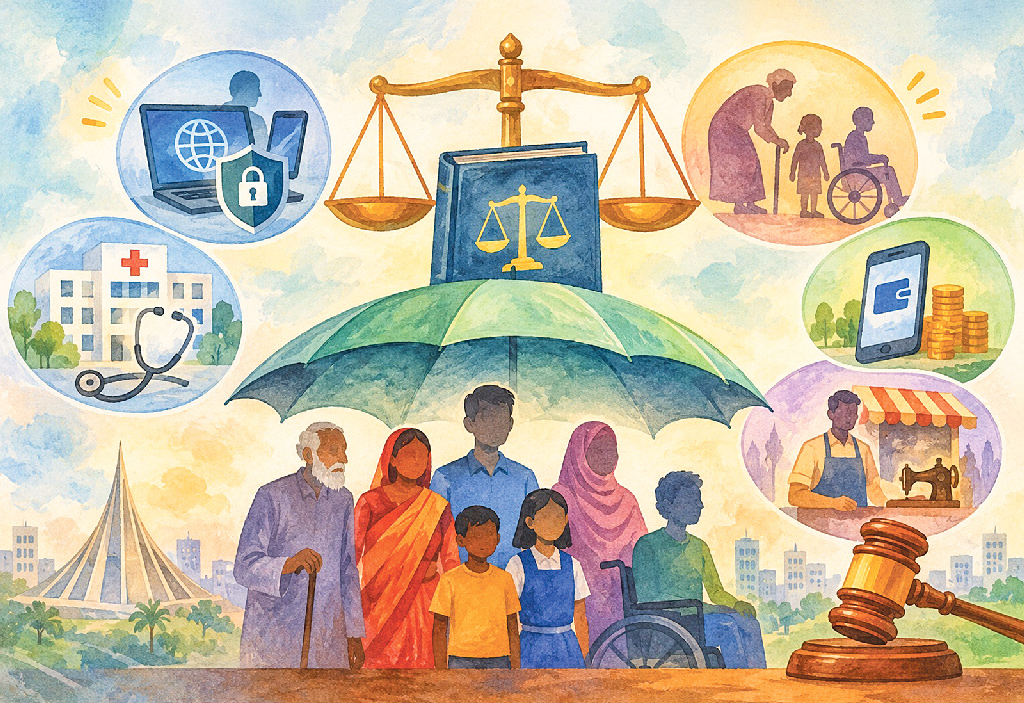
The list of services has been expanded in the 2026 draft Consumer Rights Protection (Amendment) Act. Health care has been added and digital commerce has been brought under the law. But three big questions remain over the draft: whether users of free digital services count as consumers, whether bringing health care under the law creates new risks for medical care, and whether there is anything separate for weak and vulnerable consumers.
In the draft, the definition of 'consumer' rests on payment, or a promise of payment. The definition of 'service' clearly states that services provided free of charge are not included. Yet tens of millions of people in Bangladesh use 'free' social media, search engines, maps, video and messaging apps every day. They do not pay money, but they give personal data.
A review of the draft notes that none of these — fraudulent apps, loan traps, fake 'free trials' that later turn into charges on their own, or the dishonest sale of users' data — falls under this law. It therefore argues for widening the definition of consumer to cover exchange 'for money or personal data', so that people cheated on digital platforms can get legal shelter, and for making it mandatory for 'free' advertising to state the real cost and how data will be used.
As an international example, the European Union's digital content directive has brought under consumer protection even contracts in which the consumer gives personal data instead of money. In 2018, Italy's competition and consumer authority took action against Facebook over the misleading use of a 'free' claim.
On health care being added, the review notes that a representative of the health services division has also been included in the national council for this purpose. Complaints of excessive bills, unnecessary tests and patients being held hostage by private hospitals and clinics are not new in Bangladesh. Getting remedies for these problems under consumer law is a fair expectation.
However, section 20(D) of the draft newly adds any harm to a service recipient caused by a provider's 'negligence, irresponsibility or carelessness' as an act against consumer rights. In medical care, this could mean putting doctors or hospitals at risk of criminal offences. The review notes that treatment outcomes do not always match hopes, and complications often arise from the disease itself.
As an example, it cites India's Supreme Court judgment in the Jacob Mathew case (2005), which held that a doctor's criminal liability arises only for gross negligence, not for ordinary mistakes. In the United Kingdom, too, criminal charges over medical deaths are limited to a 'gross negligence' standard. New Zealand and Sweden have 'no-fault' compensation systems, where patients receive compensation without having to prove fault.
On vulnerable consumers, the review says it is not easy for elderly rural citizens, women with little schooling, children and adolescents, disabled people and the families of expatriate workers to understand online fraud or complex terms. No separate protection for these groups was noticed in the draft's comparative description. The EU's unfair commercial practices directive clearly sets out the concept of the 'vulnerable consumer', the UK's financial conduct authority introduced a 'Consumer Duty' in 2023, and Canada's Quebec province has banned commercial advertising aimed at children under 13.
The digital complaint system is described as commendable, but alternatives are called for those who have no smartphone or internet. These include Union Digital Centres, a telephone hotline and the option to complain by post.
The draft excludes online banking and financial services from the definition of digital commerce. Yet fraud in mobile financial services, app-based digital loan traps and failure to recover money from mistaken transactions are major problems for ordinary people. The review cites the UK's financial ombudsman and the Reserve Bank of India's integrated ombudsman system as examples of independent routes for financial consumers' complaints.
As a positive point, the draft's definition of consumer also includes a person who buys goods to earn a living through self-employment. A tailor who buys a sewing machine, a worker who buys a van, or a small shopkeeper does not get the advantages of a full 'trader', yet faces risks like a large institution.
The review also makes six recommendations. They include widening the definition of consumer to include those who receive services in exchange for data, limiting criminal liability under section 20(D) in health care to gross negligence, fraud and unauthorised treatment, ensuring detailed bills and a patients' rights charter in private health care, defining 'vulnerable consumers', keeping offline alternatives alongside digital complaints, and setting out a referral agreement with Bangladesh Bank and an independent ombudsman system for financial consumers.