Democratic midterm wave upends the battle over Ten Commandments displays in Texas classrooms
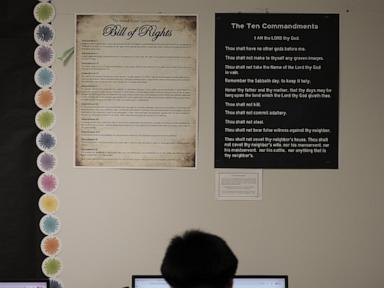
The future of the Texas law requiring the Ten Commandments to be prominently posted in every public school classroom is now in doubt. Sweeping Democratic victories in the midterm elections have raised new questions about the law's enforcement and survival, and the legal fight has reached the U.S. Supreme Court.
When Texas lawmakers last year mandated the displays, Rebecca Smith Nash raised money to print thousands of posters of the biblical text and assembled dozens of volunteers to deliver them. 'We know that we have God on our side. So, we put on our armor,' said Nash, a mother of two and a devout Christian. The campaign has sharply divided the state.
After years of momentum, advocates won classroom mandates in four states and inspired more than a dozen others to consider similar laws. Now those same advocates say their success could hang in the balance.
Sweeping Democratic victories in the midterm elections — from statehouses to state legislatures to full control of Congress — signal a sea change in political priorities. 'The pendulum has swung,' said Martin Siegel, a constitutional law scholar and First Amendment expert at the South Texas College of Law.
Siegel said the cultural and religious conservative wing of the Republican Party pushed its advantage pretty far, maybe to the outer reaches of what the public will support. With a divided legislature and a Democratic governor, he said, there are unlikely to be many more attempts to infuse religion into the school curriculum.
Texas governor-elect Gina Hinojosa has not yet said how she will handle enforcement of the law or public calls to attempt its repeal, but as a Democratic state legislator she was strongly opposed to it.
Incoming Texas Democratic leaders will also need to address the multiple ongoing legal challenges to the state law and decide whether to keep defending it in court. Under Republican Governor Greg Abbott, the state vigorously defended the Ten Commandments law, known as SB10, against all lawsuits.
The dispute has already reached the U.S. Supreme Court, where the justices are expected to decide in the coming weeks whether to take up the case and decide it next year.
Jonathan Covey, policy director for Texas Values, a conservative advocacy group that has championed the classroom displays, said: 'The Ten Commandments help shape the legal and moral foundations of our nation, and the ideas of respect and truthfulness and responsibility are all essential to a free society. Students really deserve to understand about that heritage.'
Emily Roth, a Houston mother of two elementary school children who is suing the state, says she shares respect for the biblical values but that presenting those concepts to her children is her right as a parent. 'The state doesn't own my child. My child is mine,' Roth said, adding that she is no longer in control of bringing religion into her child's life because the state is leading it.
Audrey Nath, another mother of two who has joined Roth in the Texas lawsuit, also objects to some of the concepts in the Commandments as inappropriate for elementary school, pointing to the passage about not coveting a neighbor's manservant. She said the law is still on the books and the poster is still up, so the fight will continue until it is gone.
Outside Texas, the displays may be on firmer footing. In Louisiana, Alabama and Arkansas, Republicans retained control of state legislatures and governorships in last month's election, so no immediate change is expected in how those states' Ten Commandments mandates are enforced.
New Orleans public school teacher Chris Dier, named Louisiana teacher of the year in 2020, opposes posting the biblical imperatives in his classroom and says it will likely take a federal court ruling to get states to back down. His lawsuit against Louisiana is now pending consideration by the Supreme Court. Dier, who identifies as Christian, said the fight against the displays is not a fight against Christianity itself and that the opponents want respect for all religions. 'I firmly believe it is time for the Supreme Court to step in and make a ruling,' he said.
In a landmark decision 46 years ago, the Supreme Court struck down a near-identical Kentucky law mandating classroom displays, concluding it violated the First Amendment's Establishment Clause, which prohibits government promotion of a particular faith. That 1980 precedent, Stone v. Graham, may be revisited if the justices take up the Louisiana or Texas cases.
Siegel called it the most important First Amendment issue the court has considered this century, involving millions of children and millions of families. A decision on whether the court will wade into the dispute is expected by early next year. Meanwhile, Texas families on opposing ends of the debate are holding firm, and Smith Nash said she hopes removing the Ten Commandments will not be a top priority for the incoming Democrats — and that she would speak out if the posters were taken down.