Bennett Meets Netanyahu for Over Two Hours Without Telling Allies, Raising Suspicion in Opposition Camp
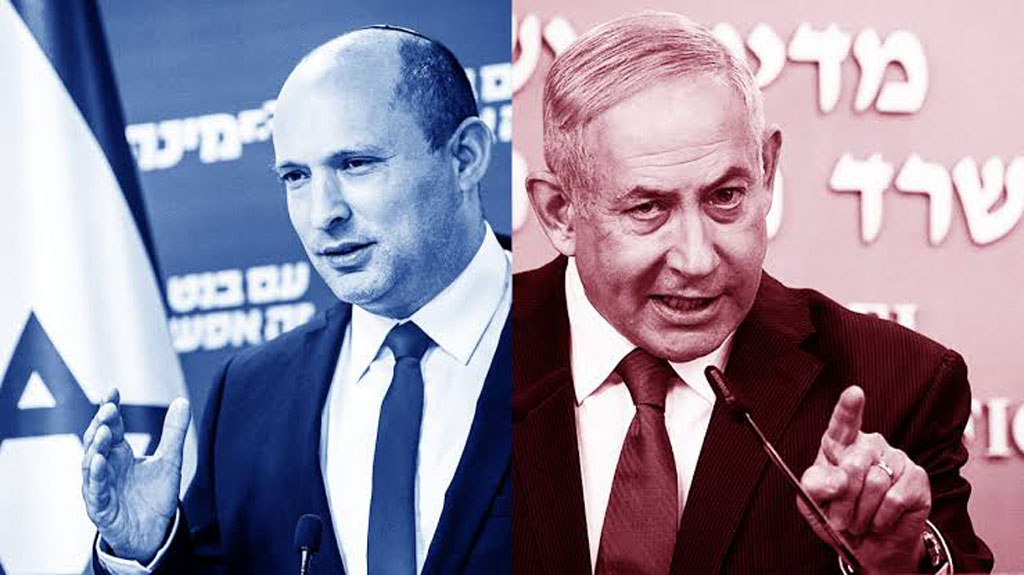
Former Israeli prime minister Naftali Bennett met Prime Minister Benjamin Netanyahu for more than two hours at the Knesset on Wednesday local time. Holding the meeting without informing his own political allies has created suspicion in the opposition camp.
Both sides described the meeting as a security briefing. But people close to Gadi Eisenkot allege that Netanyahu wants to use Bennett to derail the opposition alliance's effort to form a government. People close to Bennett say he has no plan to join a government under Netanyahu.
In 2021, Bennett played a role in bringing down Netanyahu's government and became prime minister himself. Relations between the two leaders then turned bitter. In this election campaign too, Bennett called Netanyahu unfit and demanded his resignation.
After the meeting, Bennett and Yair Lapid held talks with leaders of the alliance led by Gadi Eisenkot. In a joint statement they said their main goal is to remove Netanyahu and form a national emergency government under Eisenkot. But there are differences among them over how to form that government.
Bennett wants to test the possibility of a unity government with Likud, on condition that Eisenkot serves as prime minister in the first term. Lieberman and Golan, by contrast, are unwilling to form any government with Netanyahu. Eisenkot accuses Netanyahu of stalling and says forming a government quickly is essential.
People close to Bennett reiterated that he will not join a government under Netanyahu and favours Eisenkot becoming prime minister first, though he is not ruling out other possibilities. Lapid said he and Bennett are continuing efforts to form a government under Eisenkot's leadership.
In the Oct. 27 election, neither side won a majority. In the 120-seat Knesset, Eisenkot's alliance holds 48 seats. Most alliance leaders object to taking the support of the Arab parties' 19 lawmakers, so Eisenkot is considering the alternatives of support from ultra-Orthodox Jewish parties or a unity government with Likud.
Netanyahu's alliance won 53 seats in the latest election; 61 are needed to form a government. If Bennett now leaves with his alliance's 12 seats and joins Netanyahu, the total would reach 64, securing the majority needed. Eisenkot's alliance would fall to 36 seats; even adding the Arab parties' 19 seats would bring it to 55, still at least six seats short.
Likud communications minister Shlomo Karhi said that if neither Eisenkot nor Netanyahu can form a government, his party could compromise with Bennett or Lieberman to avoid a new election. On Tuesday, Bennett also called a unity government the best option, saying a new election would have terrible consequences.
National Security Council head Shmuel Ben Ezra attended the meeting, and the prime minister's military secretary, Major General Guy Markizeno, joined later. Channel 12 reported that Netanyahu and Bennett spoke privately for half an hour before the others joined.
On Tuesday, Bennett said that if they could fight together in Gaza, they could also work together in the Knesset. Last week, however, he criticised Netanyahu's anti-Arab remarks, saying national unity cannot be built that way.